

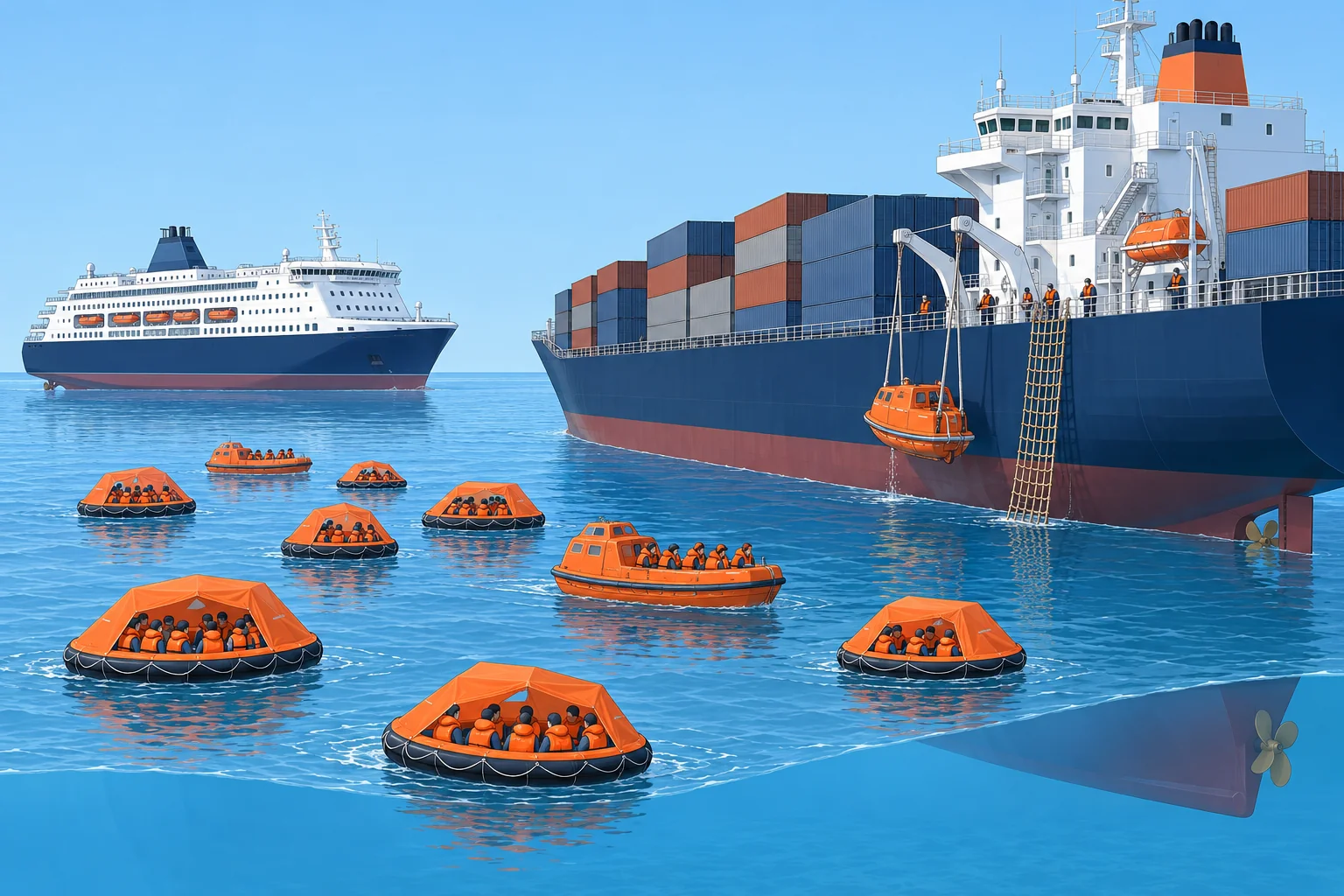
Mass rescue operations
1The lesson in plain words
When rescue needs exceed normal SAR capacity, merchant ships may become essential. Plan the response, coordinate recovery and prepare to care for survivors.
What makes it mass
A mass rescue operation (MRO) is one where so many people are in distress that the SAR services' normal capability is not enough: a passenger ship fire, a ferry capsizing, an aircraft ditching, an overloaded migrant boat. Nearby merchant ships may become essential; plan for the expected number of survivors.
Plans before the event
SOLAS V/7.3 requires passenger ships on international voyages to carry a SAR cooperation plan, developed with the company and SAR services and exercised regularly (MSC.1/Circ.1079/Rev.1). SOLAS III/17-1 requires ship-specific plans and procedures for recovering people from the water: identify equipment and measures that protect the crew. Before an incident, check your recovery arrangements and capacity for survivors, including shelter, blankets, water and toilets.
On scene
The SMC and OSC allocate recovery and transport tasks. Choose a method from the ship’s recovery plan that suits the sea conditions, height to the deck and survivors’ ability. Launch a rescue boat only if it can be operated and recovered safely. People on a crowded boat may rush to one side as you approach and capsize it. Approach slowly, talk to them, and bring them out in groups.
Survivors on board
Register every survivor: name, age, nationality, health, and who is missing. Keep families together and give children extra care. Give first aid, with radio medical advice where needed (see Medical: radio medical advice). Food, water, toilets and shelter run out fast. Keep an eye on security, and on stability if many people gather on one deck. Report numbers to the RCC regularly.
A place of safety
Rescue ends at a place of safety, where life is no longer threatened, basic needs such as food, shelter and medical care can be met, and onward transport can be arranged. Being aboard a ship does not automatically meet these conditions. Under SOLAS V/33.1-1 and MSC.167(78), the government responsible for the SAR region where recovery occurred leads coordination for prompt disembarkation. Keep the RCC and company informed of your capacity and needs.
2Key data
- MRO
- More people in distress than normal SAR capability can handle
- International passenger ship SAR plan
- SOLAS V/7.3; guidance MSC.1/Circ.1079/Rev.1
- Persons rescued at sea
- Guidelines MSC.167(78); delivery to a place of safety
- Survivor register
- Name, age, nationality, health, missing persons
3Key points
- 1
An MRO exceeds normal SAR capability; merchant ships become rescue platforms.
- 2
Passenger ships on international voyages carry an exercised SAR cooperation plan (SOLAS V/7.3).
- 3
Approach crowded boats slowly: a rush to one side can capsize them.
- 4
Register every survivor and report numbers to the RCC.
- 5
The rescue ends at a place of safety, arranged with the responsible government and RCC.
4Frequent mistakes
Wrong: Come alongside an overloaded boat quickly to save time.
Right: Approach slowly and calmly; a sudden rush to one side can capsize the boat and put everyone in the water.
Wrong: Once survivors are on board, the rescue is over.
Right: It ends at a place of safety. Until then they need registering, care, food, water and shelter.
5Practice case & exam keys
Your bulk carrier with 21 crew is asked by the RCC to help an overloaded boat with about 150 people, taking water. A naval vessel is 10 hours away. Wind force 4.
Show the answer
Confirm your arrival time and capacity to the RCC. Prepare shelter, water, blankets, toilets, first aid and a survivor register; brief the crew. Approach slowly, make a lee (shelter from wind and waves) and talk to the people. Use the ship’s recovery plan and equipment assessed as safe for the sea conditions, deck height and survivors’ ability, while protecting your crew. Recover in small groups. Report numbers and health to the RCC and ask it to arrange a place of safety.
Exam keys
- MRO: number in distress exceeds normal SAR capability.
- SOLAS V/7.3: SAR cooperation plan for passenger ships on international voyages; MSC.1/Circ.1079/Rev.1.
- Slow approach to crowded boats; recover in groups; register every survivor.
- Delivery to a place of safety; MSC.167(78).
Finish this unit
When you've read it, answer three questions. Get all three right to finish the unit; opening the page alone doesn't count.
My notes for this unit
No notes