

Approaching and recovering a person in the water
1The lesson in plain words
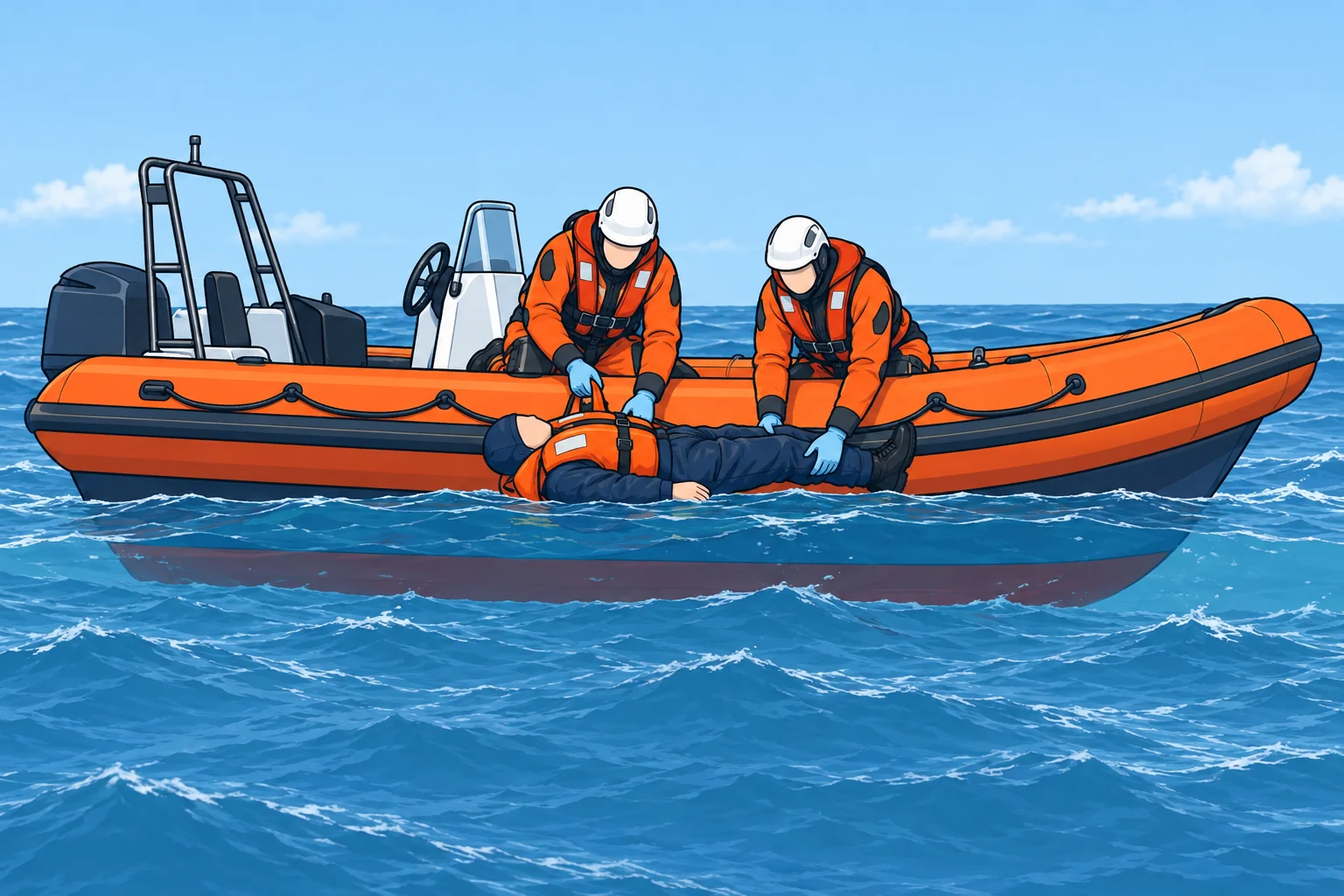
Find the person, approach slowly into wind or sea, stop propulsion as required and keep clear of it. Two crew support torso and legs for a horizontal lift.
Finding them
The ship's bridge guides you by VHF radio, giving bearing and distance from the ship. At low height, a head in the water is hard to see: one crew member points and never looks away. Follow the ship's search directions; search patterns are covered in Emergencies: search and rescue near the coast.
The approach
Slow early. Approach slowly into the dominant wind or sea, keeping the person in the coxswain's view and clear of propulsion. With propeller drive, select neutral and ensure the propeller has stopped; stop the engine if necessary. Waterjet neutral does not stop the impeller, the rotating pump blades: follow the maker's recovery procedure and shut down when required. Keep the person and lines clear of the propeller, jet intake and outlet.
Getting them aboard
Two crew recover the person as horizontally as possible. Use the boat's recovery net or a parbuckle, a sling or net that rolls them aboard. For a trained manual lift, support the upper body and pelvis or legs together. A lifejacket lifting loop alone does not support the lower body; use only a designated lifting point, never arbitrary clothing. Handle gently. For medical care after recovery, see Emergencies: survival in water.
Radio and signals
The FRB carries a hands-free watertight VHF. Report when you are away, when you sight the person, when they are aboard and their condition, and your estimated time of arrival (ETA) back at the ship. Agree hand signals with the ship for when the radio cannot be heard. Agree the communication link with the helicopter, directly on its assigned channel or through the ship. Report your position and intentions, clarify instructions and keep clear of its winching area unless directed.
2Step by step
Recovering a person in the water
- 1
Slow down early and keep one crew member pointing at the person.
At sea level the person disappears behind every wave.
- 2
Make the final approach slowly into the wind or sea, person on the coxswain's side.
You keep control and the coxswain can see them all the time.
- 3
Select neutral and ensure the propeller has stopped; stop the engine if needed. For waterjets, follow the maker's recovery shutdown procedure. Keep people and lines clear of propulsion.
Neutral alone may not stop propulsion; a stationary propeller remains a contact hazard.
- 4
Two crew position the approved recovery aid or, for a trained manual lift, support the upper body and pelvis or legs. Use designated lifting points, never arbitrary clothing.
A lifting loop alone leaves the lower body unsupported.
- 5
Lift together using the trained method, keeping the person as horizontal as possible.
Supporting the torso and legs keeps the person horizontal and secure.
- 6
Report to the ship and return gently.
The ship prepares the recovery and medical care; slamming harms the casualty.
3Key data
- Final approach
- Slowly into wind or sea; person on the coxswain's side
- Close to the person
- Propeller stopped; waterjets: maker shutdown procedure; keep clear
- Lift
- Two crew; support torso and legs for a horizontal lift
- Radio
- Hands-free watertight VHF; agreed hand signals as backup
4Key points
- 1
One crew member points at the person at all times.
- 2
Final approach slowly into wind or sea, person on the coxswain's side.
- 3
Propeller stopped near the person; for waterjets, follow the shutdown procedure. Keep everyone clear of propulsion.
- 4
Two crew support torso and legs, lifting as horizontally as possible; report to the ship.
5Frequent mistakes
Wrong: Approach fast and stop with a burst astern next to the person.
Right: Slow down early. Ensure the propeller has stopped before the person reaches its danger area. For waterjets, follow the maker's shutdown procedure. Keep the person clear of propulsion throughout.
Wrong: Pull the casualty up by the arms, upright.
Right: Two crew use the boat's trained recovery method, supporting torso and legs for a horizontal lift. Use designated lifting points, never arbitrary clothing.
Wrong: Talk to the ship only when you are back alongside.
Right: Report each stage: away, sighted, aboard with condition, and your ETA.
6Practice case & exam keys
Your FRB reaches a man in a lifejacket who is shivering hard and cannot hold a line. Wind 15 knots, short sea of 1 m.
Show the answer
Slow down, keep a crew member pointing and approach slowly into the dominant wind or sea, keeping him in the coxswain's view. Stop propulsion as the installed system requires and keep him clear of it. Two crew use approved recovery gear or a trained manual lift, supporting torso and legs as horizontally as possible. Keep him supported, report his condition and return gently. For medical care, see Emergencies: survival in water.
Exam keys
- Keep the person in sight: a crew member points continuously.
- Final approach slowly into wind or sea; propeller stopped; waterjets: maker's shutdown procedure; person clear of propulsion.
- Two crew support torso and legs throughout a horizontal lift; use approved recovery gear or the trained manual method.
- Report each stage to the ship by VHF; hand signals as backup.
Finish this unit
When you've read it, answer three questions. Get all three right to finish the unit; opening the page alone doesn't count.
My notes for this unit
No notes