

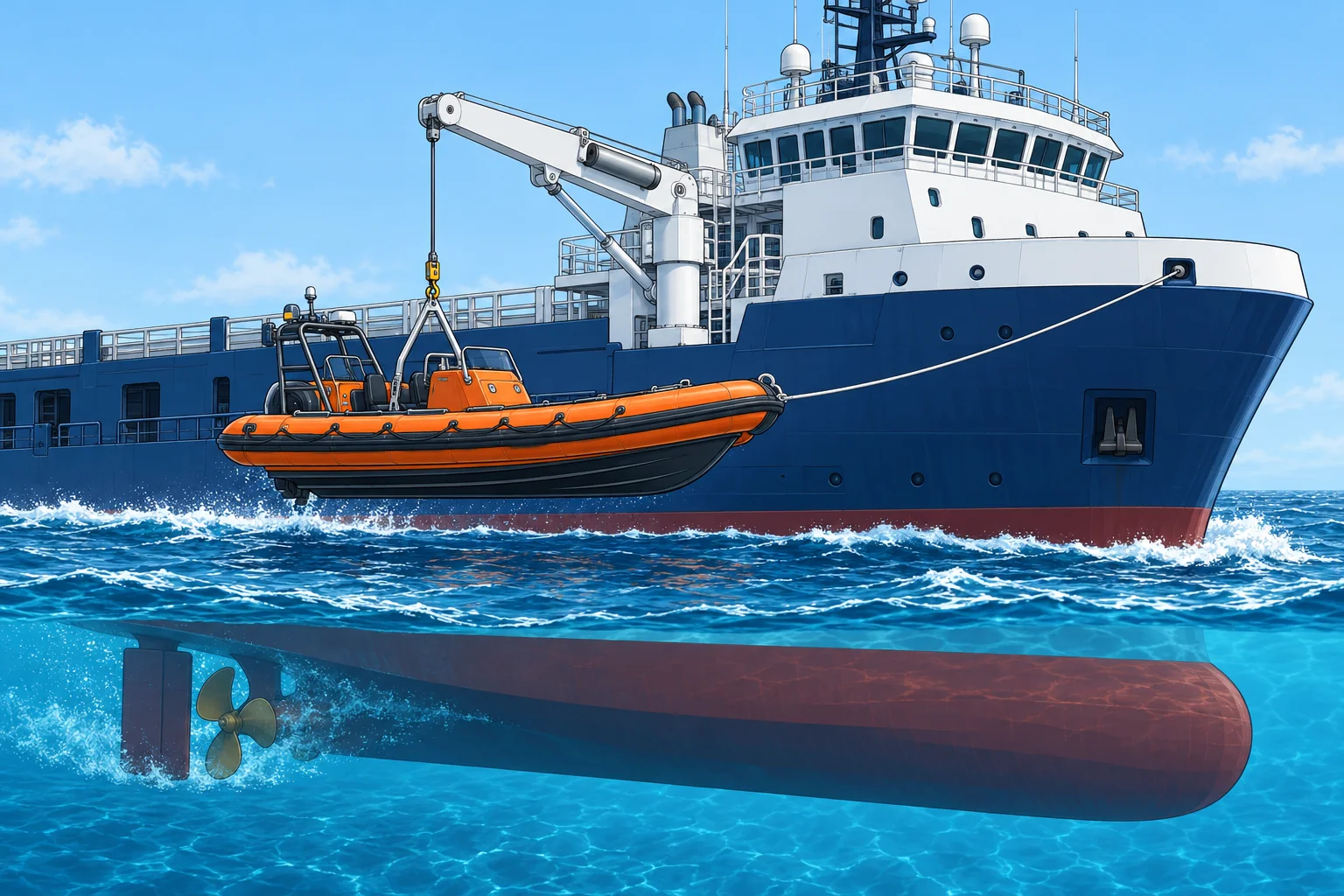
The launching appliance and launching under way
1The lesson in plain words
An FRB davit absorbs shocks and keeps the wire tight. Launch in the lee with the painter rigged; start and check the engine as the maker permits before hook release.
A davit built for waves
An FRB davit, the boat-launching crane, meets extra rules (LSA Code 6.1.7). A shock absorber with a damping element softens the jerks when the boat meets waves. An automatic high-speed tensioning device, often called heave compensation, keeps the wire from going slack as the boat rises and falls. The brake acts gradually. The loaded boat is lowered at not more than 1 m/s, and the winch hoists it with six people aboard at not less than 0.8 m/s.
One hook
A single-point suspension hook holds the boat at one lifting point. Know whether your fitted hook releases only off-load, when the water supports the boat, or also on-load, while carrying weight. Use its approved release procedure only when fully waterborne. Check the hook and any bridle, the lifting sling, before launch.
Launching under way
Agree slow, steady headway, forward movement through the water, and course with the bridge. Launch on the lee side, sheltered by the ship. Attach the painter, a line controlling the boat alongside, led forward to the ship, before lowering. Start only when the engine's cooling arrangements and maker permit; check steering before releasing the hook. If immersion is required, do these checks waterborne. Release the hook fully waterborne and running with the ship. Steer away from the ship while still attached to the painter, then release it and motor clear.
Who does what
The officer in charge directs the launch. A trained, designated operator controls the davit, using agreed signals with the coxswain. The coxswain confirms readiness and releases the hook under the approved procedure. Confirm who operates each control and who gives release and stop signals. Agree hand signals and the VHF channel before starting. Keep crew seated and holding on until clear of the ship.
2Step by step
Launching an FRB with the ship under way
- 1
Ship steady at slow speed with the boat on the lee side; brief signals and channel.
A steady lee and agreed signals make the launch predictable.
- 2
Crew aboard in full PPE; coxswain clips on the kill cord; painter attached forward.
The painter holds the boat against headway; the kill cord stops the engine if the coxswain falls.
- 3
Complete the maker's permitted pre-lowering checks. Start the engine here only if its cooling arrangements allow.
Some engines need cooling water before starting; propulsion and steering must be ready before release.
- 4
Lower steadily under the approved tensioning procedure. Once waterborne, start the engine if not already running and check steering before hook release.
A slack wire that snatches tight can injure the crew and damage the boat.
- 5
Release the hook under its approved procedure only when fully waterborne and running with the ship.
The water supports the boat, allowing release as the fitted hook requires.
- 6
Steer away on the painter, then release it and motor clear.
Turning away first keeps the boat from being drawn under the flare or towards the propeller.
3Key data
- Launching appliance
- LSA Code 6.1.7: shock damping and high-speed tensioning
- Lowering speed
- Not more than 1 m/s fully loaded
- Hoisting speed
- At least 0.8 m/s with 6 persons and equipment
- Brake
- Gradual action; extra dynamic load ≤ 0.5 × working load
- Suspension
- Fixed single-point hook where possible
- Launch
- Lee side, slow steady headway, painter rigged forward
4Key points
- 1
The FRB davit has a shock absorber and high-speed tensioning to keep the wire tight.
- 2
Lowering is at most 1 m/s; hoisting at least 0.8 m/s with six people.
- 3
A single-point hook holds one lifting point; follow its approved waterborne release procedure.
- 4
Launch on the lee side at slow headway with the painter rigged and the engine running.
5Frequent mistakes
Wrong: Change the ship's speed during an agreed under-way launch without warning.
Right: Maintain the agreed course and speed throughout this launch. Whether to launch stopped or under way follows the ship's approved procedure and conditions.
Wrong: Start the engine only after the hook is released.
Right: Start only when cooling arrangements and the maker permit. If immersion is required, wait until waterborne; have the engine running and steering checked before hook release.
Wrong: Release the painter at the same moment as the hook.
Right: Release the hook, steer away on the painter, then release the painter and motor clear.
6Practice case & exam keys
The bridge confirms a safe lee and steady slow headway. As the FRB becomes waterborne, a crew member reaches for the painter release while the suspension hook is still connected.
Show the answer
Keep the painter attached. Start the engine only when cooling arrangements and the maker permit; confirm it is running and steering is checked. Release the hook only when fully waterborne and running with the ship. Steer away on the painter, then release it and motor away.
Exam keys
- LSA 6.1.7: shock damping, automatic high-speed tensioning, gradual brake.
- Lowering ≤ 1 m/s fully loaded; hoisting ≥ 0.8 m/s with 6 persons.
- Single-point suspension where possible; know the fitted hook and its approved waterborne release procedure.
- Launch on the lee side at slow steady headway; painter forward; engine running before release.
Finish this unit
When you've read it, answer three questions. Get all three right to finish the unit; opening the page alone doesn't count.
My notes for this unit
No notes