
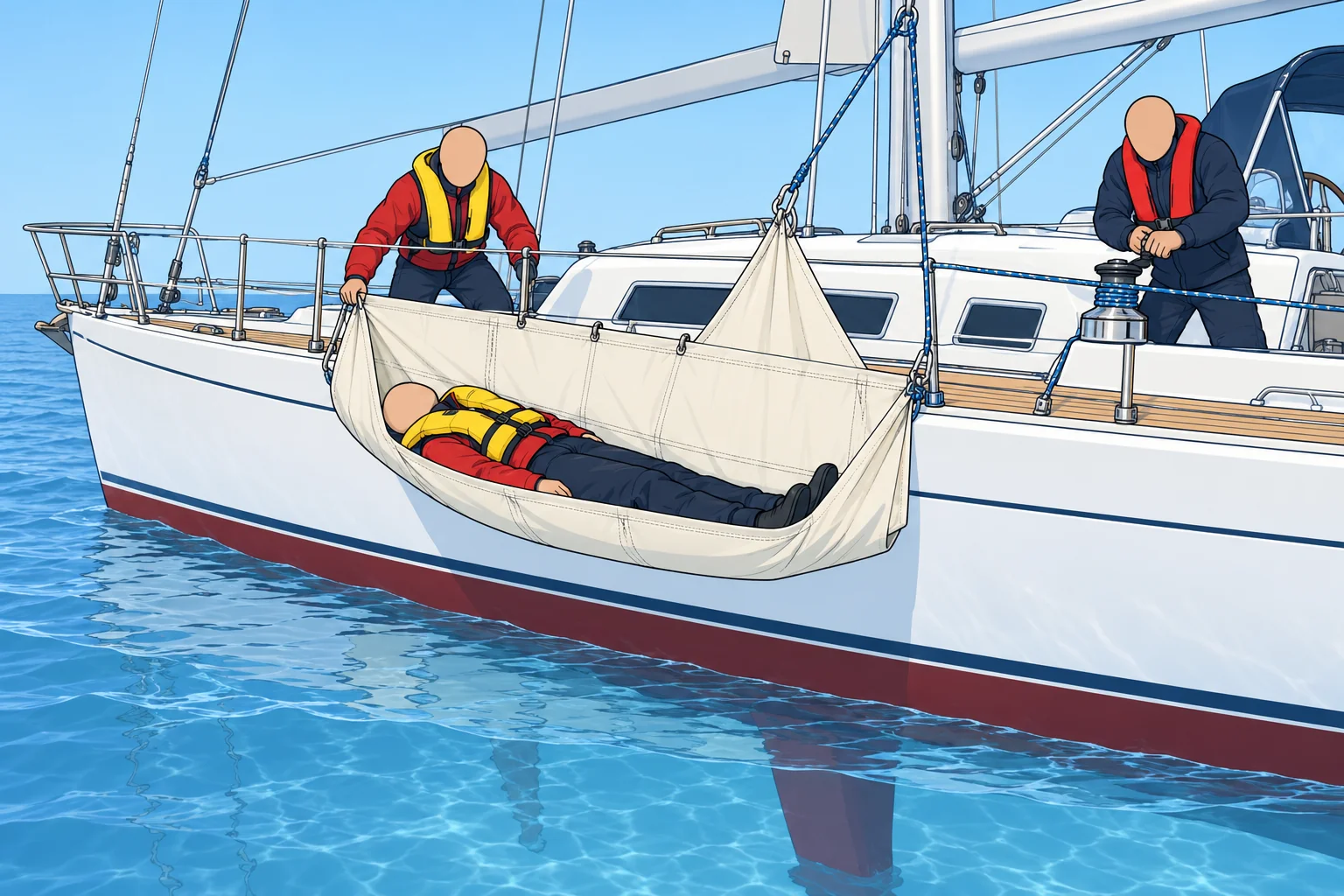
Getting the person back aboard
1The lesson in plain words
Alongside is only halfway. A cold, exhausted person may be unable to climb; plan a suitable lift, ideally horizontal, before you need it.
Contact first
Once alongside, secure the person with a recovery sling or suitable line, keeping their airway clear. Clip only to an attachment the maker approves for that purpose. If they are beyond reach, a heaving line, a rope thrown to them, or a floating recovery sling can reach a person able to help. Your boat and the person can drift apart, so secure contact promptly.
Recovery sling
A Lifesling-type sling is a buoyant horseshoe on a floating line. Circle slowly with the line secured aboard and clear of the propeller so it reaches a conscious casualty able to help. They pull the sling to them and fit it under their arms as its maker instructs. Stop the boat; if motoring, stop the engine before hauling them alongside. An unresponsive casualty cannot fit it: use your practised assisted-recovery method. Hoist only with suitable rated gear.
Lifting
Use a planned, load-rated recovery system. A halyard, a rope for raising a sail, led to a winch, or a tackle, a rope through pulleys, provides lifting power. Use a rated recovery sling or manufacturer-approved lifting point; an ordinary tether ring is unsuitable. Use a boom only with suitably rated supports and attachments, restrained against swinging. A parbuckle rolls the person horizontally aboard in a suitable sail or net. A ladder suits only someone fit to climb, with the engine stopped.
Lift horizontally
Water pressure helps support circulation during immersion. Lifting a person vertically can let blood pool in their legs and contribute to post-rescue collapse, a sudden deterioration after rescue. Where possible, lift them horizontally using suitable supports, a net or a parbuckle. Keep them horizontal, handle them gently and watch for collapse. For care after recovery, see Medical: cold water.
2Key points
- 1
Contact first: secure them with a suitable line or sling; clip only to an approved attachment.
- 2
Recovery sling: circle to reach a conscious casualty able to help; hoist only with suitable rated gear.
- 3
Use mechanical advantage: winch, tackle or parbuckle.
- 4
Ladders only for a fit casualty, engine stopped.
- 5
Lift horizontally, handle gently and watch for post-rescue collapse.
3Frequent mistakes
Wrong: They can climb the ladder once alongside.
Right: Cold, fatigue or injury may prevent climbing. Have a lifting method ready.
Wrong: Lift them straight up by the lifejacket.
Right: Use a rated recovery sling or manufacturer-approved lifting point, never an ordinary tether ring; lift horizontally where possible.
4Practice case & exam keys
A cold crew member is secured alongside but cannot climb. Your practised, load-rated rig can lift them upright in a sling or roll them aboard in a recovery net. Both are ready. Which do you choose, and why?
Show the answer
Choose the recovery net and use your practised parbuckle arrangement to roll them aboard horizontally. Keep their airway clear and handle them gently. A horizontal lift reduces the risk of post-rescue collapse compared with an upright lift. Keep them secured throughout.
Exam keys
- Contact first: suitable line or sling; clip only to an approved attachment.
- Recovery sling for a conscious casualty able to help; stop the boat; if motoring, stop the engine before hauling them alongside. Hoist with rated gear.
- Rated parbuckle or tackle; ladder only when able to climb safely, engine stopped.
- Horizontal lift and gentle handling to limit post-rescue collapse; see Medical: cold water for care.
Finish this unit
When you've read it, answer three questions. Get all three right to finish the unit; opening the page alone doesn't count.
My notes for this unit
No notes