

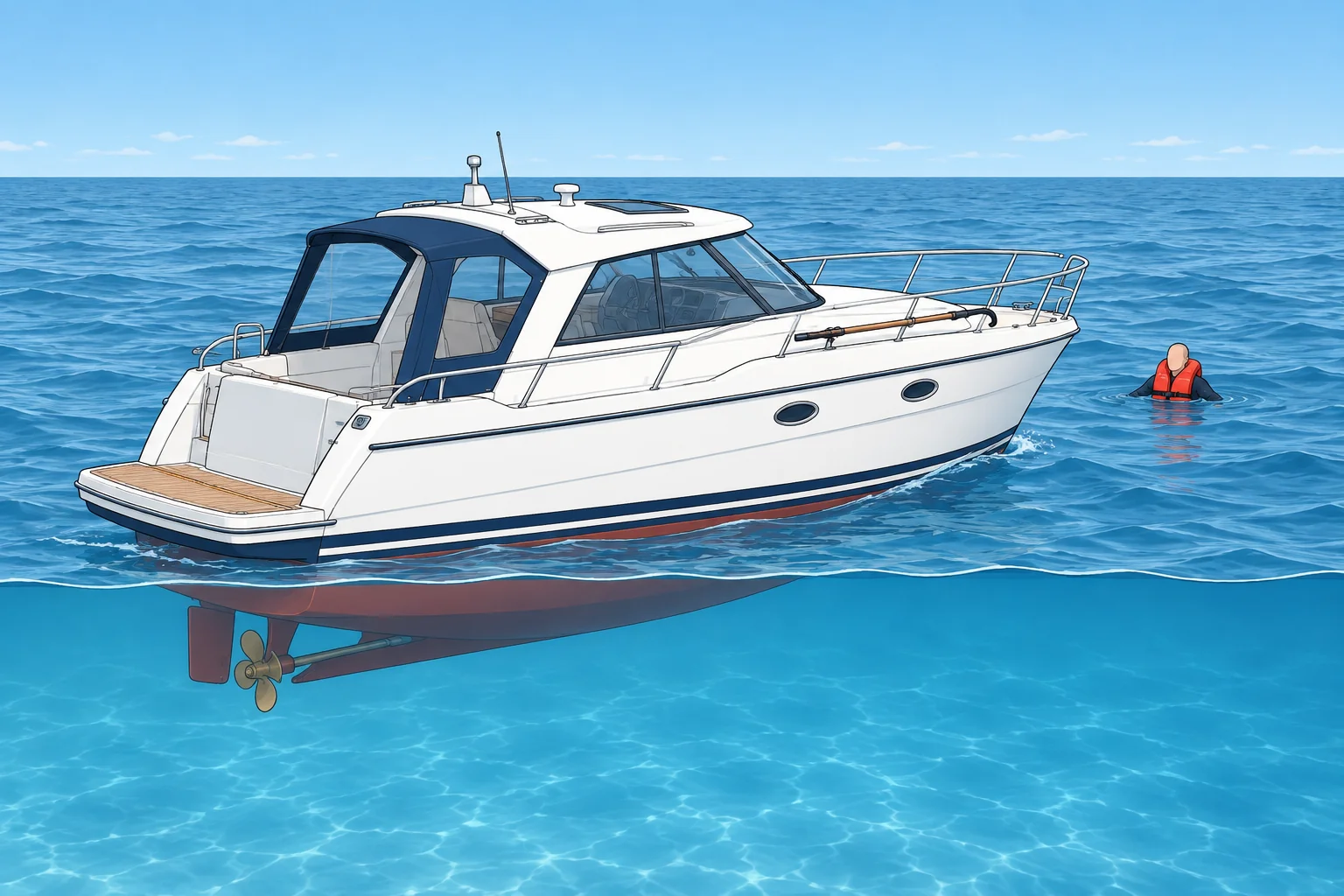
The motor approach
1The lesson in plain words
The propeller is the danger. Approach slowly, into wind or sea, with the person in sight, and be in neutral before they reach the stern.
Before you go
For a witnessed fall, turn promptly towards the side the person fell to swing the stern and propeller clear. Use a controlled turn suited to your boat; reduce speed promptly and keep the crew secure. Then furl or drop the headsail and secure the boom near the centreline to limit its swing. Check no lines trail over the side before engaging propulsion for the return.
Approach into the elements
Approach heading into the wind or sea, whichever most affects control. Use very low speed and keep the person in sight on the helm’s side, forward of the beam. Allow for drift from both wind and waves; heading into one does not cancel the other. Keep the hull clear as you stop alongside.
Neutral near the person
Reduce speed early so you are almost stopped at about one boat length. Select neutral: it removes engine drive but does not brake the boat or guarantee a stationary propeller. Stop the engine before the person comes near the propeller or stern recovery point. Secure them as soon as they are alongside.
Motor boats
A fast motor boat’s wake (waves it creates) and propeller can injure the casualty. Return at very low speed. Stop an outboard engine before the person reaches the stern. Wear the kill cord, the safety link that stops the engine if you leave the controls.
2Step by step
Motor approach to a person in the water
- 1
For a witnessed fall, turn promptly towards that side, reducing speed and using a controlled turn suited to the boat.
The stern and propeller swing away from them.
- 2
Furl or lower the headsail, secure the boom near the centreline and check no lines trail before engaging propulsion for the return.
Trailing lines can foul the propeller; an unsecured boom can swing across.
- 3
Approach slowly into the wind or sea, keeping the person in sight on the helm’s side.
This helps control the approach, but wind and waves can still move the boat onto the person.
- 4
Reduce speed early; select neutral about one boat length away, almost stopped.
Neutral disengages engine drive, but the propeller may still rotate.
- 5
Stop alongside, forward of the stern, and get a line on them at once.
Contact secured, the recovery can begin.
- 6
Stop the engine before stern recovery or if they drift towards the propeller.
Stopping the engine prevents powered rotation and accidental engagement near the casualty.
3Key points
- 1
For a witnessed fall, turn towards that side in a controlled turn, reducing speed promptly.
- 2
Approach into the wind or sea, slowly.
- 3
Keep the person in sight on the helm’s side.
- 4
Almost stopped at a boat length: neutral removes drive. Stop the engine before stern recovery.
- 5
On small powerboats, wear the kill cord.
4Frequent mistakes
Wrong: Back down towards the person to save time.
Right: Going astern brings the propeller straight at them. Approach bow first.
Wrong: Keep the engine in gear to hold position alongside.
Right: Be in neutral before they reach you. Stop the engine if they drift aft.
5Practice case & exam keys
From a 9 m motor cruiser, a crew member falls overboard to starboard while you are travelling at 15 knots. The wind is light, but a swell runs from the west. What do you do?
Show the answer
Reduce power promptly and make a controlled starboard turn suited to the boat, keeping crew secure. Throw flotation and press MOB. Return slowly into the swell with the person in sight on the helm’s side. Be almost stopped at a boat length and select neutral; the propeller may still turn. Stop alongside forward of the stern and secure them. Stop the engine before stern recovery or if they drift towards the propeller.
Exam keys
- Witnessed fall: controlled turn towards that side, reducing speed, to swing the propeller clear.
- Approach slowly into wind or sea, person in sight.
- Almost stopped at a boat length; neutral removes drive, not all propeller rotation. Engine stopped near stern.
- Check for lines in the water; kill cord on small powerboats.
Finish this unit
When you've read it, answer three questions. Get all three right to finish the unit; opening the page alone doesn't count.
My notes for this unit
No notes