

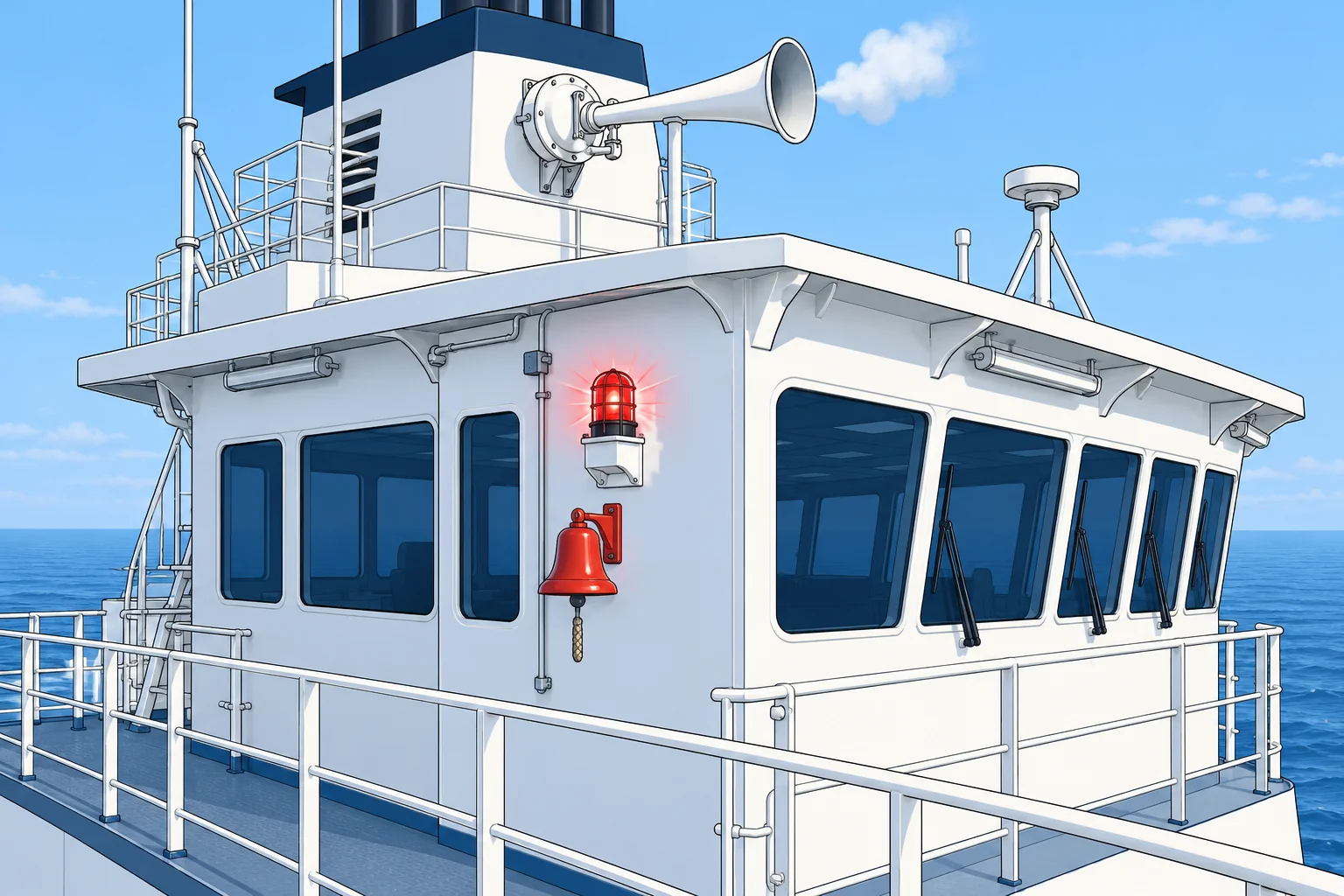
The general emergency alarm and other signals
1The lesson in plain words
Seven or more short blasts and one long blast call you to follow your muster-list duties. Learn your ship's other signals too.
The general emergency alarm
The general emergency alarm is seven or more short blasts followed by one long blast on the whistle or siren and electric bells or klaxons throughout the ship (SOLAS III/6.4.2). Follow your muster-list instructions: report to your assigned station or carry out your emergency duty. If on watch, follow your emergency instructions; do not simply abandon your post. The alarm is sounded from the bridge. On its own it does not mean abandon ship.
Announcements
After the alarm, the bridge normally uses the public address (PA) system to say what is happening and where, for example 'Fire, fire, fire in the engine room'. Listen carefully: the message may change your route, because you must not walk through the affected area. Drills are announced as drills. The muster list shows every signal used on your ship and what it means.
Fire alarm
Fire detectors and manual call points, break-glass alarm buttons in corridors and spaces, raise the fire alarm on the bridge and at the fire control station. The crew are then summoned with the ship's fire signal, often continuous ringing of the alarm bells; the exact signal is in your muster list. If you discover a fire, shout 'Fire!', press the nearest call point and make sure the bridge knows.
CO2 release alarm
Some spaces, such as the engine room, are protected by a fixed CO2 (carbon dioxide) system. Before the gas is released, a pre-discharge alarm, a distinct siren or horn with flashing lights, sounds in the space for at least 20 seconds. CO2 puts out fire by pushing out the oxygen, and it will kill you too. Leave at once by the nearest exit and never go back in until an officer says it is safe.
Man overboard
If you see someone fall into the sea, shout 'Man overboard' and the side, port or starboard. Throw the nearest lifebuoy towards them, keep pointing at them, and make sure the bridge knows. The ship's own man-overboard signal is set by the company and shown in the muster list; many ships use three long blasts.
Abandon ship
No alarm abandons the ship automatically. Only the master decides, and the order is normally given by word of mouth or over the PA after the crew have mustered; the muster list says how. Never leave the ship on your own because the general alarm has sounded.
2Key data
- General emergency alarm
- 7 or more short blasts + 1 long, on whistle and bells
- Its meaning
- Follow your muster-list duty; not an order to abandon ship
- Fire signal
- Ship's own signal in the muster list, often continuous bells
- CO2 pre-discharge alarm
- At least 20 s before release (FSS Code ch. 5); leave at once
- Abandon ship
- Ordered by the master only, by voice or PA
3Key points
- 1
General alarm: 7+ short blasts, then 1 long. Follow your muster list: report to your station or carry out your duty.
- 2
Listen to the PA: it tells you what and where, and may change your route.
- 3
CO2 pre-discharge alarm: leave the space at once; the gas kills.
- 4
Man overboard: shout, throw a lifebuoy, point, tell the bridge.
- 5
Only the master orders abandon ship, by voice or PA.
4Frequent mistakes
Wrong: The general emergency alarm means abandon ship.
Right: Follow your muster-list instructions. Abandon ship is a separate order from the master.
Wrong: When the CO2 alarm sounds, finish what you are doing first.
Right: Leave at once by the nearest safe exit. Never use the warning interval to finish a job.
Wrong: Run to the bridge to report a man overboard.
Right: Shout the alarm, throw a lifebuoy and keep pointing. Direct a named person to alert the bridge and confirm it. If alone, alert the bridge by the quickest available means while keeping the person in sight where possible.
5Practice case & exam keys
You are painting in the engine room when a siren you have not heard before starts and lights flash at the exits. Your workmate says it is probably a test and keeps working.
Show the answer
Treat it as a CO2 pre-discharge alarm. Put the brush down and leave at once by the nearest exit, telling your workmate to come with you. Close doors behind you if that is the drill on your ship. Report to your muster station or the person in charge and say who was in the space with you. Do not go back in until an officer says it is safe. A test is announced in advance; if you are unsure, get out first and ask afterwards.
Exam keys
- General emergency alarm: seven or more short blasts followed by one long blast (SOLAS III/6.4.2).
- Follow your muster-list duty: report to your station or carry out your emergency duty. Listen to the PA.
- CO2 pre-discharge alarm: at least 20 s warning; evacuate immediately.
- Only the master orders abandon ship; the muster list shows how.
Finish this unit
When you've read it, answer three questions. Get all three right to finish the unit; opening the page alone doesn't count.
My notes for this unit
No notes