

Staying alive in the water
1The lesson in plain words
Control your breathing, move away from the ship's side, and stay still and together. Swim only to a craft or group safely within reach.
Cold-water dangers
Cold water can disrupt breathing and quickly weaken your swimming. Keep your face clear of waves, control your breathing and avoid hard swimming while it settles. See Medical: cold water for the body's reactions.
Move away
Then move away from the ship's side, where wreckage, falling objects or a survival craft being launched can hit you, and away from the propellers if the engine is still turning. Head for a survival craft only if it is safely within reach. If there is oil on the water, keep your mouth shut and your head high; if it is burning, swim upwind, away from it.
Swimming in a lifejacket
To move in a lifejacket, lie on your back and kick slowly. Cross your arms over the jacket and look over your shoulder to steer. Use the same stroke in an immersion suit. Swim only to a craft or group safely within reach: swimming pumps cold water through your clothes and burns energy.
Without a lifejacket
If you have no lifejacket, float on your back with arms and legs spread and move your hands gently back and forth to stay afloat, or tread water slowly. Hold on to anything that floats. Keep your clothes on: they trap air and warmth.
HELP and huddle
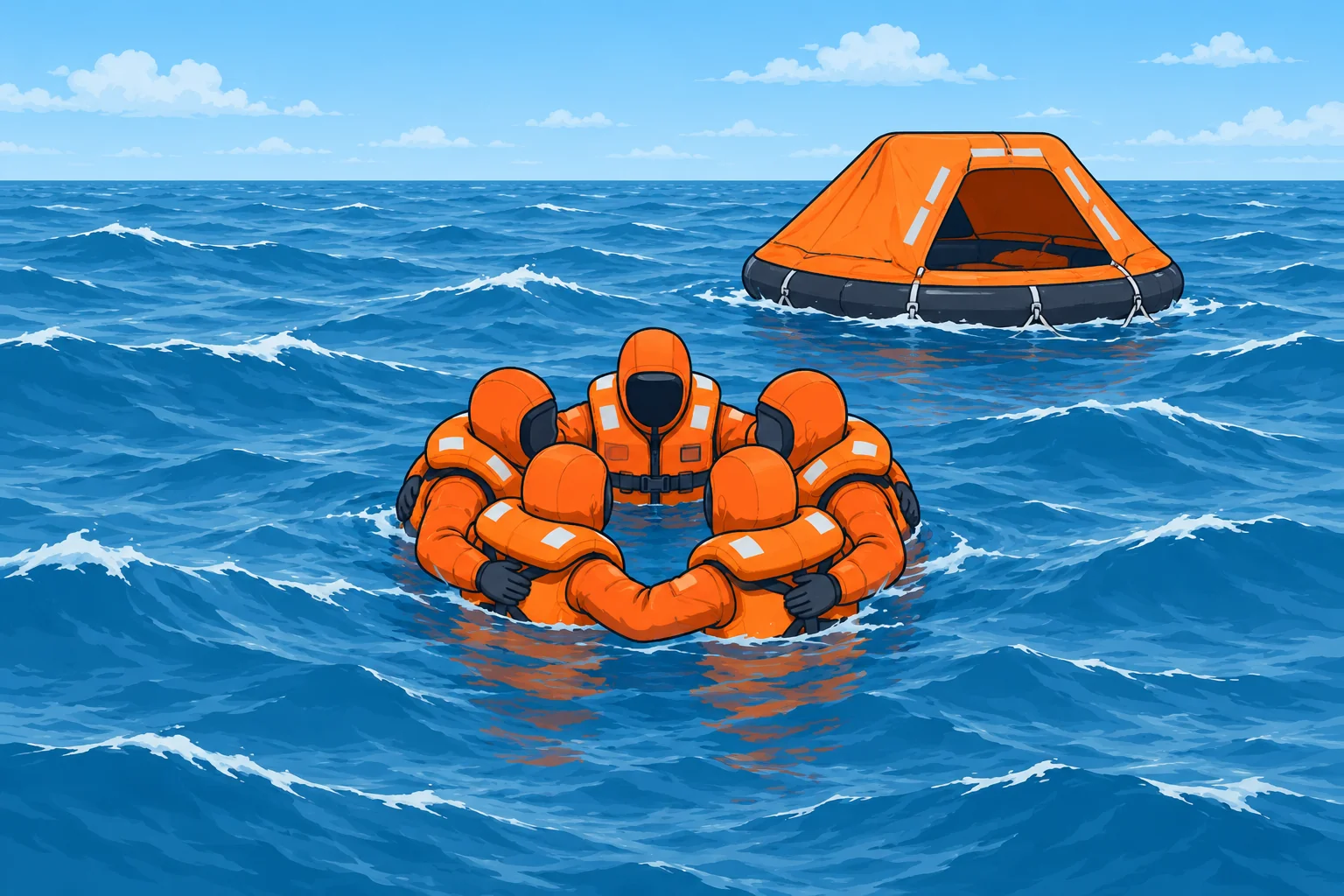
When alone, with a lifejacket keeping your mouth above water, use HELP (heat escape lessening posture): draw up your knees and cross your arms over the jacket to reduce heat loss. If this puts your face underwater, relax your legs and lean back. In lifejackets, form a huddle, a tight circle facing inwards, arms linked, with the weakest person supported in the middle. Stay together: a group is easier to see. If you must move, form a chain, linking on your backs and kicking together.
2Key data
- HELP
- Lifejacket on, mouth clear: knees up, arms across jacket
- Huddle
- In lifejackets, mouths clear: circle linked, weakest supported inside
- Swimming in a lifejacket
- On your back, arms crossed, slow leg kicks
- Burning oil
- Swim upwind, away from it
3Key points
- 1
Control your breathing first; see Medical: cold water for cold shock.
- 2
Move away from the ship's side, propellers, wreckage and burning oil.
- 3
Swim on your back in a lifejacket, and only to a craft or group safely within reach.
- 4
With a lifejacket: HELP alone, huddle together; keep your mouth clear. Without one, float and hold anything buoyant.
- 5
Keep your clothes on, with or without a lifejacket.
4Frequent mistakes
Wrong: Swim hard to keep warm while you wait for rescue.
Right: Save heat and energy. With a lifejacket, use HELP or huddle only while your mouth stays clear. Without one, float and hold anything buoyant.
Wrong: Strip off heavy clothing in the water so you float better.
Right: Keep clothes on. They trap air and warm water and slow heat loss.
5Practice case & exam keys
You and four crew mates are in the water in lifejackets after a sudden capsize. The nearest liferaft is about 150 m downwind. One of the group has an injured arm and cannot swim properly.
Show the answer
Control your breathing. Do not assume you can catch a raft 150 m downwind; it may drift faster than you. Support the injured person in a huddle, keep mouths clear and signal its occupants with whistles and lights. Swim together only if the craft is clearly reachable without exhausting anyone; otherwise save heat and energy. Stay together and keep your clothes on.
Exam keys
- Control breathing, then move away from the ship's side and hazards.
- In a lifejacket: swim on your back, arms crossed, slow kicks.
- With a lifejacket: HELP alone, huddle together, mouths clear; chain to move. Without one, float and hold anything buoyant.
- Burning oil: swim upwind. Keep clothes on.
Finish this unit
When you've read it, answer three questions. Get all three right to finish the unit; opening the page alone doesn't count.
My notes for this unit
No notes