
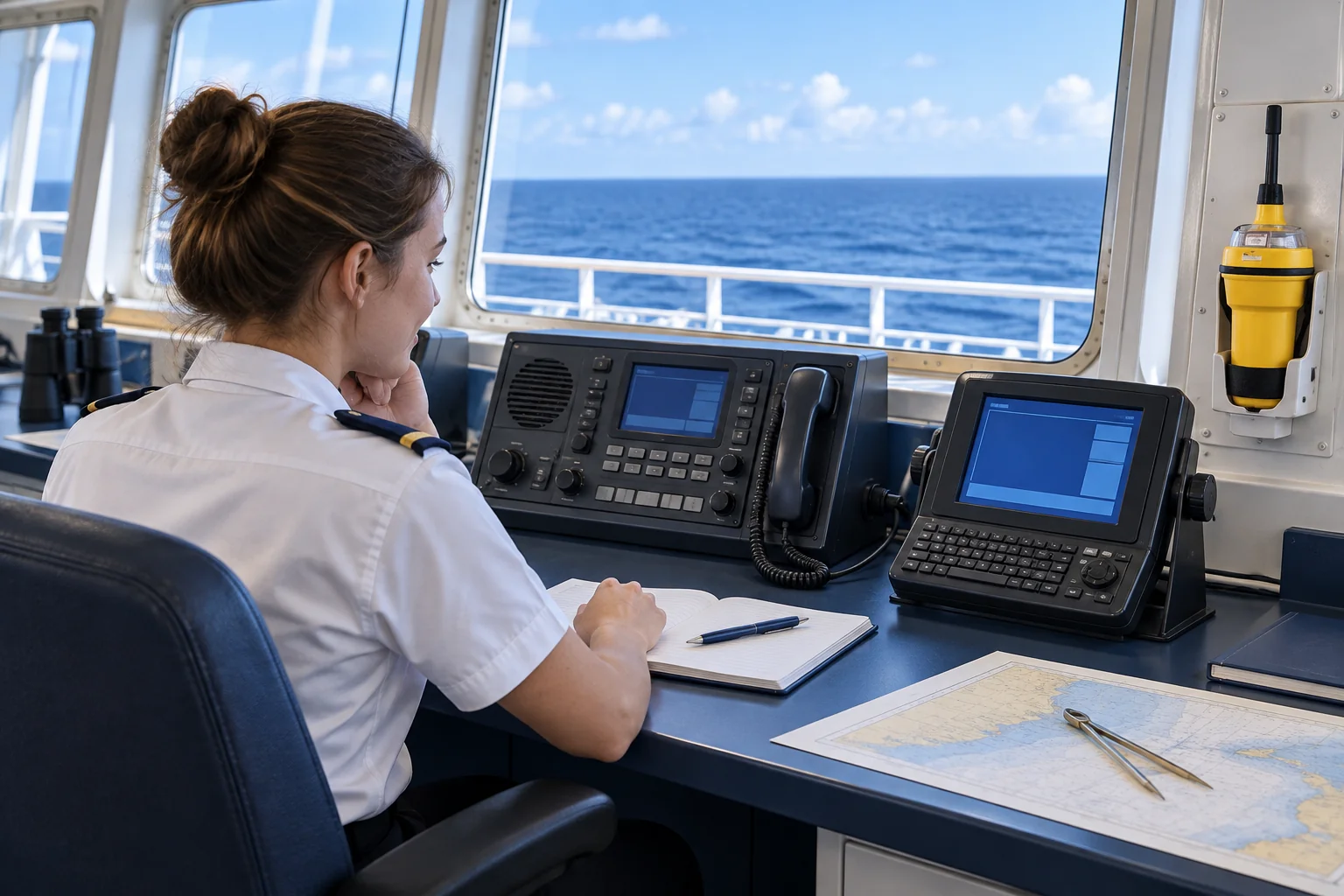
Module 10 — GPS, antennas, batteries and reserve power
1The lesson in plain words
Check source, time and radio path; use the best available position and update it without delaying a life-saving alert.
Where does the position come from?
Identify integral GNSS, a connected receiver, or manual entry; the source matters too when judging the data.
What do you read with the position?
Check its age and UTC time, because an old position is still information, even when it is not current.
What do you check in the path?
Check the displayed identity, antenna connections and power; an indication does not prove the whole path.
How do you understand reserve power?
Distinguish main, emergency and reserve sources; their roles are not interchangeable and duration depends on SOLAS conditions.
2Step by step
Position, antenna and power check
- 1
Identify the source: integral GNSS, connected receiver, or manual entry.
It tells you where the data comes from.
- 2
Read the position age and UTC time, if shown.
It lets you state when it was recorded.
- 3
Compare the displayed identity with the radio record and voyage documents.
A valid MMSI does not prove a valid position.
- 4
Check antenna connections and power; record any defect.
A monitored indication does not prove transmission will arrive.
- 5
Distinguish the main, emergency and reserve sources.
Each source has different roles and conditions.
- 6
Send the best available information and update rescue services if it changes.
Do not delay a life-saving alert while correcting data.
3Key data
- Manual-entry warning
- Beyond 4 h
- Manual-entry erasure
- Beyond 23.5 h
- Reserve with full emergency
- At least 1 h
- Reserve otherwise
- At least 6 h
- Maintenance in A1/A2
- At least one approved method
- Maintenance in A3/A4
- Combination of at least two
4Key points
- 1
Source, age, identity and update: four checks before judging a position.
- 2
Interconnection supplies data; it does not certify accuracy, antenna, datum or wiring.
- 3
Main, emergency and reserve sources have different roles.
- 4
A life-saving alert does not wait for a perfect fix or a completed log.
5Frequent mistakes
Wrong: "If the GNSS position is old, I should wait before alerting."
Right: Use the best available position, state its source and age, then update it.
Wrong: "A correct MMSI proves that the position is correct too."
Right: Check the identity and the position separately.
Wrong: "A charged battery proves sufficient endurance."
Right: A charge indication does not prove endurance under the required load.
6Exam keys & interpretation
Exam keys
- When «manual» appears with «4 h» and «23.5 h», remember warning first and erasure later.
- When main, emergency and reserve are separated, do not mix their roles or conditions.
- «A1/A2» calls for one approved method; «A3/A4» calls for a combination of at least two.
How to read it
- A position is data with a source and age, not an automatic guarantee of accuracy.
- Think of power as a chain: one healthy indication covers only one part.
7Go deeper: GOC exam level
The detail behind each step for the General Operator's Certificate: the rules, the radio technique and worked cases.
- 1. Whip antenna
- 2. Automatic tuning unit (ATU) at its base
- 3. RF earth strap to the hull
- 4. Coaxial feeder
- 5. MF/HF transceiver and DSC controller
- 6. Reserve batteries
The reserve source of energy
While the ship is at sea there must be enough power to run the radio installations and to charge the batteries that form the reserve. There must also be a reserve source, independent of propulsion and the main electrical system, able to keep distress, urgency and safety communications going if the main and emergency sources fail.
| Situation (SOLAS IV) | Minimum reserve capacity |
|---|---|
| The emergency source fully meets SOLAS II-1/42 or 43 and supplies the radio installations | At least 1 hour |
| No such compliant emergency source | At least 6 hours |
The reserve must be able to feed the VHF and the equipment required for the sea area (MF, MF/HF or the ship earth station) simultaneously, together with their mandatory loads such as the position input and the emergency light. It does not need to feed two independent MF and HF installations at once unless the rule demands it.
Sizing rule. Battery capacity for the reserve is worked out from half the transmitter current, plus the full receive current and the additional loads, multiplied by the required hours (1 or 6), with a margin for temperature and age.
Batteries: why the voltmeter can lie
Usable capacity depends on the rated Ah, temperature, age, state of charge, discharge current and chemistry. A battery that shows the correct voltage off load can collapse under transmit load.
- Check the charger, alarms and indicators every day.
- Test on load according to the ship's procedures.
- Note the result in the radio record.
Electricity basics for the radio station
| Rule | What it gives you |
|---|---|
| Ohm's law: V = I × R | Voltage drop across a cable or a corroded terminal |
| Power: P = V × I | Current a set draws (a 400 W load on 24 V takes about 17 A) |
| Cells in series | Voltages add, capacity stays the same (two 12 V 100 Ah → 24 V 100 Ah) |
| Cells in parallel | Capacity adds, voltage stays the same (two 12 V 100 Ah → 12 V 200 Ah) |
Battery types. Flooded lead-acid batteries need electrolyte checks and topping up with distilled water; a hydrometer reads their specific gravity, roughly 1.28 when fully charged and about 1.12 when discharged. Sealed gel and AGM batteries are not topped up or measured with a hydrometer: check their voltage on load, temperature and the charger instead.
Position input and the four-hour rule
Two-way equipment that includes position automatically in a distress alert must receive it from an internal or external navigation receiver. If that receiver fails, SOLAS requires manual updating of position and time at intervals not exceeding 4 hours while the ship is underway.
Antennas: length, resonance and the ATU
Working formulas: λ (m) ≈ 300 / f (MHz); quarter-wave L ≈ 75 / f (MHz); half-wave L ≈ 150 / f (MHz). Real antennas need corrections for end effects, structure, diameter, radome, earth plane and matching networks.
| Frequency | Quarter-wave | What happens on board |
|---|---|---|
| VHF Ch 16, 156.8 MHz | ≈ 0.48 m | A compact whip |
| HF 8291 kHz | ≈ 9.05 m | Achievable but only for one band |
| MF 2182 kHz | ≈ 34.4 m | Too long; a shorter antenna plus ATU |
| NAVTEX 518 kHz | ≈ 145 m | Receive only; a short active antenna is used |
| EPIRB 406 MHz | ≈ 18.5 cm | Built into the approved beacon |
An MF/HF ship antenna has to work on many frequencies and cannot be resonant on all of them. The ATU (automatic tuning unit) transforms the impedance the transmitter sees so it can deliver power efficiently and safely.
VSWR and reflected power
VSWR (voltage standing wave ratio) measures mismatch. 1:1 is ideal; higher values mean more energy reflected back towards the transmitter. Modern transmitters reduce power to protect the final stage when they detect a severe mismatch, so "the set switches on" does not mean "the antenna works".
VSWR = (1 + |Γ|) / (1 − |Γ|), where Γ is the reflection coefficient; the reflected power fraction is |Γ|².
| VSWR | Γ | Reflected power |
|---|---|---|
| 1.5:1 | 0.20 | 4 % |
| 2:1 | 0.33 | 11 % |
| 3:1 | 0.50 | 25 % |
Decibels, SNR and receivers
The decibel expresses a ratio on a log scale. For power: dB = 10 log₁₀(P₂/P₁); for voltage on the same impedance: dB = 20 log₁₀(V₂/V₁). Quick rules: +3 dB ≈ double power, +10 dB = ×10, −3 dB ≈ half.
In a link, gains and losses multiply physically but add in dB: transmitter power + antenna gain − cable loss − path loss + receive antenna gain. That is why link budgets are written in dB.
SNR (signal-to-noise ratio) often matters more than absolute signal: an S5 signal over S0 noise can be more readable than S9 over S8. Filters, antenna, band choice and killing on-board noise improve SNR without more transmit power.
Sensitivity is the ability to receive weak signals at a given quality; selectivity is rejecting adjacent signals; dynamic range is coping with very strong and very weak signals together. On a bridge full of electronics, intermodulation and blocking can matter as much as the weak signal.
Try it: worked numbers
- 1Quarter-wave for 6215 kHz. 75 / 6.215 ≈ 12.1 m.
- 2Endurance. A 24 V, 150 Ah reserve bank feeds an average radio load of 300 W. Energy ≈ 24 × 150 = 3,600 Wh; 3,600 / 300 = 12 h in theory. With about 70 % usable capacity in the cold, plan on roughly 8 h: comfortably above a 6-hour requirement.
- 3Position age. The DSC position is 3 h old and the ship makes 14 knots: the alert could be up to 42 NM out.
- 4Reflected power. A VSWR of 2:1 gives |Γ| = (2 − 1) / (2 + 1) ≈ 0.33, so about 11 % of the power is reflected.
Safety around radio equipment
STCW A-IV/2 asks every GOC holder to know the radio-frequency and electrical hazards of the station.
- RF radiation. An MF/HF antenna and its tuner carry very high RF voltages while transmitting. Never touch them, and keep people clear. Satellite and radar antennas have safety distances set by the manufacturer.
- Work aloft. Before anyone works near antennas, switch off and isolate the transmitters and radars, and put up warning notices at the consoles.
- Electrical. Battery banks hold a lot of energy and give off hydrogen when charging: ventilate, no flames, insulated tools. Isolate supplies before opening equipment.
- Lightning. Earth the antennas, and use the earthing switch or disconnect where the installation provides one.
Local fault finding
The GOC is not a repair technician, but must find simple faults and keep a station working.
| Symptom | Check first |
|---|---|
| Set dead | Supply switch, fuses or breakers, battery selector, connectors |
| Display shows no position | GNSS feed, cable, the navigation receiver's output; enter position manually |
| VHF transmits but range is poor | Antenna, coax, connectors, power setting, VSWR |
| ATU will not tune | Antenna insulators, feed, earth strap, ATU supply |
| Loud noise on every band | On-board interference: switch suspect equipment off one by one |
| Satellite terminal not logged in | Antenna blockage, cabling, alarms, position, subscription status |
| Battery alarm | Charger operation, connections, electrolyte or temperature, load |
Write every fault and repair in the radio record, and report what cannot be fixed on board.
GOC exam check
Your ship's emergency source does not meet SOLAS II-1/42 or 43 for supplying the radio installations. What minimum reserve capacity is required?
- At least 1 hour
- At least 4 hours
- At least 6 hours
- It depends on the sea area
Show the answer
C. At least 6 hours
Why: Without a compliant emergency source the reserve must last at least 6 hours; 1 hour applies only when a compliant source feeds the radio. The figure does not depend on the sea area.
The GNSS feed to the DSC equipment fails while the ship is underway. What is the maximum interval for manual position and time updates?
- 1 hour
- 4 hours
- 6 hours
- 12 hours
Show the answer
B. 4 hours
Why: SOLAS sets 4 hours as the maximum interval. It is a ceiling, not a target: update straight away and fix the feed.
Using L ≈ 75 / f (MHz), roughly how long is a quarter-wave antenna for 6215 kHz?
- About 12.1 m
- About 24.1 m
- About 48.3 m
- About 9.1 m
Show the answer
A. About 12.1 m
Why: 75 / 6.215 ≈ 12.1 m. About 24 m is the half-wave (150 / f) and about 48 m the full wavelength.
An antenna system shows a VSWR of 2:1. About how much of the power is reflected?
- 4 %
- 25 %
- 50 %
- 11 %
Show the answer
D. 11 %
Why: At 2:1, |Γ| ≈ 0.33 and the reflected fraction |Γ|² is about 11 %. 4 % goes with 1.5:1 and 25 % with 3:1.
After repairs the ATU shows a perfect 1:1 VSWR, but coast stations still report a weak signal. What is the right conclusion?
- The antenna is fine, so the problem must be propagation
- A match is needed but does not prove good radiation
- The transmitter must be increased to full power
- VSWR 1:1 means the earth connection is perfect
Show the answer
B. A match is needed but does not prove good radiation
Why: A dummy load also shows 1:1 and radiates almost nothing; losses in the ATU, earth and structure remain. Blaming propagation first skips the antenna checks.
A transmitter's output is raised from 50 W to 100 W. In decibels this is about:
- +6 dB
- +10 dB
- +3 dB
- +2 dB
Show the answer
C. +3 dB
Why: Doubling power is about +3 dB. +10 dB would be ten times the power, and +6 dB is a doubling of voltage, not power.
A technician is going aloft to work near the MF/HF antenna. What must be done first?
- Switch off and isolate transmitters and radars, with notices
- Set the MF/HF transmitter to low power for the job
- Switch off the radars only, as MF/HF is safe to touch
- Tune the ATU first so the antenna voltage is low
Show the answer
A. Switch off and isolate transmitters and radars, with notices
Why: Transmitters and radars are switched off and isolated, with warning notices at the consoles. MF/HF antennas carry very high RF voltages when transmitting.
The ATU will no longer tune on bands that used to work. What do you check first?
- The propagation forecast for those bands
- The receiver's AGC and noise blanker
- The GNSS input to the DSC controller
- Antenna insulators, feed, earth and ATU
Show the answer
D. Antenna insulators, feed, earth and ATU
Why: A failure to tune points to the antenna, feed, RF earth or the ATU itself. Propagation does not stop an ATU matching.
MV BOREAL's emergency generator does not meet SOLAS II-1/42 or 43 for the radio. The MF/HF draws 30 A transmitting and 2 A receiving, the VHF 6 A and 1 A, and the position input and emergency light 2 A. What current do you size the reserve battery for?
- 41 A, every load at full current
- 20 A, half the transmit current plus 2 A
- 18 A, half of both transmit currents
- 23 A, half transmit plus receive and loads
Show the answer
D. 23 A, half transmit plus receive and loads
Why: The rule is half the transmitter current, plus the full receive current, plus the other loads: 18 + 3 + 2 = 23 A. 41 A is the tempting overestimate that counts every transmitter at full current; 20 A forgets the receivers.
Same scenario: for how long must the reserve supply that current, and what capacity does that give before any margin?
- 6 hours, about 138 Ah
- 1 hour, about 23 Ah
- 6 hours, about 246 Ah
- 1 hour, about 41 Ah
Show the answer
A. 6 hours, about 138 Ah
Why: With no compliant emergency source the reserve must last 6 hours, so 23 A × 6 h ≈ 138 Ah before margins for temperature and age. 1 hour applies only when the emergency source meets II-1/42 or 43, and 246 Ah comes from the wrong 41 A figure.
8Full lesson & sources
Open the full lesson (diagrams and official references)
Check GNSS position and UTC time, antenna connections, radio identities and power supplies. Do not delay a life-saving alert while correcting a missing position or filling in a log. Supply the best available position and its time, then update rescuers. For manual input, MSC.511(105) requires a warning beyond 4 h and erasure beyond 23.5 h; those thresholds do not make an inaccurate position acceptable.
The reserve radio source is independent of the main and emergency sources. SOLAS IV/13 requires 1 h where a compliant emergency supply fully powers the radio installation, otherwise 6 h. Maintenance availability uses at least one approved method in A1/A2 and a combination of at least two in A3/A4. Repair defects and assess voyage compliance with the master and responsible authority.
Start with the information that is available
A distress alert is only as useful as the position inside it. Rescuers go to the position you send, so an old position sends them to the wrong place. Work out how wrong: a ship making 15 knots whose position stopped updating 4 hours ago may be 60 NM from it. That is an area larger than a helicopter can search in one sortie.
Yet a stale position is far better than no alert. Send the best available information at once, with its UTC time, so the RCC knows how old it is. Then give the current position by voice as soon as you can. Identity, position, time and confidence are four separate facts, and each one can be wrong on its own.
Trace the position path
ITU Radio Regulations Article 32.5B says that a GMDSS radio able to send its position, but without its own GNSS receiver, must be connected to the ship's navigation receiver so the position goes in automatically. That connection can fail without obvious signs: a loose plug, a GNSS unit switched to a different output, a sentence format the radio does not accept. The radio then keeps showing the last good position, sometimes with no warning.
If the feed fails, SOLAS requires you to enter position and time by hand at intervals of not more than 4 hours while the ship is underway. Four hours is the most the rule allows, not a target. In a traffic separation scheme at 18 knots you would update every hour or less, and fix the feed.
| Display shows | What it tells you | What it does not prove |
|---|---|---|
| A position with today's UTC time, a few minutes old | The feed was working recently | That the GNSS fix itself is accurate |
| A position with a time 5 hours old | The feed has stopped | Anything about where the ship is now |
| No position at all | The alert would go out without a position | That the radio cannot alert: it still can |
| The ship's MMSI | Which identity will be transmitted | That the registration database is up to date |
Power is a chain, not one number
The radio installation runs from the ship's main supply, falls back to the emergency source, and below that has a reserve source, usually a battery bank, that must keep distress and safety communications going if both fail. SOLAS IV/13 sets the size: at least 1 hour when a compliant emergency source fully powers the radio installation, or at least 6 hours if not. The figure depends on the emergency source, not on the sea area.
Here is a worked check for a 6-hour ship. On 24 V the VHF draws 1.5 A receiving and 5 A transmitting, the MF/HF 2 A receiving and 20 A transmitting, the satellite terminal 1.5 A and the radio-room light 1 A. The usual sizing rule counts half of each transmitter's current (2.5 A + 10 A), plus the receivers and other loads. That totals about 18.5 A, or 111 Ah over 6 hours. Batteries in a cold compartment deliver perhaps 70 % of their rating, so you need at least 111 / 0.7 ≈ 159 Ah. A 150 Ah bank falls just short; a 200 Ah bank gives a sensible margin.
Apply the distinction
At 1210 UTC the DSC display shows 41° 22.4' N, 008° 43.1' W with a time 18 minutes old; the ship is making 10 knots, so it could be about 3 NM out. A fire is now out of control. Send the alert straight away with that position. In the MAYDAY that follows by voice, give the current position from the chart plotter and its time. Afterwards, log that the automatic feed had stopped and get it repaired. You can update the position by voice in seconds, but you cannot get back time lost before the alert.
Sources: ITU Radio Regulations 2024, Articles 32.5B and 32.9–32.10; SOLAS IV/13, MSC.496(105).
Official references · 2026-09-09
Finish this unit
When you've read it, match the terms, then answer three questions. Get them all right to finish the unit; opening the page alone doesn't count.
My notes for this unit
No notes