
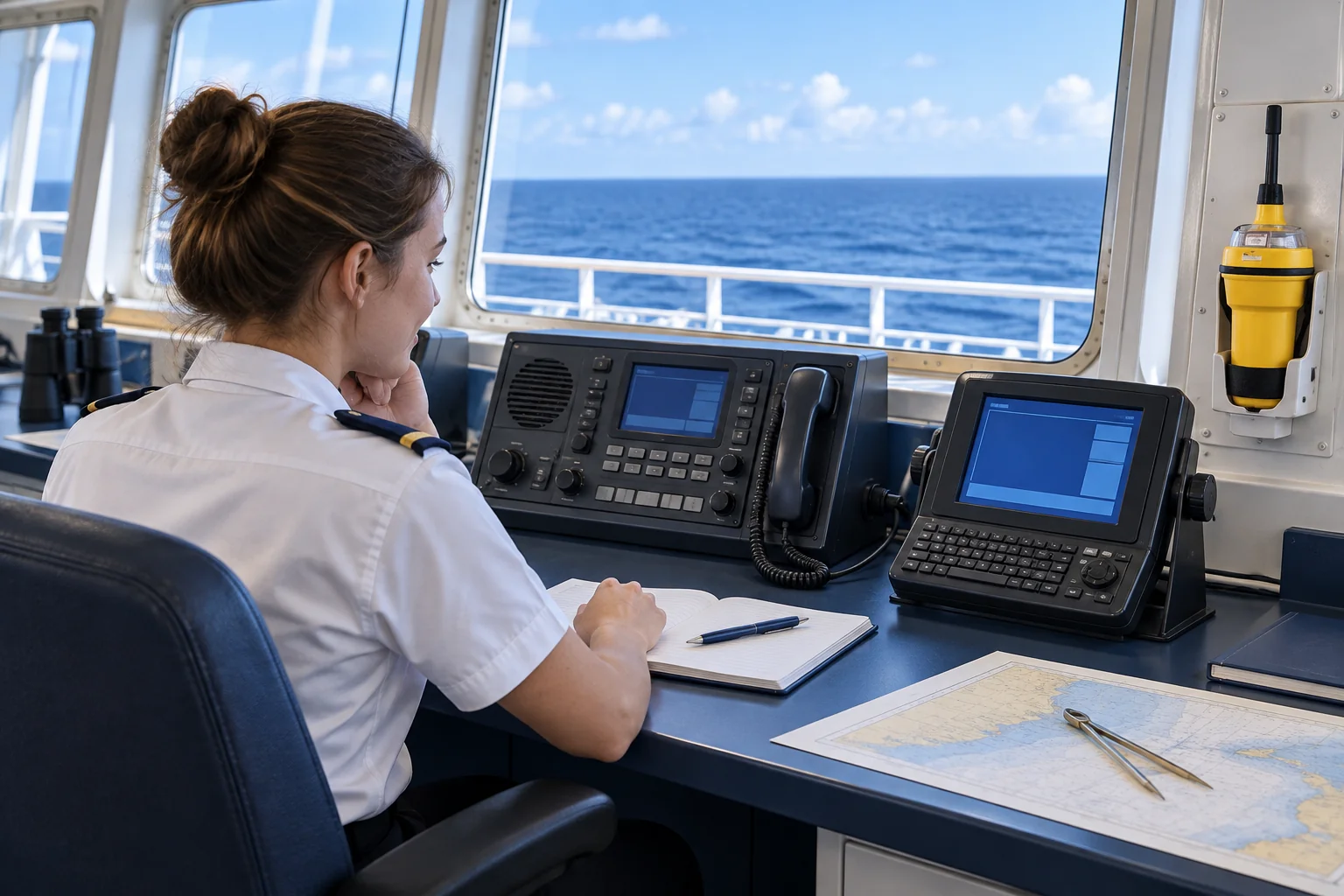
Module 9 — SART, AIS-SART and survival VHF
1The lesson in plain words
A radar SART helps make survivors findable through suitable X-band radar and its matching sensor.
What does a radar SART show?
It responds to suitable X-band radar and creates a pattern from the approximate survivor position; nearby it can appear as arcs or concentric circles.
What identifies an AIS-SART?
It broadcasts locating information on AIS frequencies and uses the identity prefix 970; it needs an AIS receiver for detection.
How do you help detection?
Raise the antenna as instructed, keep it clear and remember that radar and AIS need compatible receivers.
What do you take to the craft?
Follow the muster plan and transfer assigned equipment, including the portable survival VHF, when safe.
2Step by step
SART and VHF survival workflow
- 1
Follow the muster plan and take the EPIRB, SART and portable VHF when safe.
Assigned equipment should reach the survival craft when possible.
- 2
Activate the locating device using its marked procedure.
Activation lets the equipment help locate survivors.
- 3
Raise the antenna at least 1 m above sea level, as instructed.
Antenna height affects equipment detection.
- 4
Keep the equipment exposed and monitor rescue instructions on the portable VHF.
Exposure and monitoring support detection and coordination.
- 5
Tell rescuers which device is active and what radar or AIS presentation to expect.
Rescuers must match the transmitter to the correct sensor.
- 6
Preserve batteries and follow approved test or replacement procedures after the event.
Post-event maintenance must follow approved procedures.
3Key data
- Radar SART standby
- 96 h
- Continuous interrogation
- 8 h
- AIS-SART operation
- 96 h
- Antenna height
- At least 1 m above sea level
- Radar SART response
- Twelve marks from approximate position
- AIS-SART identity
- Prefix 970
- Survival VHF
- Channel 16 and one more
- Batteries and testing
- Approved procedures
4Key points
- 1
Radar SART and AIS-SART locate; the EPIRB complements alerting.
- 2
Match the transmitter to its receiver before interpreting the display.
- 3
Exposed equipment and a clear antenna support detection.
- 4
The portable VHF supports coordination during rescue.
5Frequent mistakes
Wrong: "A radar SART always appears as an AIS target."
Right: Radar SART needs compatible radar; AIS-SART needs an AIS receiver.
Wrong: "The twelve marks are twelve survivors."
Right: They are repeated responses from an approximate position, not a person count.
Wrong: "I can hide the antenna and stop listening after activation."
Right: Keep the equipment exposed and monitor rescue instructions on VHF.
6Exam keys & interpretation
Exam keys
- When you see «X-band radar» with «twelve marks», think radar SART, not AIS-SART.
- When you see «prefix 970», identify AIS-SART and look for AIS reception.
- If an option mixes radar SART with an AIS target, reject it: each device depends on its sensor.
How to read it
- Picture three roles: EPIRB alerts, SART locates and portable VHF supports coordination.
- A display is not enough: identify what transmits, what receives and how the signal should appear.
7Go deeper: GOC exam level
The detail behind each step for the General Operator's Certificate: the rules, the radio technique and worked cases.
Radar SART
The search and rescue radar transponder answers interrogation by an X-band (9.2–9.5 GHz) radar. When a radar pulse hits it, it sends a series of replies that appear on the searching radar as a line of 12 dots pointing outward from the SART's position. As the searcher closes, the dots turn into arcs and, very close, into concentric circles.
- Switch it on only when appropriate and mount it as high as practicable in the survival craft. Its performance depends heavily on height above the sea and radar line of sight.
- Do not confuse a SART with an EPIRB: the SART is tactical, short-range locating.
- Check the battery and use the test mode according to the manufacturer.
| Searcher | Performance standard |
|---|---|
| Ship's navigational radar, antenna about 15 m | Detection at not less than about 5 NM |
| Aircraft at about 3,000 ft | Detection at not less than about 30 NM |
AIS-SART
An AIS-SART transmits position reports on the AIS channels AIS1 (161.975 MHz) and AIS2 (162.025 MHz). Compatible AIS equipment and chart displays show it with a dedicated SAR symbol and the identity 970XXYYYY. The current AIS technical reference is ITU-R M.1371.
| Feature | Radar SART | AIS-SART |
|---|---|---|
| Physical link | Responds to X-band radar | Transmits on VHF AIS |
| Displayed on | Radar screen | AIS display / ECDIS / chart plotter |
| Gives | Bearing and range on the radar picture | GNSS position and identity |
| Needs on the searcher | An X-band radar | AIS reception |
AIS in the GMDSS picture
AIS is carried under SOLAS Chapter V for navigation, not as a GMDSS alerting system, yet it now plays a part in search and rescue:
| AIS element | Role in SAR |
|---|---|
| AIS-SART, AIS-MOB, EPIRB-AIS | Show survivors' positions on every nearby AIS display |
| SAR aircraft AIS (MMSI 111MIDXXX) | Lets ships see the aircraft and its track on scene |
| Ships' AIS positions | Help the RCC pick which ships can assist |
| AIS safety-related text messages | Short local warnings; they never replace MSI or a distress alert |
Survival-craft two-way VHF
Survival-craft VHF radios let liferafts, ships and SAR units coordinate. Performance standards require at least Channel 16 and one other simplex channel, a minimum effective radiated power of 0.25 W, and a primary battery with enough capacity for 8 hours of operation at the specified duty cycle.
- Know where the sets and their sealed emergency batteries are stored.
- Know who collects them under the muster list.
- Keep the emergency battery sealed for real use; use the rechargeable or training battery for drills.
Worked case: three locating aids, one survivor craft
A liferaft carries a radar SART, an EPIRB that floated free, and a portable VHF. The EPIRB put the alert into Cospas-Sarsat and gives the RCC a position. The helicopter homes on 121.5 MHz and sees the AIS position on its display. The rescue ship's X-band radar shows the SART line. The VHF lets survivors tell the rescuers how many they are and who is injured. Each device does one job in a chain.
GOC exam check
Which equipment on a searching unit triggers a radar SART?
- An X-band (9.2–9.5 GHz) radar
- An S-band (about 3 GHz) radar
- An AIS receiver on AIS1 and AIS2
- A 121.5 MHz direction finder
Show the answer
A. An X-band (9.2–9.5 GHz) radar
Why: A SART answers X-band radar interrogation in 9.2–9.5 GHz. AIS reception is what an AIS-SART needs, not a radar SART.
As a rescue ship closes in to very short range, how does the SART signal change on its radar?
- The dots turn into a single bright spot
- The line of dots shortens to three dots
- The dots become arcs, then concentric circles
- The line of dots disappears from the screen
Show the answer
C. The dots become arcs, then concentric circles
Why: The 12-dot line turns into arcs and, very close, into concentric circles. It does not collapse to one spot.
On the radar screen, which part of the SART line marks the SART's position?
- The outermost dot
- The middle of the line
- The brightest dot
- The innermost dot
Show the answer
D. The innermost dot
Why: The dots point outward from the SART, so the innermost dot marks its position. The outer dots only extend the line.
What detection range does the performance standard expect for a SART seen by an aircraft at about 3,000 ft?
- Not less than about 5 NM
- Not less than about 30 NM
- Not less than about 15 NM
- Not less than about 50 NM
Show the answer
B. Not less than about 30 NM
Why: An aircraft at about 3,000 ft should detect it at not less than about 30 NM. About 5 NM is the figure for a ship's radar with its antenna at about 15 m.
An AIS target appears with a SAR symbol and an identity starting 970. What is it?
- An AIS-MOB device
- An EPIRB-AIS
- An AIS-SART
- A SAR aircraft
Show the answer
C. An AIS-SART
Why: 970XXYYYY is an AIS-SART. MOB devices use 972 and EPIRB-AIS 974; SAR aircraft use 111MIDXXX.
What minimum effective radiated power does the standard require of a survival-craft two-way VHF?
- 0.25 W
- 1 W
- 0.5 W
- 2.5 W
Show the answer
A. 0.25 W
Why: The minimum is 0.25 W, with Channel 16 plus one other simplex channel and 8 hours of battery. 1 W is the typical low-power setting of a fixed VHF.
During an abandon-ship drill, a crew member wants to break the seal on the survival VHF's emergency battery to make it realistic. What do you say?
- Fine, as long as the battery is replaced next month
- Fine, as the battery is rechargeable
- No, the drill must not use the radio at all
- No, use the training or rechargeable battery
Show the answer
D. No, use the training or rechargeable battery
Why: The sealed primary battery is kept for real use; drills use the training or rechargeable battery. The radio itself may still be used in the drill.
Survivors in a liferaft have the SART on, but the rescue ship's radar shows nothing at 4 NM. What should they do?
- Switch it off and on to restart the replies
- Mount it high on its pole, clear of the canopy
- Keep it on the floor to protect it from spray
- Switch to test mode to raise its output
Show the answer
B. Mount it high on its pole, clear of the canopy
Why: SART range depends heavily on height and radar line of sight; lying on the raft floor it loses most of it. Test mode is for checks, not for boosting output.
Your crew abandoned ship two hours ago and you are in a liferaft with a survival-craft two-way VHF. A rescue ship appears on the horizon. On which channel do you make the first call?
- Channel 70, the DSC channel
- Channel 13, bridge-to-bridge
- Channel 16, the distress channel
- Channel 72, an intership channel
Show the answer
C. Channel 16, the distress channel
Why: Every survival-craft VHF has Channel 16, and the rescue ship is listening there for initial contact. Channel 70 is for DSC only, never voice, and Channel 72 may not even be on the set.
Same scenario: contact is made and the rescue ship asks you to move off the distress channel for on-scene traffic. Your set has Channel 16 and Channel 6. Which do you use?
- Stay on 16, because you are the casualty
- Channel 6, for intership and SAR on scene
- Channel 70, to save battery power
- Channel 13, for navigational safety
Show the answer
B. Channel 6, for intership and SAR on scene
Why: Channel 6 is the intership and SAR on-scene channel, and it is the other simplex channel your set carries. Staying on 16 is tempting, but the controlling station asked to keep the distress channel clear.
8Full lesson & sources
Open the full lesson (diagrams and official references)
A radar SART responds to suitable X-band radar and creates twelve marks extending away from its approximate position; arcs or circles can appear at close range. AIS-SART broadcasts locating information on AIS frequencies, with identity prefix 970. They locate survivors and complement the EPIRB alerting function.
Radar SART endurance is 96 h standby followed by 8 h continuous interrogation; AIS-SART requires 96 h operation. Raise the antenna to at least 1 m above sea level as instructed. Radar settings and equipment compatibility affect detection. Transfer the devices assigned by the muster plan to survival craft when safe. A survival-craft portable VHF provides channel 16 and at least one additional channel; use approved emergency batteries and testing procedures.
Two locating devices, two detection pictures
Once the alert is out, the rescuers' problem changes from "is someone in trouble?" to "where exactly is the liferaft?". An EPIRB position may be accurate to around a hundred metres, or a few miles off if it has no GNSS, and a liferaft drifts. SARTs solve the last few miles.
A radar SART responds when interrogated by a suitable X-band radar. It stays silent until a 9 GHz radar pulse hits it, then answers with a sweep that appears on the searching radar as a line of 12 dots running outward along the SART's bearing. The dots are about 0.6 NM apart, so the line stretches roughly 7 NM beyond the raft. The dot nearest the searcher marks the SART. Within about a mile the dots become arcs, and very close they turn into full circles. That tells the searcher they are almost there.
An AIS-SART works differently: it uses its own GNSS and broadcasts its position on the AIS channels about once a minute. It uses the identity prefix 970, so it appears on AIS displays, ECDIS and chart plotters as a special SAR symbol at its exact position.
| Radar SART | AIS-SART | |
|---|---|---|
| Needs on the searcher | An X-band (3 cm) radar | An AIS receiver |
| What appears | 12 dots, then arcs, then circles | A target with ID 970XXYYYY |
| Typical detection | About 5 NM from a ship radar at 15 m; about 30 NM from an aircraft at 3,000 ft | Around 5 NM at sea level, more from aircraft |
| Battery | 96 h standby plus 8 h answering | 96 h of transmission |
Height is range
Both devices work by line of sight, and the sea surface gets in the way. A SART lying on the floor of a liferaft sits about 0.3 m above the water; in a 2 m swell it spends much of its time hidden in the troughs and behind the canopy. On the pole supplied, 1 m or more above the sea, it clears most waves and its range can roughly double. Mount it, hold it upright and keep it clear of the canopy.
A practical survival workflow
- 1Follow the muster list: the person assigned takes the SART or AIS-SART and the survival-craft VHF.
- 2Once in the raft, switch the SART on and fit it to its pole as high as you can.
- 3Watch for the light or beep that shows a radar has interrogated it: a searcher is within range.
- 4Listen on the survival VHF (Channel 16, with at least one other simplex channel, typically Channel 6) and tell rescuers what you have.
- 5Save batteries: the survival VHF's sealed battery is rated for about 8 hours of use.
Worked insight: twelve marks are not twelve survivors
A watchkeeper sees 12 marks in a line on bearing 040°, the nearest at 4.2 NM. They are not 12 boats, and not range rings. They are one SART answering one radar. Steer for the inner dot at 4.2 NM. As you close, expect arcs at around a mile and circles very close. If AIS shows nothing at the same time, that does not disprove the SART: the raft may simply have no AIS-SART.
The IMO performance standards for radar SART and AIS-SART set the minimum figures; the device manual gives the switch-on, test and battery details for the unit on board.
In a drill, go through the three in that order: alert the rescue system, make the raft easy to find, then listen and answer.
Official references · 2026-09-09
Finish this unit
When you've read it, match the terms, then answer three questions. Get them all right to finish the unit; opening the page alone doesn't count.
My notes for this unit
No notes