

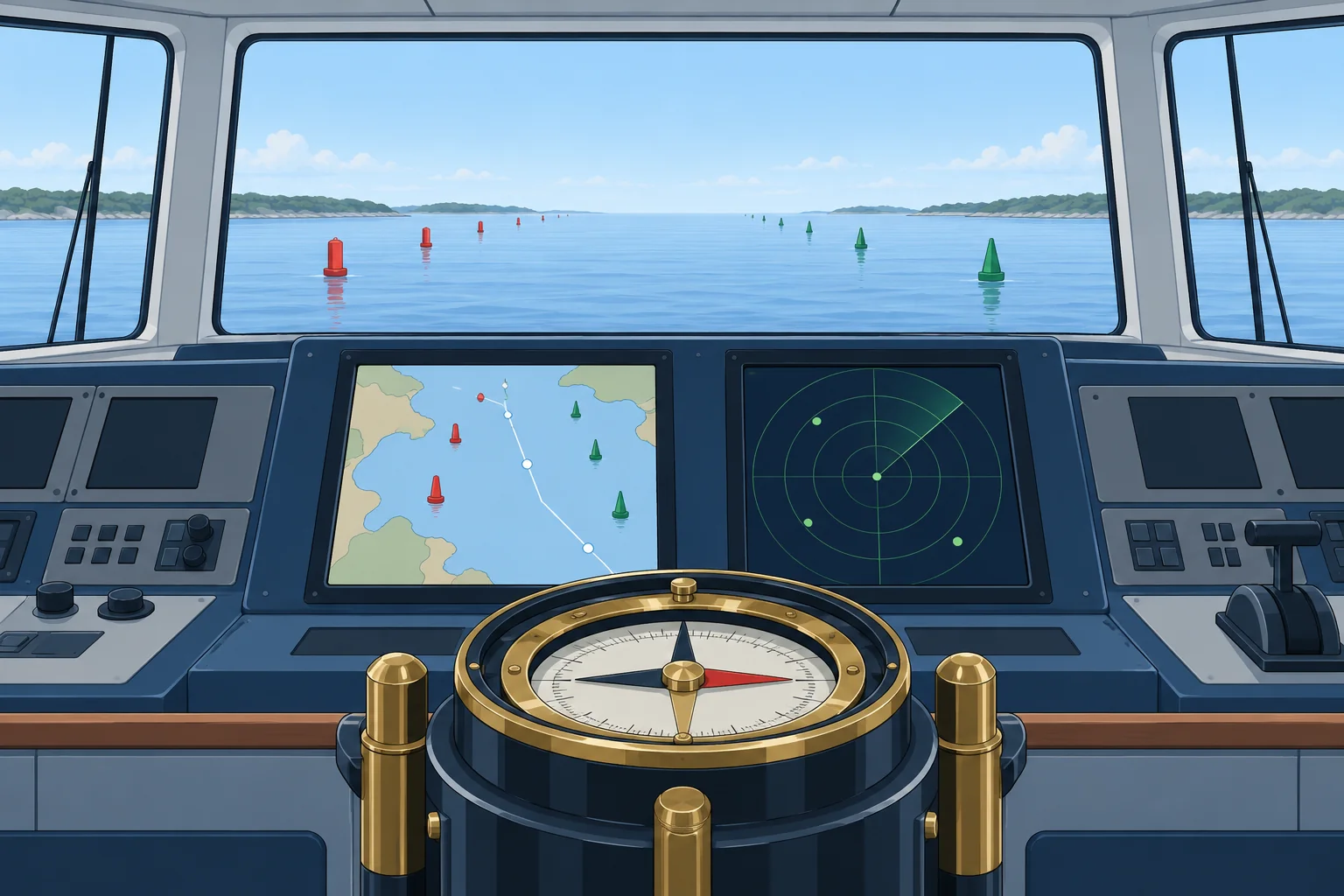
e-Navigation, S-100 and the new IALA
1The lesson in plain words
Aids to navigation are going digital. e-Navigation links ship and shore data, S-100 standards carry it, and IALA became an intergovernmental organisation in 2024.
e-Navigation
e-Navigation is the International Maritime Organization’s (IMO’s) approach to sharing and displaying navigation information electronically on ships and ashore. Common formats help you use information about marks, warnings, tides and traffic throughout a voyage.
S-100
S-100 is the International Hydrographic Organization’s (IHO’s) framework for marine data. A product specification defines one type of data. S-101 covers electronic navigational charts (ENCs). ECDIS means electronic chart display and information system. For new IMO-compliant ECDIS installations, S-100-capable standards are optional from 1 January 2026 and required from 1 January 2029. These dates do not require you to replace an existing ECDIS or leisure plotter.
AtoN specifications
S-201, in IALA’s S-200 series, supports aids-to-navigation data exchange between providers. S-125, a separate S-100 product specification, covers marine aids-to-navigation information for mariners, including status updates. Receiving those updates needs a supporting service and compatible equipment.
IALA becomes an IGO
On 22 August 2024 IALA changed from an association of lighthouse authorities into an intergovernmental organisation (IGO), under a convention ratified by 30 states. Its new name is the International Organization for Marine Aids to Navigation, and it kept the initials IALA. Its first General Assembly met in Singapore in February 2025.
What it means at sea
Digital marks add information but bring new risks: data can be wrong, late, spoofed or missing. Physical marks, lights and the official chart stay the base layer. If satellite positioning or a live data feed is unreliable, cross-check with radar observations, charted features and the magnetic compass, independently of that source.
2Key data
- e-Navigation
- IMO approach to sharing electronic navigation information
- S-100 ECDIS standards
- New installations: optional 1 Jan 2026; required 1 Jan 2029
- S-201
- Aids-to-navigation data exchange between authorities (IALA)
- S-125
- Marine aids-to-navigation information and status for mariners
- IALA’s status
- Intergovernmental organisation since 22 August 2024
- New name
- International Organization for Marine Aids to Navigation
3Key points
- 1
e-Navigation is IMO’s approach to sharing electronic navigation information.
- 2
S-100 is the IHO data framework; S-101 is the new ENC.
- 3
S-201 exchanges AtoN data between providers; S-125 supplies AtoN information and status for mariners.
- 4
IALA became an intergovernmental organisation on 22 August 2024.
4Frequent mistakes
Wrong: S-101 is a type of AIS aid to navigation.
Right: S-101 defines electronic navigational charts. S-201 exchanges AtoN data between providers; S-125 covers AtoN information for mariners. Both use S-100.
Wrong: Digital marks will soon replace buoys and lights.
Right: Physical marks and lights remain the base layer; digital data adds to them.
Wrong: IALA is still a private association of lighthouse services.
Right: Since 22 August 2024 it is an intergovernmental organisation, keeping the IALA initials.
5Practice case & exam keys
A live AtoN feed says a channel buoy is on station, but its light and radar echo disagree with its charted position. Your crew wants to follow the digital display. How do you decide?
Show the answer
Keep a safe margin in charted water. Check your position independently, then compare the chart, visible mark and radar echo. Allow for stale or faulty digital status. Resolve the discrepancy before committing to the channel, and report it to the relevant authority. COLREG Rule 5 still requires a proper lookout by sight and hearing.
Exam keys
- e-Navigation: IMO’s approach to sharing electronic navigation information.
- S-100 framework; S-101 ENC; S-201 provider exchange; S-125 AtoN information for mariners.
- IALA became an IGO on 22 August 2024, keeping its initials.
Finish this unit
When you've read it, match the terms, then answer three questions. Get them all right to finish the unit; opening the page alone doesn't count.
My notes for this unit
No notes