

Racons: marks that answer your radar
1The lesson in plain words
A racon answers your radar pulse with a Morse letter on the screen. It picks out a mark among the clutter and tells you which one it is.
What a racon is
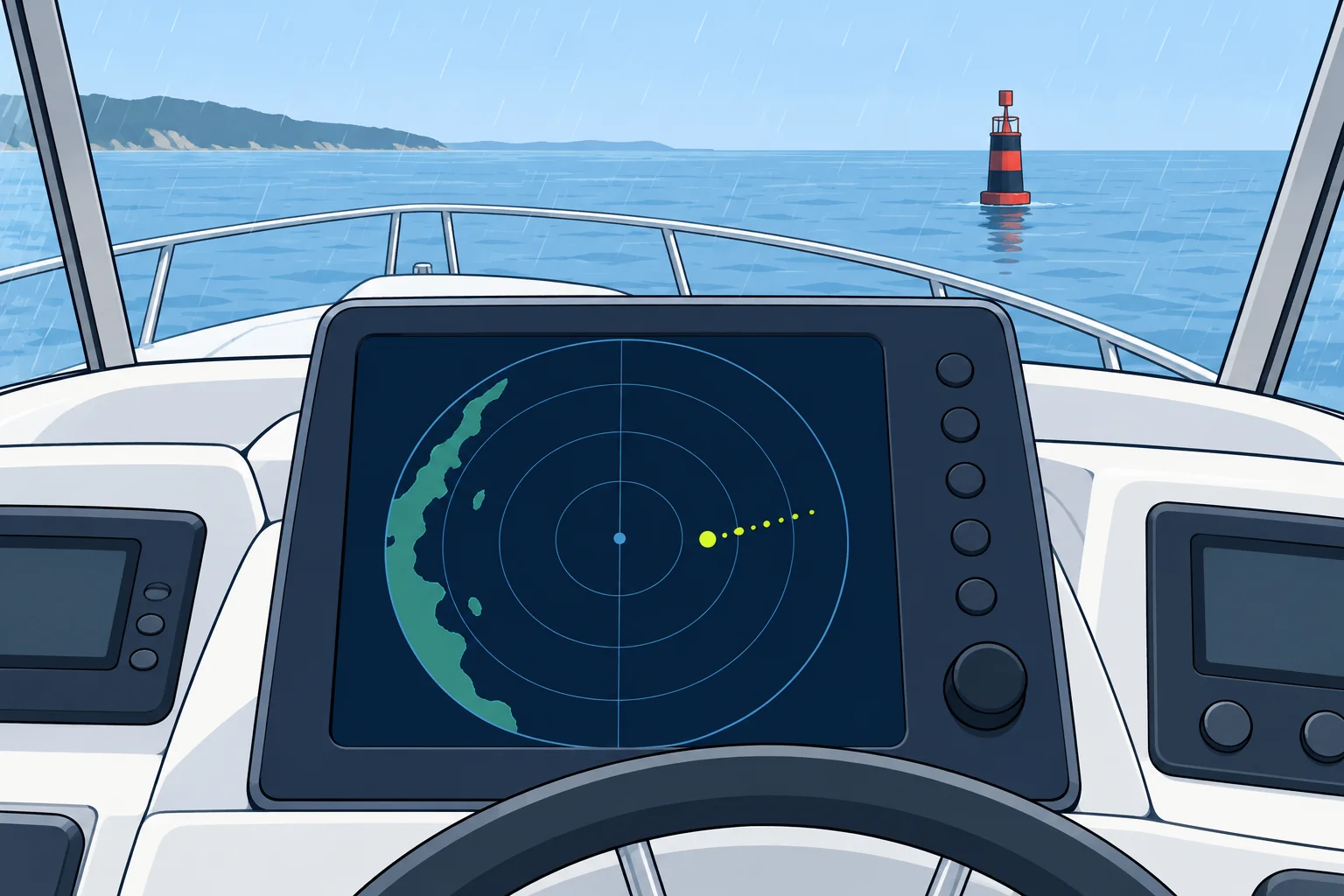
A racon (radar beacon) is a receiver-transmitter on a buoy, beacon, lighthouse or bridge. When your radar pulse reaches it, it replies on your radar’s own frequency. Your display then shows a short line of dots and dashes forming a Morse letter: the racon’s identifier, which the chart prints beside the mark, for example Racon (K).
How it looks
The response starts just beyond the mark’s echo, because the racon takes a moment to reply, and runs outward along the bearing, away from you, for a mile or more on screen. Racon identifiers normally begin with a dash; check the letter shown on the chart. The response gives the mark’s bearing. Measure range to the physical echo when available; the response’s near end gives an approximate range because the reply is delayed.
Bands and codes
Racons operate in X band (9300–9500 MHz, 3 cm), S band (2900–3100 MHz, 10 cm), or both. Check the published bands for that racon. Modern racons are frequency agile: they detect each radar pulse and reply at once on its frequency. Under IALA, a new danger may carry a racon transmitting Morse D (– · ·). Match the identifier to the chart; D is not globally reserved for new dangers.
When you cannot see it
The rain clutter control (anti-rain, or FTC) and some interference filters can hide a racon: turn them down briefly to look. A badly tuned receiver weakens it. At close range the response may smear. Unusual bending of radar waves in the atmosphere can produce misleading flashes. Check the published identifier over several scans and any transmission cycle, then cross-check the chart and other aids.
Solid-state radars
Many new small-craft radars are solid-state sets, using long, low-power pulses or a continuous sweep instead of the short, powerful pulses of traditional magnetron radars. They may show a racon weakly, oddly or not at all. Check your radar’s manual, and test it on a known racon before you rely on one.
2Key data
- Racon response
- Morse letter starting just beyond the mark’s echo
- Bands
- X band, S band, or both; check the published bands.
- Morse D (– · ·)
- IALA convention for a new danger, such as a recent wreck
- Can be hidden by
- Rain clutter control, interference filters, poor tuning
3Key points
- 1
A racon replies to your radar with a Morse letter just beyond the mark’s echo.
- 2
Racon identifiers normally start with a dash; under IALA, Morse D marks a new danger.
- 3
Rain clutter control can hide a racon; turn it down briefly to check.
- 4
Solid-state radars may not show racons well: test yours.
4Frequent mistakes
Wrong: The racon is at the far end of the Morse line.
Right: The mark is near the start of the response, not its far end. Use its physical echo for range when available.
Wrong: If no racon appears, the mark is missing.
Right: Check the clutter controls and tuning first. Some solid-state radars do not show racons.
5Practice case & exam keys
In rain at night you look for a charted buoy marked Racon (K). The screen shows heavy rain clutter and no Morse response. What do you check before deciding the buoy is missing?
Show the answer
Rain clutter control and interference filters can suppress a racon, so turn the rain control down briefly and look again on the expected bearing. Check the radar’s tuning. A solid-state radar may not show racons at all. Then cross-check with the buoy’s light, the depth and your position before concluding that the buoy is missing or out of position, and report it.
Exam keys
- Racon: radar beacon; charted Morse identifier beyond the echo.
- X band, S band, or both; modern racons are frequency agile.
- IALA new-danger convention: Morse D; check the charted identifier.
- Rain clutter control may suppress the response.
Finish this unit
When you've read it, match the terms, then answer three questions. Get them all right to finish the unit; opening the page alone doesn't count.
My notes for this unit
No notes