

Error chains, the Swiss cheese model and just culture
1The lesson in plain words
Accidents rarely have one cause. Break the chain early, find the holes in the defences, and report honestly in a just culture.
The error chain
An error chain is a sequence of events and decisions that contributes to an accident. Fatigue, outdated information, unsuitable equipment settings and an unchallenged order can combine. Interrupting the sequence can prevent harm. Check for other remaining hazards too.
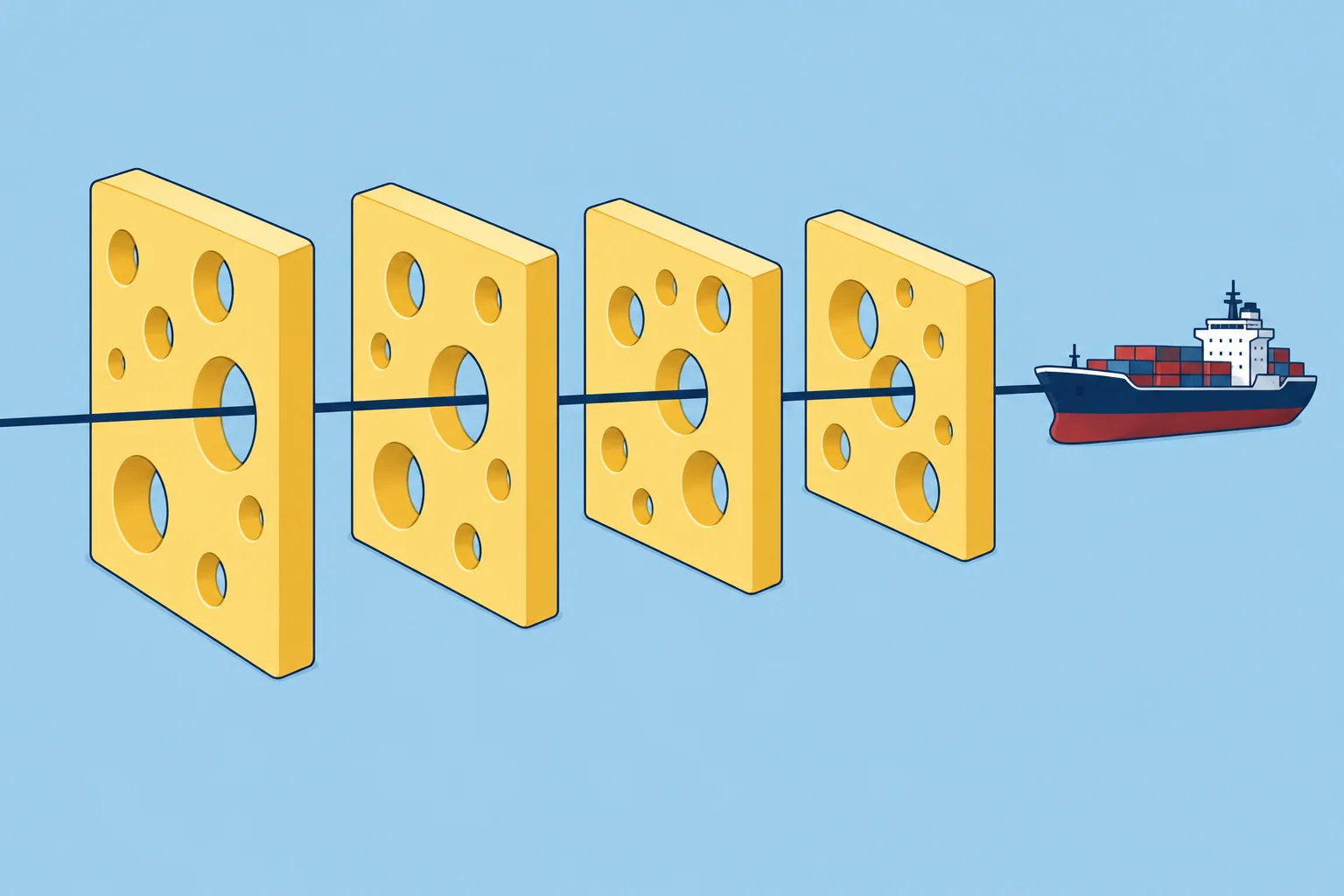
The Swiss cheese model
Psychologist James Reason pictured defences as slices of Swiss cheese. Each slice has holes. Active failures are unsafe acts by people at the sharp end, such as a missed check. Latent conditions are hidden weaknesses built in earlier, such as poor procedures, bad design, low manning or commercial pressure. An accident happens when holes in several slices line up. Fixing latent conditions protects against many future errors.
Kinds of error
A slip is a correct plan carried out wrongly, such as pressing the wrong button. A lapse is a memory failure, such as forgetting a step. A mistake is a wrong plan, from poor knowledge or a misread situation. A violation is a deliberate departure from a rule. It may be routine, a shortcut everyone takes, or exceptional. Each needs a different fix: design, checklists, training or supervision.
Just culture
A just culture encourages honest reporting and fair accountability. Distinguish unintentional error, risky shortcuts and reckless conduct. Examine intent, risk awareness, training, workable procedures and operating conditions before deciding the response. The ISM Code, section 9, requires reporting and analysis of accidents, hazardous situations and non-conformities. A near miss is an event that could have caused harm but did not. Near-miss reports show weaknesses before an accident.
2Key points
- 1
Breaking an error chain can prevent harm; check for remaining hazards.
- 2
Swiss cheese: active failures at the sharp end, latent conditions built in earlier.
- 3
Slips, lapses, mistakes and violations need different fixes.
- 4
Just culture: no blame for honest error, no tolerance for recklessness.
- 5
Report near misses; ISM section 9 requires reporting and analysis.
3Frequent mistakes
Wrong: After an accident, find the person who made the mistake and the job is done.
Right: Look for the latent conditions too: procedures, design, manning and pressure that set the person up to fail.
Wrong: A just culture means nobody is ever held accountable.
Right: Learn from honest errors and examine why rules were bypassed; reckless conduct can warrant discipline.
4Practice case & exam keys
During cargo work, a rating opens the wrong ballast valve. The valve labels had faded, the mimic diagram was out of date, and he was working alone at the end of a 14-hour day. The chief mate wants to give him a written warning. What do you advise?
Show the answer
Establish his intention and what happened before classifying the error or deciding on discipline. A correct plan carried out wrongly is a slip; a wrong plan is a mistake. Record the faded labels, outdated diagram and workload as contributing conditions. Report through the near-miss or incident procedure. Correct the labels and diagram, and review workload and checks before the task resumes.
Exam keys
- Error chain: connected contributing events; interrupting the sequence can prevent harm.
- Reason's Swiss cheese model: active failures and latent conditions.
- Error types: slip, lapse, mistake, violation.
- Just culture and near-miss reporting (ISM Code section 9).
Finish this unit
When you've read it, answer three questions. Get all three right to finish the unit; opening the page alone doesn't count.
My notes for this unit
No notes