

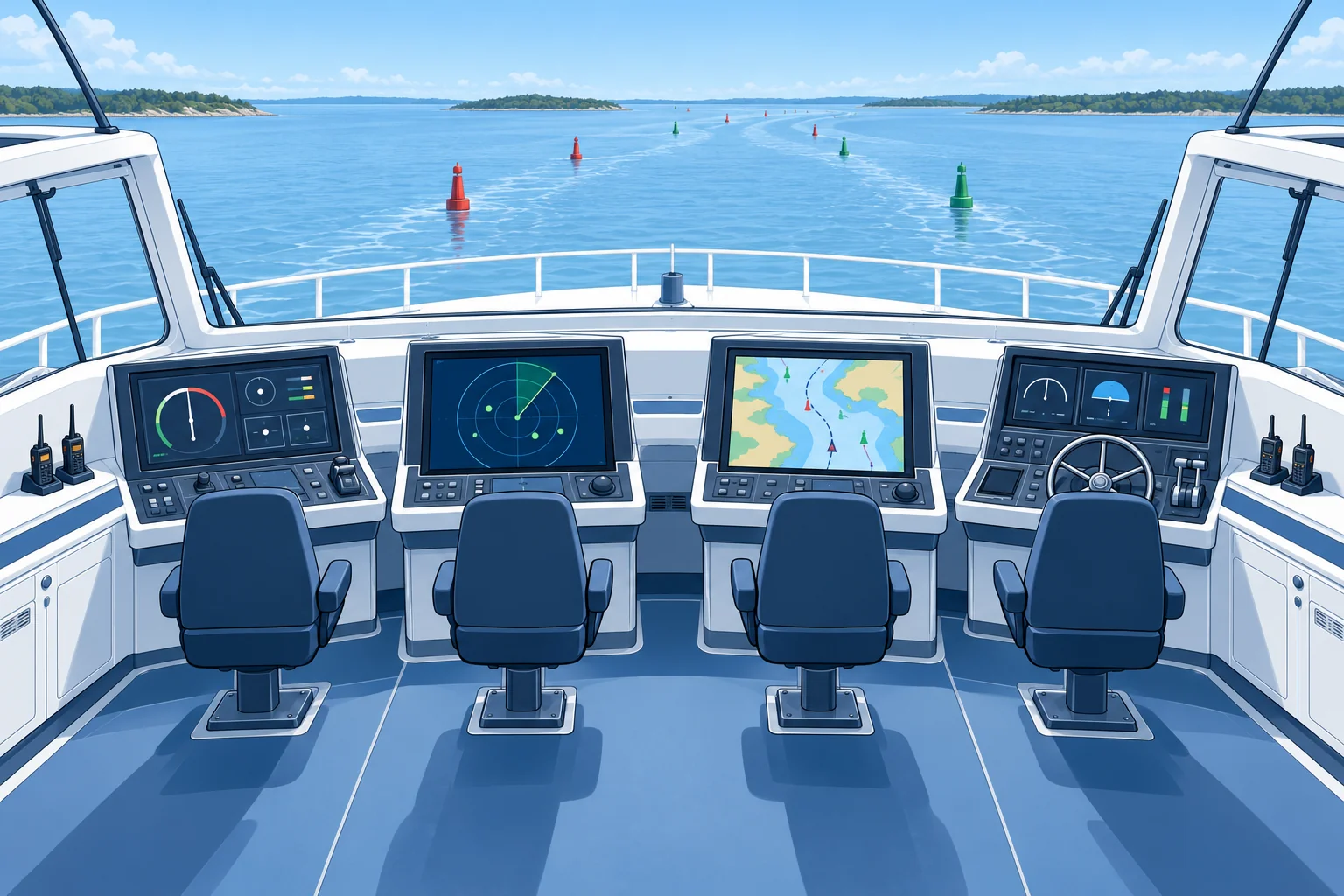
The bridge team: BRM, closed loops and challenge and response
1The lesson in plain words
A bridge team works when everyone shares the plan, repeats orders back, and speaks up when something looks wrong, whatever their rank.
What BRM means
Bridge resource management (BRM), also called bridge team management (BTM), is the use of all resources on the bridge: people, equipment and information. STCW table A-II/1 makes it part of the OOW's competence: allocating and prioritising resources, communicating, being assertive and leading, and keeping situational awareness. Situational awareness means knowing what is going on around you; human factors covers it in depth. BRM aims to catch one person's error before it becomes an accident.
Roles
A typical team in pilotage waters: the master holds the con or oversees; the OOW monitors position and traffic and keeps the log; the helmsperson steers; the look-out reports; the pilot advises. Each role is stated in the briefing before arrival or departure. The navigator role is to monitor the ship's position against the plan and call out any deviation.
Shared mental model
Before a critical stage, brief everyone on the route, turns, traffic and roles. Set limits such as minimum under-keel clearance (water beneath the keel) and maximum cross-track distance (distance sideways from the planned track). Agree abort points, where you stop or change the operation if limits cannot be met. This creates a shared mental model: everyone understands the same plan and can spot deviations.
Closed-loop communication
In a closed loop, you give an instruction, hear the read-back and correct any error. The receiver acts and reports completion; you acknowledge. For example: "Check our position." "Check our position." "Position checked; we are on track." "Understood." Use the IMO Standard Marine Communication Phrases (SMCP) where applicable, with names and short, clear phrases. Never assume an instruction was heard.
Challenge and response
Any team member who sees a problem must speak up: name the person, state the fact, say the risk, propose an action. 'Master, our cross-track distance exceeds the agreed limit. We risk leaving safe water; I recommend following our briefed contingency.' If there is no response, repeat it more firmly. The leader welcomes challenges and answers them. Escalate and take immediate safety action when needed.
2Step by step
Challenge and response, step by step
- 1
Get the person's attention by name or rank.
A challenge nobody hears is no challenge.
- 2
State what you see as a fact, with numbers.
Facts are harder to dismiss than feelings.
- 3
Say the risk you think it creates.
The other person may not have made the link.
- 4
Propose a clear action.
A proposal gives the leader something to accept or reject at once.
- 5
Seek an answer and escalate; take immediate safety action if needed.
Silence is not agreement, and time is short.
3Key points
- 1
BRM uses all people, equipment and information on the bridge to catch errors early.
- 2
Brief the plan, limits and roles so the team holds a shared mental model.
- 3
Closed loop: instruction, read-back, correction if needed, action, report, acknowledgement.
- 4
Anyone may challenge: name, fact, risk, proposed action, answer.
- 5
State who has the con and who monitors position and traffic before each critical stage.
4Frequent mistakes
Wrong: Juniors should not question the master or the pilot.
Right: Everyone must speak up with facts. A good leader expects and answers challenges.
Wrong: A briefing is only needed for the pilot.
Right: Brief the whole team on route, limits, abort points and roles before each critical stage.
Wrong: If a team member acts, there is no need to hear the read-back.
Right: Read-back exposes a misheard instruction. Check it and correct any error before action.
5Practice case & exam keys
Departure briefing done. Halfway down the channel the master orders a turn to port. You see on the electronic chart that the planned position for starting the turn is still 0.4 nautical miles ahead. The helmsperson repeats the order. What do you do?
Show the answer
Challenge now: "Master, the planned start of the turn is still 0.4 nautical miles ahead. We are turning early; I suggest stopping the turn." Seek a clear answer and check any revised plan against the position and agreed limits. If unanswered, repeat firmly. If danger becomes immediate, take or ensure the necessary safety action and state it aloud. Keep monitoring; repeated challenges must never delay urgent action.
Exam keys
- BRM/BTM: allocation, prioritisation, communication, assertiveness, leadership, situational awareness (STCW A-II/1).
- Briefings create a shared mental model of route, limits, abort points and roles.
- Closed-loop communication with SMCP phrases.
- Challenge and response: name, fact, risk, action, answer.
Finish this unit
When you've read it, answer three questions. Get all three right to finish the unit; opening the page alone doesn't count.
My notes for this unit
No notes