

Nursing the sick and injured on board
1The lesson in plain words
A patient may stay in your care for days. Good nursing, careful charts and simple comfort prevent complications and give the radio doctor reliable facts.
The ship’s hospital
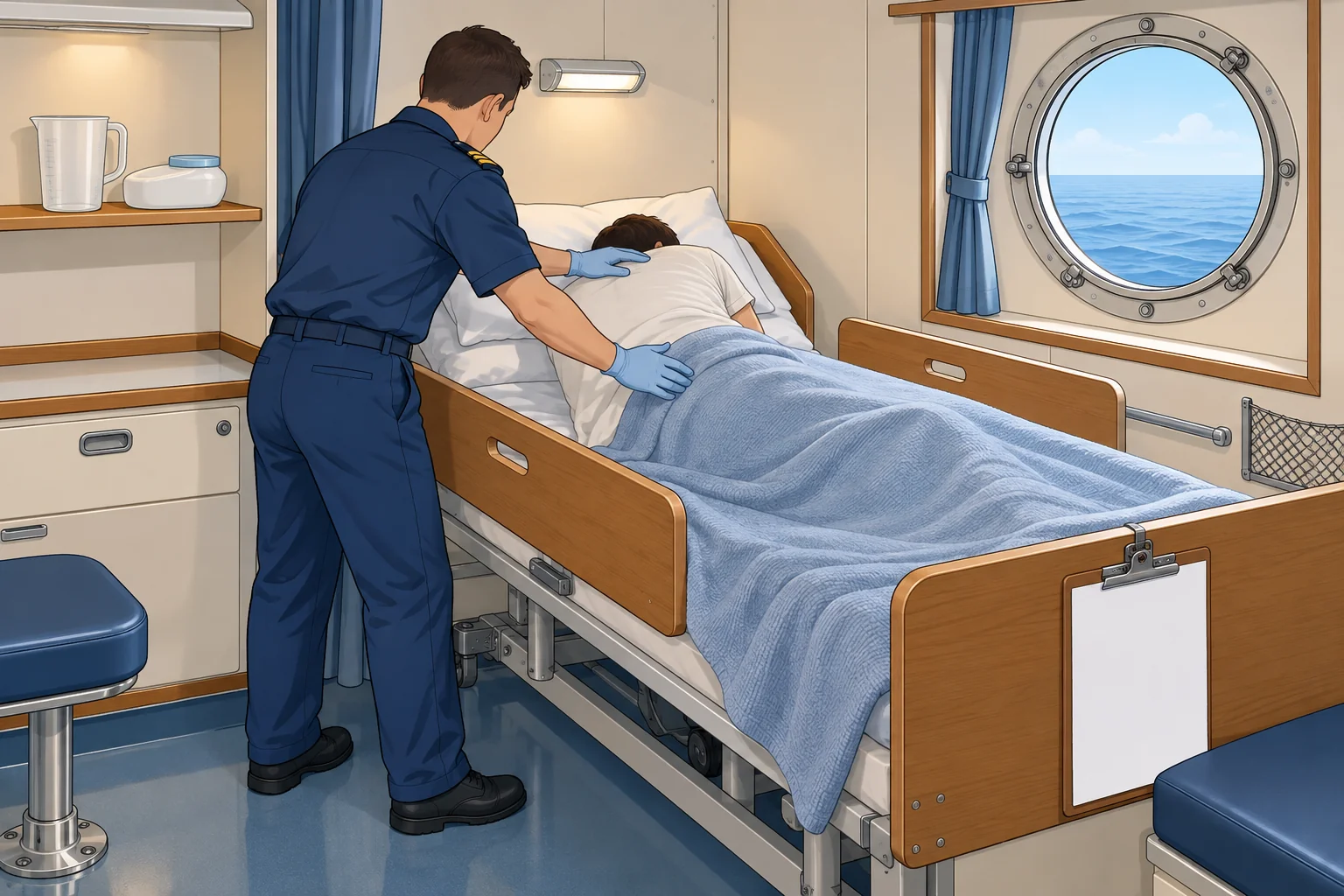
Ships carrying 15 or more seafarers on voyages over three days must have separate hospital accommodation under the Maritime Labour Convention (MLC), Standard A3.1. The competent authority may relax this requirement for coastal trade. Keep it clean, ready and never used as a store. Nurse a patient there, or in a cabin, with a call bell or regular checks, good light and fresh air, a bowl and urine bottle, and a way to keep them safely in the bunk in bad weather.
Observation charts
An observation chart records pulse, breathing, blood pressure, oxygen saturation, temperature, consciousness and pain, each with the time. The radio doctor sets how often: every 15 minutes for a seriously ill patient, perhaps every 4 hours for a stable one. Note new symptoms, vomiting, bowel movements and medicines on the same sheet. Trends, such as a pulse rising over several readings, warn you early.
Fluid balance
A fluid balance chart records measured intake and urine, vomit and diarrhoea in millilitres, with 24-hour totals. Record unmeasured losses separately. Adult urine output below about 0.5 ml/kg/h is a warning. Dehydration is one possible cause; poor circulation, kidney injury or retention can also reduce output. Retention means urine cannot leave the bladder. Report low output, colour changes and trends promptly. Give fluids only as advised: low urine output alone does not tell you how much fluid is safe.
Pressure care and moving
A patient who lies still can develop pressure sores: skin that breaks down under constant pressure over bony points such as the base of the spine, hips, heels, shoulders and elbows. Help them change position at least every 2 hours, keep the sheets dry and smooth, and check the skin daily. Encourage leg movements and deep breathing to prevent blood clots and chest infection. Raise the head end for breathlessness.
Hygiene and dignity
Wash your hands before and after every contact. Give a daily bed bath, mouth care and help with the toilet, in privacy. Offer light food and drinks as the doctor allows. Explain what you are doing and keep the patient informed. Keep medical information confidential: tell other crew only what they need to know for safety and work.
2Key data
- Hospital accommodation
- 15+ seafarers, >3 days; coastal relaxation may apply (MLC A3.1)
- Observations
- As the doctor asks: e.g. 15-minutely if serious, 4-hourly if stable
- Fluid balance
- Measured intake and output in ml; note unmeasured losses separately
- Urine output
- Below about 0.5 ml/kg/h in an adult: report promptly
- Pressure care
- Change position at least every 2 hours; check skin daily
3Key points
- 1
Keep the ship’s hospital clean, equipped and ready; it is not a store.
- 2
Chart observations with the time, as often as the doctor asks.
- 3
Chart measured intake and output in millilitres over 24 hours; note unmeasured losses separately.
- 4
Turn a bedbound patient at least every 2 hours and check the skin daily.
- 5
Hand hygiene before and after every contact; protect privacy and confidentiality.
4Frequent mistakes
Wrong: Estimate how much the patient drank.
Right: Measure drinks in millilitres with a jug. Clearly mark any estimates and note losses you could not measure.
Wrong: Let a weak patient lie without moving for days.
Right: Turn them at least every 2 hours and encourage leg movement to prevent sores, clots and chest infection.
Wrong: Jot observations on scraps and copy them later.
Right: Write each set straight onto the chart with the time, so the trend is clear.
5Practice case & exam keys
A cadet with vomiting and diarrhoea has been in the hospital for 24 hours. The chart shows 1,800 ml in by mouth and 2,900 ml out, including only 300 ml of dark urine in the last 12 hours. He weighs 65 kg. What does this tell you and what do you do?
Show the answer
The recorded balance is minus 1,100 ml; it is not an exact measure of total dehydration. Urine output averages 25 ml/hour over the last 12 hours, below 32.5 ml/hour for 65 kg. Report both figures and the trend promptly to the radio doctor. Keep measuring intake and output, chart timed observations and follow the agreed monitoring and fluid plan. Record any losses you could not measure.
Exam keys
- Hospital accommodation: 15+ seafarers, voyages over 3 days (MLC A3.1); coastal-trade relaxation may apply.
- Observation chart: vital signs with times, at the frequency the doctor sets.
- Fluid balance: measured ml over 24 h, unmeasured losses noted; adult urine below about 0.5 ml/kg/h needs advice.
- Pressure care: reposition at least every 2 hours; check the skin daily.
Finish this unit
When you've read it, answer three questions. Get all three right to finish the unit; opening the page alone doesn't count.
My notes for this unit
No notes