

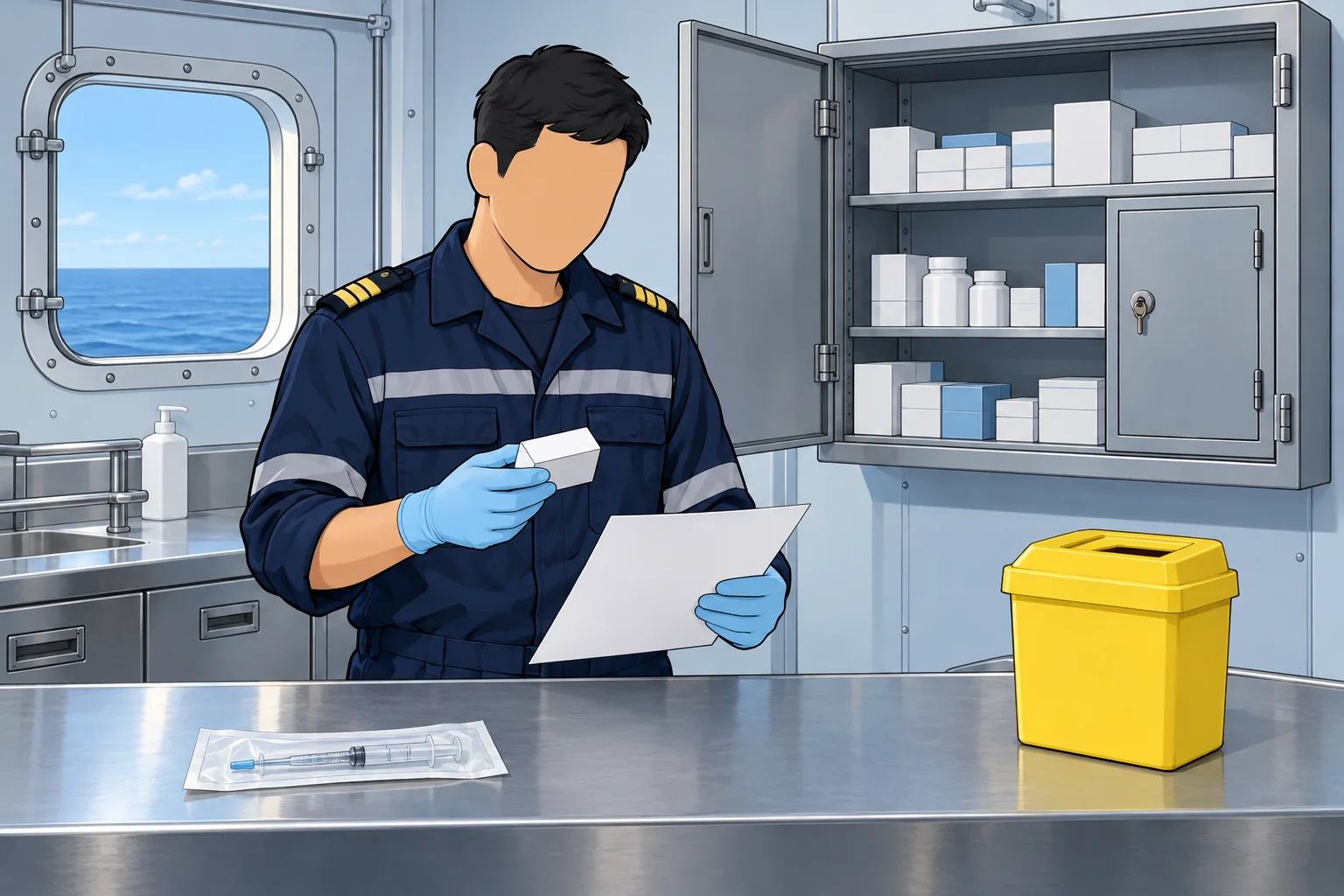
Giving medicines safely: routes, injections and the controlled drugs register
1The lesson in plain words
Give prescription medicines only on radio medical advice. Check the five rights, use the agreed route and record each dose. Lock and account for controlled drugs.
On radio medical advice
Prescription medicines from the ship’s chest are given only on radio medical advice: the doctor chooses the medicine, dose, route and timing from your medicine list. The ship’s guide explains how each medicine works, its side effects and how to give it; it is not a licence to prescribe. Before every dose, ask about allergies and other medicines, and about pregnancy where relevant.
The five rights
Check the five rights before every dose: the right patient, the right medicine (generic name and strength), the right dose, the right route and the right time. Read the label three times: when you take it out, when you prepare it and before you give it. Check the expiry date and that it looks normal. If anything does not match, stop and ask. Then record it.
Routes
Oral medicines are swallowed; sublingual ones dissolve under the tongue; inhaled ones are breathed in; topical ones go on the skin or eye; rectal medicines go into the rectum. An intramuscular injection goes into muscle; a subcutaneous one into fat under the skin; intravenous medicines go into a vein. For every injection, use the medicine-specific site, anatomical landmarks and technique taught in practical training and confirmed by the radio doctor. Landmarks are body features used to locate the site.
Giving an injection
Give injections only if trained and authorised, on radio medical advice. Check the five rights and allergies. Wash your hands, wear gloves and use a new sterile needle and syringe. Use aseptic technique: keep sterile parts untouched. Follow product instructions, including any air bubble in a prefilled syringe. Clean the skin and let it dry. Use your trained site, landmarks and technique. Bring a rigid sharps box to the patient; discard equipment immediately without recapping. Observe and record reactions; have emergency equipment ready.
Controlled drugs
Controlled drugs, such as morphine, are legally restricted. Keep them in a separate locked cupboard inside the medicine chest; the master controls the key. Enter every receipt, dose, broken ampoule and disposal in the controlled drugs register: date, time, quantity, patient, who ordered it, who gave it and the balance. Check the stock regularly with a witness. Follow your flag’s rules, for example keeping the register for two years after the last entry.
2Key data
- Prescription medicines
- Only on radio medical advice
- Five rights
- Patient, medicine, dose, route, time; then record
- Label check
- Three times: taking out, preparing, before giving
- Intramuscular sites
- Use trained landmarks and medicine-specific medical instructions
- Used needles
- Never recap; straight into the sharps box
- Controlled drugs register
- Every receipt, dose, loss and disposal; e.g. kept 2 years
3Key points
- 1
Prescription medicines are given only on radio medical advice.
- 2
Check the five rights and read the label three times before every dose.
- 3
Ask about allergies and other medicines before you give anything.
- 4
Never recap a needle: take the sharps box to the patient.
- 5
Record every controlled drug movement, including broken ampoules, with a witness.
4Frequent mistakes
Wrong: Use the guide’s usual dose when radio contact is poor.
Right: Keep trying the maritime rescue coordination centre (MRCC) and other channels: prescription medicines need radio medical advice.
Wrong: Recap the needle carefully before carrying it to the bin.
Right: Recapping causes needle-stick injuries. Take the sharps box to the patient.
Wrong: A broken morphine ampoule does not need recording.
Right: Record it in the register with a witness: every ampoule must be accounted for.
5Practice case & exam keys
The radio doctor advises an intramuscular painkiller for a crew member with a broken ankle. Preparing it, the officer finds two strengths of the medicine in the chest, and one box expired last month. What should happen?
Show the answer
Stop before preparing it. Confirm the strength with the doctor using the generic name and strength from the list. Use the in-date box; set the expired one aside for return ashore. Check the five rights and allergies. Read the label three times. Inject only within your training, using the instructed site and landmarks; discard equipment into the sharps box. Record medicine, dose, route, time, who gave it and the response; enter controlled drugs in the register too.
Exam keys
- Prescription medicines only on radio medical advice.
- Five rights: patient, medicine, dose, route, time; label read three times; record.
- Injections: trained route, site and landmarks; sterile equipment and aseptic handling; never recap.
- Controlled drugs: locked inner cupboard, register of every movement, witness checks.
Finish this unit
When you've read it, answer three questions. Get all three right to finish the unit; opening the page alone doesn't count.
My notes for this unit
No notes