

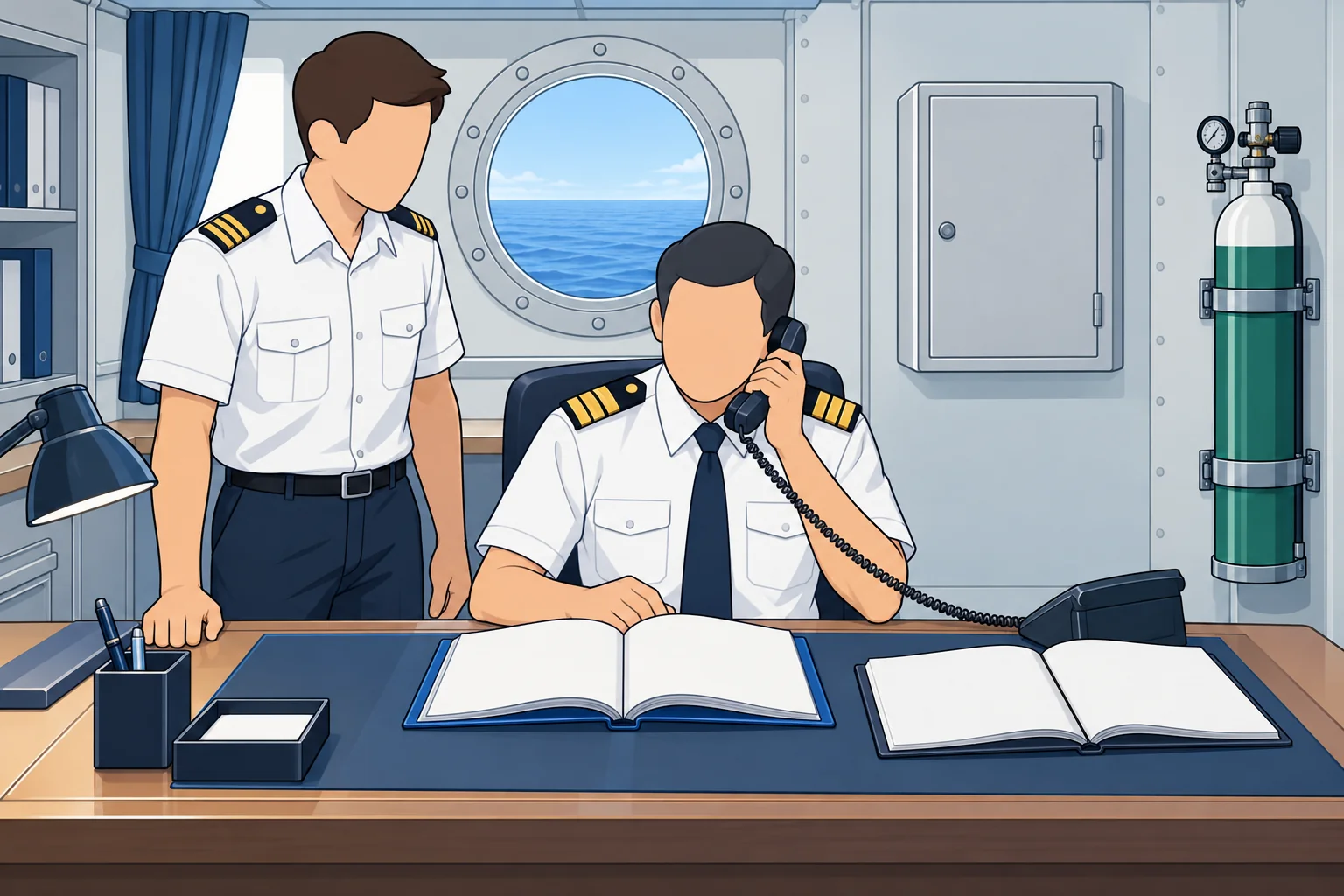
The master’s medical responsibilities: MLC 2006, the medicine chest and radio advice
1The lesson in plain words
The master is responsible for medical care on board. MLC 2006 and STCW set the minimum: chest, guide, trained people, free radio advice and records.
MLC 2006 Regulation 4.1
The Maritime Labour Convention (MLC) 2006, Regulation 4.1 and Standard A4.1, requires prompt medical care on board, as close as possible to care ashore. Every ship carries a medicine chest, medical equipment and a medical guide, as the flag State specifies and inspects. Ships carrying 100 or more persons and ordinarily engaged on international voyages lasting over three days must carry a qualified doctor. Otherwise carry a designated medical-care seafarer or, where the flag State permits, a seafarer competent in medical first aid.
Who does what
Under STCW Regulation VI/4, a seafarer designated to provide medical care holds the Medical Care certificate (Code A-VI/4-2); designated first-aiders hold Medical First Aid (A-VI/4-1). The master designates them, often the master or the chief mate, and stays responsible. Many flags require a refresher about every five years. The person in charge of medical care keeps the chest, records and hospital ready and leads the care, with radio medical advice.
The chest and the guide
The flag State sets chest contents. Check the WHO International Medical Guide for Ships (IMGS) medicine list and 2010 Quantification Addendum against flag requirements. For dangerous-goods carriage, check the Medical First Aid Guide for Use in Accidents Involving Dangerous Goods (MFAG) for additional supplies. MLC guidance asks for inspection at intervals no longer than 12 months: labels, expiry dates, storage and instructions. Restock after use and return expired medicines ashore. The IMGS 3rd edition (2007) remains current; check flag notices for updates.
Records
Keep the medical log: every illness and injury and its treatment. Use the standard medical report form (MLC Standard A4.1), kept confidential, for exchanges with doctors ashore. Keep the controlled drugs register and the record of chest inspections. These records serve the patient, port health, claims and investigations; keep them as long as your flag requires.
Radio medical advice at master level
MLC requires free medical advice by radio or satellite, 24 hours a day, including specialist advice. Ensure a competent officer can make the call. Weigh advice against the voyage and weather. Decide on diversion, rendezvous or evacuation with the telemedical assistance service (TMAS) doctor and maritime rescue coordination centre (MRCC). Seek advice early. If diversion is needed, act promptly: night or bad weather can make evacuation riskier.
2Key data
- Doctor required
- 100+ persons; ordinarily on international voyages over 3 days
- Without a doctor
- Medical Care or Medical First Aid, as the flag requires
- Chest inspection
- At least every 12 months (MLC Guideline B4.1.1)
- IMGS
- 3rd edition 2007 + 2010 addendum; 4th edition in progress
- Radio medical advice
- Free, 24 hours a day, including specialists (MLC A4.1)
- Records
- Medical log, report form, drug register, chest inspection records
3Key points
- 1
Every ship carries a medicine chest, equipment and a medical guide set by the flag State.
- 2
Ships carrying 100+ persons and ordinarily on international voyages over three days must carry a qualified doctor.
- 3
Without a doctor, carry a designated medical-care or first-aid seafarer, as the flag requires.
- 4
Arrange chest inspections at intervals no longer than 12 months under flag rules; check and restock after use.
- 5
The master decides on diversion or evacuation with the TMAS doctor and the MRCC.
4Frequent mistakes
Wrong: Medical care is the designated officer’s business, not the master’s.
Right: The master designates the people and remains responsible for medical care on board.
Wrong: Check the medicine chest only when something is missing.
Right: Inspect it at least every 12 months and restock after every use.
Wrong: Delay a diversion until the patient is clearly worse.
Right: Seek advice early and act promptly on the agreed plan; delay can leave only a risky night or bad-weather evacuation.
5Practice case & exam keys
You are 450 nautical miles from the nearest port. The radio doctor suspects a heart attack and advises evacuation. The MRCC says no helicopter can reach you. The port has a hospital, 30 hours away at an estimated safe average speed of 15 knots. As master, what do you do?
Show the answer
Agree a plan with the TMAS doctor and the MRCC: divert at best safe speed towards the port, and ask about a rendezvous with a ship carrying a doctor, or a helicopter once in range. Make sure the person in charge of medical care gives oxygen and medicines only as advised, charts observations and reports at agreed times. Log the diversion and inform the company; the master’s discretion for safety (SOLAS V/34-1) protects the decision.
Exam keys
- MLC Reg. 4.1 / Standard A4.1: chest, equipment and guide on every ship; free 24 h radio advice.
- Doctor: 100+ persons, ordinarily on international voyages over 3 days; otherwise Medical Care or Medical First Aid as the flag requires.
- Chest inspected at least every 12 months; IMGS 3rd edition (2007) and 2010 addendum.
- Master decides on diversion and evacuation with the TMAS doctor and the MRCC.
Finish this unit
When you've read it, answer three questions. Get all three right to finish the unit; opening the page alone doesn't count.
My notes for this unit
No notes