

Crew health, allergies and the adrenaline auto-injector
1The lesson in plain words
Know each crew member’s conditions, medicines and allergies before you sail. Anyone with a severe allergy carries two adrenaline auto-injectors.
Ask before you sail
Before a passage, ask every crew member, in private, about medical conditions, regular medicines and allergies, and write it on a confidential crew health form kept with the medical kit. Conditions such as diabetes, epilepsy, asthma, heart disease or a severe allergy change your plans and your kit. The radio doctor will ask for this information.
Bring your own medicines
Crew members bring enough of their own prescription medicines for the whole trip plus extra for delays, in their original packs and in hand luggage, with a copy of the prescription. Seasickness can stop tablets being absorbed, and some medicines interact with seasickness tablets: they should ask their pharmacist.
Anaphylaxis
Anaphylaxis is a severe, life-threatening allergic reaction, for example to a wasp sting, nuts, shellfish or a medicine. Suspect it after sudden tongue or throat swelling, a hoarse voice, breathing difficulty or persistent faintness/collapse after a likely allergen (allergy trigger). Lip swelling alone does not establish anaphylaxis. A rash may be absent. Treat suspected anaphylaxis at once with adrenaline and call for help.
The auto-injector
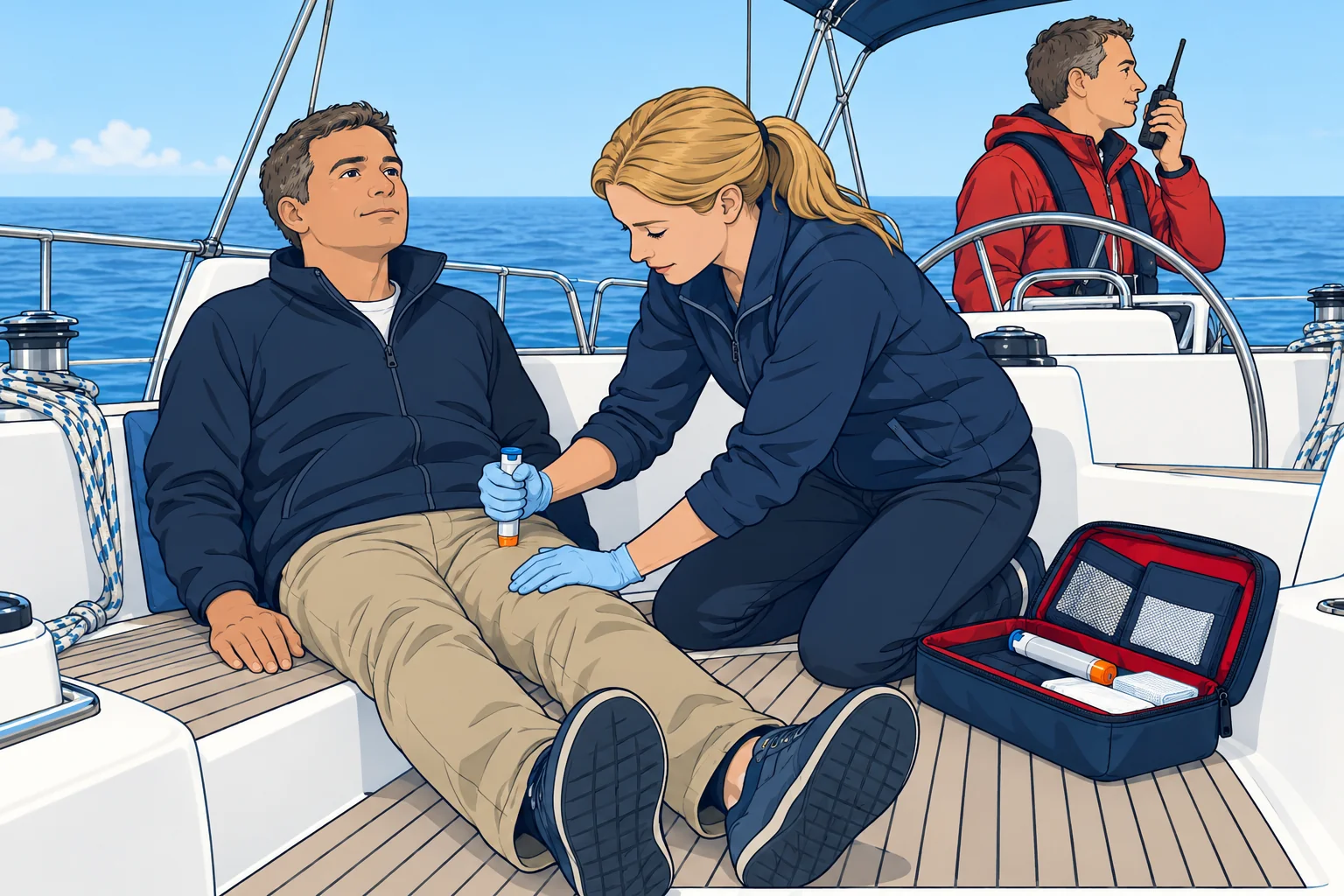
An adrenaline auto-injector is a pen that injects a fixed dose into the outer thigh, through clothing if needed. Follow the instructions on the pen; you hold it in place for a few seconds. Give a second one if airway, breathing or circulation problems persist after 5 minutes, ideally in the other leg. People at risk should carry two; check the expiry dates before you sail.
Position and after
Lay the casualty flat with the legs raised. If breathing is hard, let them sit up with legs out in front. Do not let them stand or walk, even if they feel better: this can cause collapse. If they become unresponsive but breathe normally, use the recovery position; if they are not breathing normally, start cardiopulmonary resuscitation (CPR). Every casualty given adrenaline needs hospital care, because the reaction can return.
2Step by step
Anaphylaxis: using the auto-injector
- 1
Suspect anaphylaxis after sudden tongue or throat swelling, a hoarse voice, breathing difficulty or persistent faintness/collapse after a likely allergen. Lay them flat with legs raised; if breathing is difficult, allow sitting with legs outstretched. Never let them stand or walk.
Anaphylaxis can kill within minutes. Standing can cause sudden collapse.
- 2
Give the adrenaline auto-injector immediately into the outer thigh, following the pen’s instructions.
Adrenaline reverses the swelling and the drop in blood pressure.
- 3
Call for emergency help and get radio medical advice.
The reaction can return and needs hospital care.
- 4
Give the second auto-injector if airway, breathing or circulation problems persist after 5 minutes.
One dose is not always enough, even if there has been some improvement.
- 5
If they become unresponsive and are not breathing normally, start CPR.
Severe anaphylaxis can cause cardiac arrest.
3Key data
- Before sailing
- Confidential crew health form
- Own medicines
- Whole trip plus extra, original packs
- Auto-injector
- Outer thigh, through clothing if needed
- Second dose
- After 5 minutes if serious symptoms persist; carry two
- Position
- Flat, legs raised; sit up if breathing is hard
4Key points
- 1
Collect a confidential crew health form: conditions, medicines, allergies.
- 2
Crew bring their own medicines for the trip plus extra.
- 3
Suspect anaphylaxis with throat swelling, breathing difficulty or collapse after an allergy trigger. Give adrenaline.
- 4
Outer thigh; repeat after 5 minutes if airway, breathing or circulation problems persist.
- 5
Lie flat with legs raised; never let them stand; hospital afterwards.
5Frequent mistakes
Wrong: Wait for throat swelling or breathing difficulty to get worse before using the auto-injector.
Right: Use it at once. Anaphylaxis can kill within minutes.
Wrong: After the injection she feels better, so let her walk below to rest.
Right: Keep her lying flat with legs raised. Let her sit up only if breathing is difficult. Do not let her stand or walk.
Wrong: One auto-injector is enough for a long passage.
Right: People at risk should carry two, in date, and the crew should know where they are.
6Practice case & exam keys
At anchor, a guest who told you she is allergic to wasps is stung on the arm. Within minutes her lips swell, her voice becomes hoarse and she says she feels faint. Her auto-injector is in her bag.
Show the answer
Lay her flat with legs raised; if breathing is difficult, let her sit with legs outstretched. Give her auto-injector immediately into the outer thigh, following its instructions. Do not let her stand or walk. Call for emergency help and radio medical advice. Give the second pen if airway, breathing or circulation problems persist after 5 minutes. She needs hospital care.
Exam keys
- Confidential crew health form before sailing.
- Anaphylaxis: airway swelling, breathing or circulation problems after a trigger.
- Adrenaline auto-injector: outer thigh; repeat if airway, breathing or circulation problems persist after 5 minutes.
- Lie flat, legs raised; sit with legs out only if breathing is difficult; never stand; hospital care afterwards.
Finish this unit
When you've read it, answer three questions. Get all three right to finish the unit; opening the page alone doesn't count.
My notes for this unit
No notes