

What to have ready, and recording the advice
1The lesson in plain words
The doctor cannot see your patient. Clear, ordered information lets them help you, and a written log keeps the treatment safe over hours or days.
Use a form
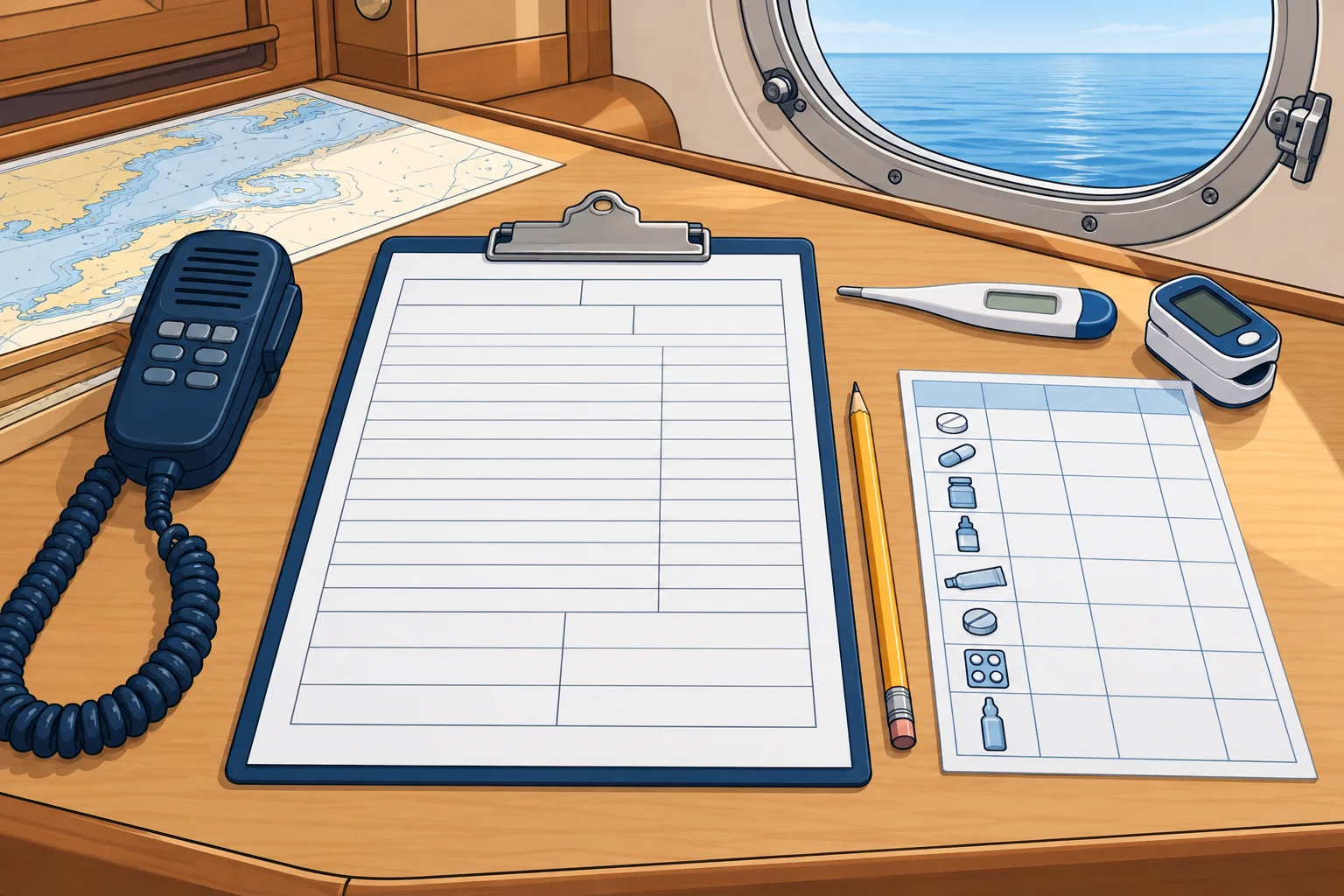
Ships’ medical guides contain a medical report form for radio calls: the World Health Organization (WHO) International Medical Guide for Ships (3rd edition), the UK Ship Captain’s Medical Guide and the Spanish Guía sanitaria a bordo. Keep a blank form with the medicine chest. For a stable patient, prepare it before the consultation. Never delay an urgent call to complete it; gather and send missing details while help is arranged.
About the boat
Have ready the boat's name, call sign and MMSI; your position, course and speed; the nearest port and how long to reach it; the weather and sea; and the number and medical training of the crew. The coastguard needs these to plan a possible evacuation.
About the patient
Age, sex and approximate weight. The main complaint: what is wrong, when it started and how it changed. What happened, if there was an injury. Known illnesses, allergies and regular medicines. What you have done and given, with times and doses. Then the vital signs with the time you took them; the next lesson shows how.
What you can offer
Tell the doctor which medicines and equipment you carry. Keep a list of the medicine chest, with names and strengths, next to the form. The doctor can only prescribe what you have aboard. If you can send photos, for example of a wound or rash, ask; it can help.
Write it all down
Write down the doctor's advice as you hear it, then read it back to check. Agree when you will call again, and what change should make you call sooner. Record every treatment, medicine, dose and time in the treatment record described in The medicine chest, with new vital signs at each step.
2Key data
- Forms
- WHO IMGS 3rd ed.; Ship Captain's Medical Guide; Guía sanitaria a bordo
- Boat
- Name, call sign, MMSI, position, nearest port, weather, crew
- Patient
- Age, sex, weight, complaint, history, allergies, medicines
- Also
- Treatment given with times, vital signs, medicine chest list
- After the call
- Read back advice; agree next call time; log every step
3Key points
- 1
Prepare a medical report form, but never delay an urgent call to finish it.
- 2
Give boat details and position: the coastguard plans any evacuation from them.
- 3
Patient: complaint, history, allergies, medicines, treatment given, vital signs.
- 4
Have your medicine chest list ready: the doctor prescribes from what you carry.
- 5
Read back the advice, agree the next call, and log every step.
4Frequent mistakes
Wrong: Delay an urgent call until every box is complete.
Right: Call promptly with your position and main concern. Gather and pass on the remaining details while help is arranged.
Wrong: Remember the doctor's advice; there is no need to write it down.
Right: Write it down and read it back. Treatment over hours or days depends on an accurate record.
5Practice case & exam keys
The doctor asks when pain relief was given. Your crewmate remembers 14:00; the treatment record says 14:30. The next dose depends on that time. What do you say and record?
Show the answer
Tell the doctor there is a timing discrepancy; do not guess. Check the written record with the person who gave the medicine. Read back the confirmed medicine, strength, dose and time, or state what remains uncertain. Record the advice and agree the next call and any reason to call sooner.
Exam keys
- Use the ship’s medical report form; urgent contact comes before completing paperwork.
- Boat details, position, nearest port, weather, crew training.
- Patient details, history, allergies, medicines, treatment given, vital signs with times.
- Read back the advice, agree the next call, keep a treatment record.
Finish this unit
When you've read it, answer three questions. Get all three right to finish the unit; opening the page alone doesn't count.
My notes for this unit
No notes