

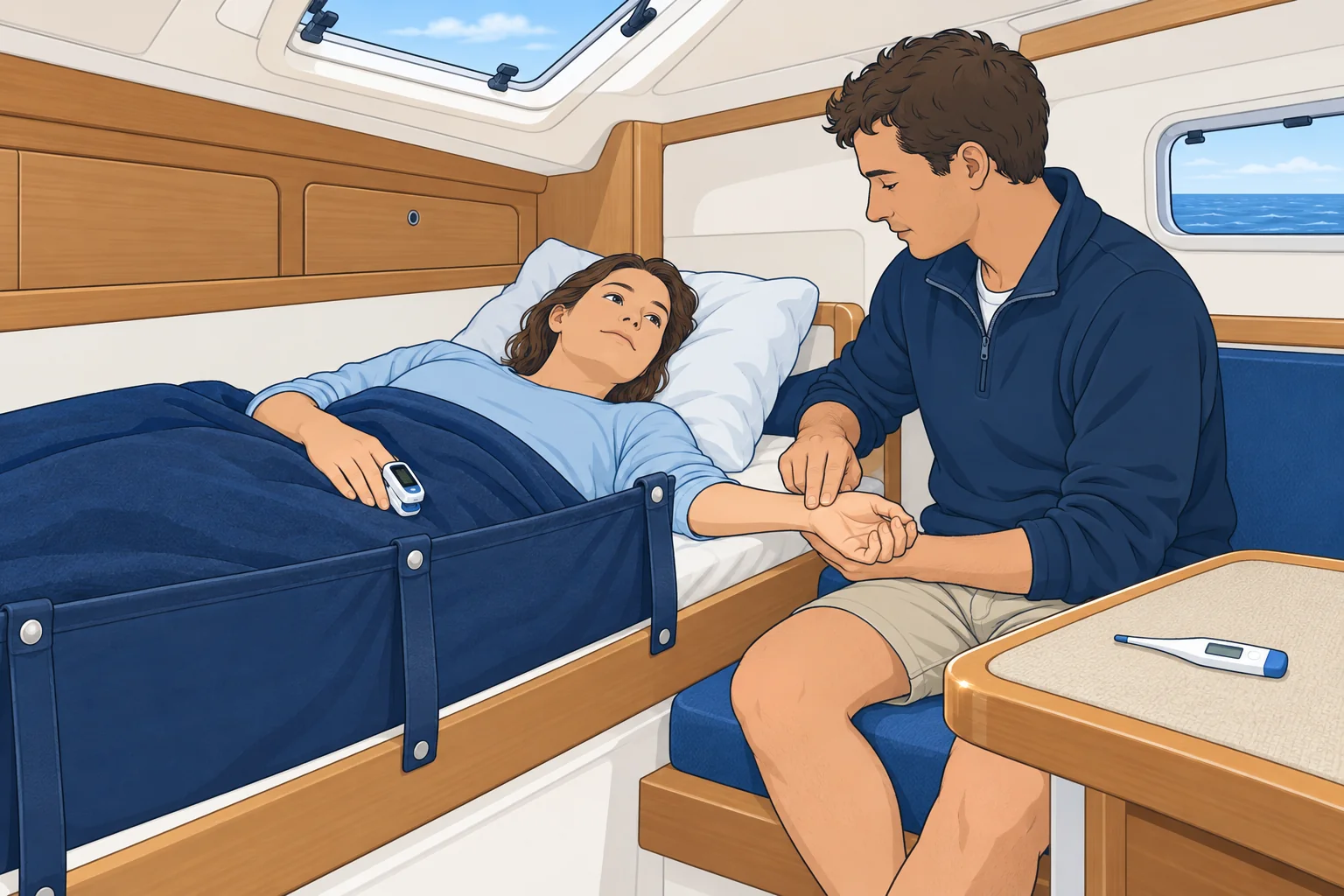
Measuring vital signs for the doctor
1The lesson in plain words
Vital signs are the doctor's eyes. Measure them the same way each time, write down the time, and repeat them to show the trend.
Pulse
Feel the pulse at the wrist, on the thumb side, or at the side of the neck. Count for 30 seconds and double if regular; if irregular, count for a full minute and report the irregularity. Note whether it is strong or weak. Example: 46 regular beats in 30 seconds is 92 a minute. A resting adult is usually between 60 and 100.
Breathing
Count for 30 seconds and double if regular; if irregular, count for a full minute and report the irregularity. Count quietly: people change their breathing when watched. Example: 11 regular breaths in 30 seconds is 22 a minute, faster than the usual adult 12 to 20. Also note whether breathing is noisy, laboured or shallow.
Temperature and more
Use a thermometer as instructed; note whether you measured in the mouth, ear or armpit. Normal is about 37 °C. If available, measure blood pressure with an automatic cuff and oxygen saturation, an estimate of how much oxygen your blood is carrying, with a pulse oximeter, a finger clip. Saturation is usually 95–100%. Cold or movement can distort readings; report a low reading promptly and repeat without delaying help.
Consciousness
Use AVPU: Alert, responds to Voice, responds to Pain, Unresponsive. V means not alert, but responds when you speak to them. P means responds only to pain. Note whether they know who and where they are. Check whether both pupils are the same size and react to light. Report any drop in consciousness promptly.
Other signs
Note skin colour and temperature: pale, grey, flushed, cold or sweaty. Ask where the pain is and score it from 0 (no pain) to 10 (worst imaginable pain). Note how much urine they pass and its colour, and any vomiting. Measure blood sugar if you carry a meter. Repeat the vital signs as the doctor asks, and write each set down with its time.
2Key data
- Count
- Regular pulse/breaths: 30 s × 2; irregular: count 60 s
- Adult at rest (typical)
- Pulse 60–100/min; breathing 12–20/min
- Temperature
- About 37 °C; note where you measured it
- Oxygen saturation
- Usually 95–100%; report low readings, recheck without delaying help
- AVPU
- Alert, Voice, Pain, Unresponsive
- Worked example
- 46 beats in 30 s = 92/min; 11 breaths in 30 s = 22/min
3Key points
- 1
Count regular pulse and breathing for 30 seconds and double; if irregular, count a full minute and report it.
- 2
Typical resting adult: pulse 60–100, breathing 12–20 a minute.
- 3
Use AVPU to describe consciousness; any drop is important.
- 4
A pulse oximeter can misread with cold or movement; report low readings promptly and recheck without delaying help.
- 5
Write every set of vital signs down with its time; the trend matters.
4Frequent mistakes
Wrong: Tell the patient you are counting their breaths.
Right: People change their breathing when watched. Count quietly, for example while still holding the wrist after the pulse.
Wrong: One set of vital signs is enough for the doctor.
Right: The trend shows whether the patient is improving or getting worse. Repeat them and record the times.
5Practice case & exam keys
While a crewmate calls about vomiting and abdominal pain, you count 52 regular pulse beats and 12 regular breaths, each in 30 seconds. An ear thermometer shows 38.6 °C. The patient responds only when spoken to. What will you report?
Show the answer
Pulse 104/min and breathing 24/min, both fast; ear temperature 38.6 °C, a fever. AVPU: V, responds only when spoken to. Report pain site and score, skin colour, vomiting and urine, with measurement times. Repeat observations without delaying help.
Exam keys
- Regular pulse/breaths: count 30 s × 2; irregular: count a full minute. Report regularity and effort.
- Typical adult at rest: pulse 60–100, breathing 12–20, temperature about 37 °C.
- AVPU for consciousness; pupils; skin; pain score; urine.
- Record each set with its time and repeat to show the trend.
Finish this unit
When you've read it, answer three questions. Get all three right to finish the unit; opening the page alone doesn't count.
My notes for this unit
No notes