

Pressure, air temperature, humidity and sea temperature
1The lesson in plain words
Report pressure corrected to mean sea level, air temperature and dew point from a ventilated screen, and sea temperature with its method.
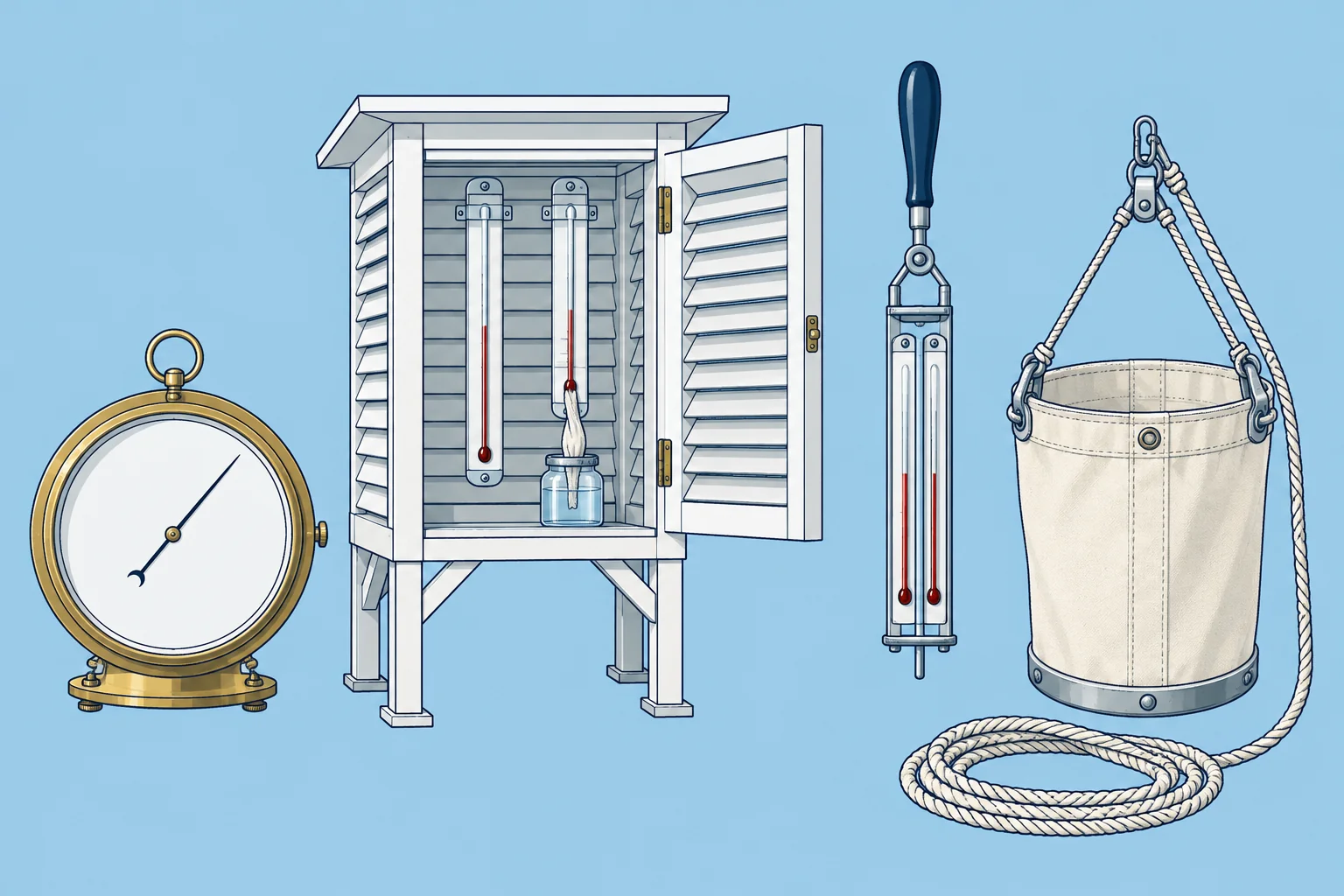
Pressure to sea level
Read the barometer to 0.1 hPa. Apply its index error from the last check against a standard, then add a height correction to mean sea level (MSL), about 0.12 hPa per metre near the surface; the logbook software or the barometer's card gives the exact value. Barometer trends and the barograph are in Forecasting on board; here you need the corrected number. Check which corrections are already applied; never add height twice.
Worked example
Your bridge barometer is 18 m above the waterline and reads 1008.6 hPa. The PMO's check found it reads 0.4 hPa high, so the corrected reading is 1008.2 hPa. Height correction: 18 × 0.12 ≈ 2.2 hPa, added because pressure is higher at sea level. Report 1010.4 hPa. Also report the 3-hour tendency: the change in hPa and its characteristic, the shape of the trace, such as rising then falling.
Air temperature and humidity
Measure air temperature with a dry bulb and humidity with a wet bulb, a thermometer in wet muslin, in a ventilated louvred screen on the windward bridge wing. Keep it clear of funnel heat, sun-warmed steel and exhaust. A psychrometer pairs these thermometers: you swing a sling type through the air; an aspirated type uses a fan. The software works out the dew point; humidity itself is explained in Clouds and humidity.
Sea temperature
Sea-surface temperature (SST) comes from three main methods. A bucket: an insulated sampler hauled from forward of any discharge and read at once in the shade. An engine-room intake sensor, a few metres down, which can read warm from engine-room heat. A hull contact sensor fixed inside the shell plating below the waterline. Report which method you used: the code has a place for it, and scientists correct each method differently.
2Key data
- Pressure reading
- To 0.1 hPa, corrected for index error and height
- Height correction
- About +0.12 hPa per metre near sea level; use the table
- Worked example
- 1008.6 − 0.4 + 2.2 = 1010.4 hPa
- Screen
- Windward side, ventilated, clear of heat sources
- SST methods
- Bucket, engine intake or hull sensor: always say which
3Key points
- 1
Correct pressure for index error and height to MSL; check which corrections are already applied.
- 2
Expose the screen on the windward side, away from heat and exhaust.
- 3
The dew point comes from dry and wet bulb readings; the software calculates it.
- 4
Report the SST method: bucket, intake and hull sensors differ.
4Frequent mistakes
Wrong: Send the barometer reading as it is; the forecasters correct it.
Right: Ship reports carry pressure at mean sea level. Check which index and height corrections are already applied before coding.
Wrong: The screen can go anywhere out of the rain, such as the lee side near the funnel.
Right: Put it on the windward side, ventilated and clear of funnel heat and warm steel, or the readings are useless.
5Practice case & exam keys
The bridge barometer displays 1005.3 hPa and is labelled MSL corrected. A cadet wants to add 2.9 hPa because the instrument is 24 m above the water. What do you check?
Show the answer
Check the setup and PMO card before adding anything. If the display already includes the verified index and sea-level corrections, report 1005.3 hPa. Adding height again would overstate pressure. The worked example starts with an uncorrected reading. If the setup is unclear, resolve it before coding.
Exam keys
- MSL pressure = reading ± index error + height correction (about 0.12 hPa/m).
- Dry and wet bulb in a ventilated windward screen give temperature and dew point.
- SST by bucket, engine intake or hull sensor; report the method.
Finish this unit
When you've read it, match the terms, then answer three questions. Get them all right to finish the unit; opening the page alone doesn't count.
My notes for this unit
No notes