

Wind and waves: true wind, sea state, wind sea and swell
1The lesson in plain words
Report the true wind, not what you feel on a moving deck, and separate the wind sea from each swell by direction, period and height.
Apparent and true wind
The anemometer measures apparent wind, the airflow relative to your moving ship. Report true wind relative to the Earth: its mean speed in knots and the direction it comes from, in degrees true, over the ten minutes before observation. Convert relative bearings using the true heading, where the bow points. Then add the ship’s course over ground (COG) and speed over ground (SOG) as a velocity vector. TurboWin+ can calculate this; check its inputs.
Worked example
Assume no current or sideways drift (leeway): heading and COG are 000°, SOG 15 knots. Apparent wind is 25 knots from 30° on the starboard bow. Air moves past you towards 210° at 25 knots: 21.7 knots southward and 12.5 knots westward. Add your motion, 15 knots northward: air moves 6.7 knots south and 12.5 knots west. Its speed is √(6.7² + 12.5²) ≈ 14 knots, towards 242°. True wind is about 14 knots from 062°.
Estimating from the sea
Without a reliable anemometer, or as a check, use sea state, the appearance of waves and whitecaps, to estimate wind with the descriptions in Beaufort. Sea appearance estimates wind relative to the water; strong currents can affect the comparison. Judge a wide area, not your bow wave. Allow for a sea that has not yet caught up with a sudden wind change, and for current against the waves, which steepens them.
Wind sea and swell
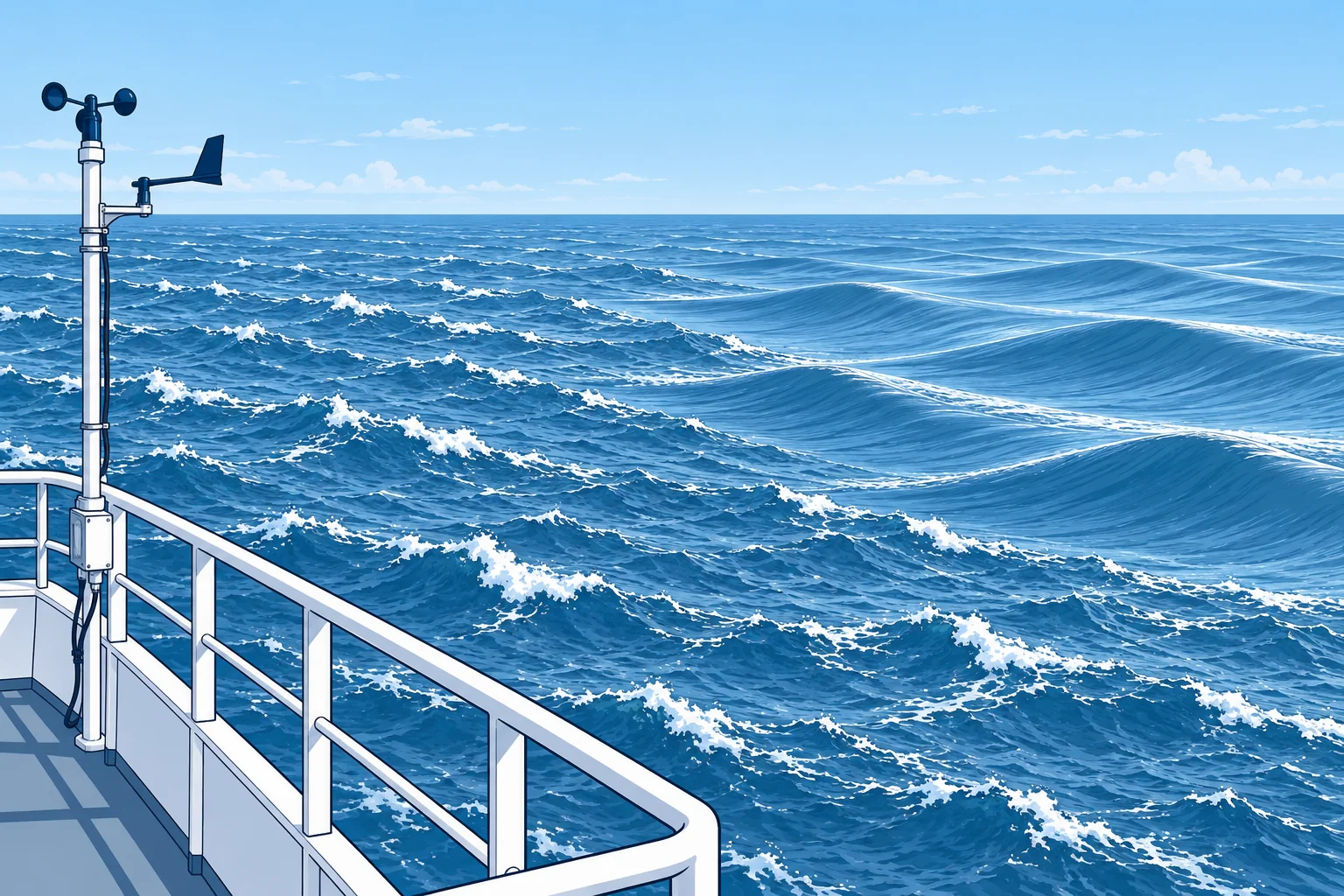
Wind waves (wind sea) are raised by the local wind: short, steep crests moving with it. Swell has run out from distant wind: longer, smoother, more regular waves, often from another direction. Report them separately: wind waves by period and height, and each swell system, up to two, by the direction it comes from, period and height. Swell travel and period are in Forecasting on board.
Measuring waves
Measure period, the time between crests, at a foam patch drifting with the water. Time from the first to the eleventh crest: ten intervals, so divide by ten. Timing crests passing a moving ship gives an encounter period instead. Estimate significant wave height: approximately the average trough-to-crest height of the highest third of waves. Report wind sea and each swell separately. Use the ship’s freeboard, its height above water, as a scale. Ignore the ship’s wake and observe safely.
2Key data
- True wind
- Earth-relative; 10-minute mean, knots, from direction in degrees true
- Worked example
- Heading/COG 000°, SOG 15 kn; 25 kn, 30° stbd bow → ≈14 kn from 062°
- Sea state
- Estimates wind over water; allow for currents and delayed response
- Wind waves
- Period and height
- Swell
- Up to two systems: direction, period and height
3Key points
- 1
For true wind, convert bearings with heading; add the ship’s velocity over ground to apparent air movement.
- 2
Directions are where the wind and swell come from, in degrees true.
- 3
Estimate the wind from the sea state over a wide area, not from your bow wave.
- 4
Report wind waves and each swell system separately.
4Frequent mistakes
Wrong: Report the anemometer reading; forecasters can correct for the ship's motion.
Right: The report must give the true wind. Convert it, or let the logbook software do so, and check the result.
Wrong: Wave height is the biggest wave you saw during the observation.
Right: Estimate the average height of the highest third, excluding the ship’s wake; report wind sea and swell separately.
5Practice case & exam keys
Assume no current or leeway: heading and COG are 090°, SOG 12 knots. The anemometer shows 12 knots of apparent wind from right ahead. What is the true wind?
Show the answer
Calm. A wind of 12 knots from right ahead is exactly what your SOG of 12 knots produces in still air. Add the ship’s velocity over ground to apparent air movement: 12 knots westward plus 12 knots eastward is zero. Do not use sea appearance to confirm calm: swell or leftover wind waves may persist after the wind drops. Report calm, not 12 knots from 090°.
Exam keys
- True wind: rotate relative bearings using heading, then add the ship’s velocity over ground to apparent air movement.
- Sea state estimates wind relative to water; allow for currents and delayed response.
- Waves: wind sea (period, height) and up to two swells (direction, period, height).
Finish this unit
When you've read it, match the terms, then answer three questions. Get them all right to finish the unit; opening the page alone doesn't count.
My notes for this unit
No notes