

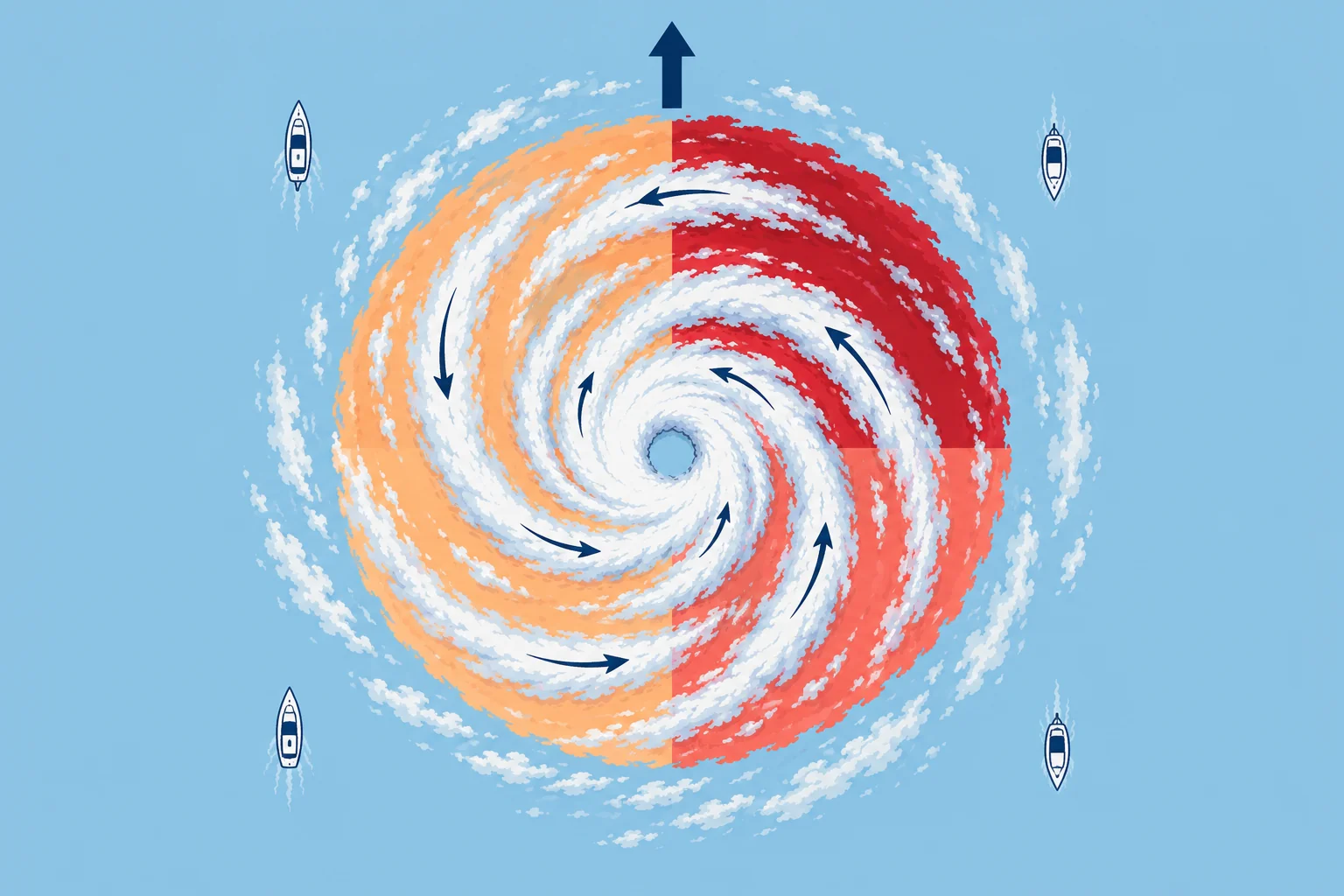
Dangerous and navigable semicircles in both hemispheres
1The lesson in plain words
One side of a storm is worse than the other. Learn which side, why, and how wind shifts and pressure trends help you check your position.
Two halves of the storm
Divide the storm by its track, the line along which the centre moves, and face the way it is going. In the northern hemisphere the dangerous semicircle is on the right and the navigable semicircle on the left. In the southern hemisphere it is the other way round: dangerous on the left, navigable on the right. Navigable means less bad, not safe: hurricane-force winds can blow there too.
Why one side is worse
On the dangerous side the storm's forward speed adds to its rotating wind; on the navigable side it subtracts. Seas are higher on the dangerous side too, because waves travel with the storm and keep growing. The front quadrant of the dangerous side is the worst place of all: its wind pushes a vessel towards the storm's future track.
Reading the wind shift
Use true wind, calculated by removing your boat's motion from apparent wind. For a nearly stationary observer, a steadily moving storm normally gives these shifts: in the north, veering (clockwise) suggests the dangerous semicircle; backing (anticlockwise) suggests the navigable one. In the south, the reverse applies. Your movement through the wind field, or a changing storm, can upset this pattern. Confirm your position from the advisory.
Ahead or behind
For a steadily moving storm of roughly steady strength, with little movement of your own, falling pressure usually suggests you are ahead of the centre; rising pressure suggests it has passed. Steady wind with falling pressure suggests the track ahead; steady wind with rising pressure suggests the track behind. Confirm your position from the advisory.
2Key data
- North, dangerous semicircle
- Right of track; veering true wind suggests this side
- North, navigable semicircle
- Left of track; backing true wind suggests this side
- South, dangerous semicircle
- Left of track; backing true wind suggests this side
- South, navigable semicircle
- Right of track; veering true wind suggests this side
- Steady wind, falling barometer
- Usually suggests the track ahead; confirm with advisory
- Steady wind, rising barometer
- Usually suggests the track behind; confirm with advisory
3Key points
- 1
Face the way the storm moves: north, the dangerous side is on the right; south, on the left.
- 2
For a steady storm and little boat movement: veering suggests dangerous in the north; backing does in the south.
- 3
Pressure trends suggest ahead or behind; confirm with the advisory.
- 4
Forward motion strengthens winds on the dangerous side and weakens them on the navigable side.
- 5
Use true wind; boat movement through the wind field and storm changes can upset these clues.
4Frequent mistakes
Wrong: The navigable semicircle is safe to sail in.
Right: It is only less dangerous. Winds there can still reach hurricane force; keep clear of it too.
Wrong: A veering wind always means the dangerous semicircle.
Right: For a steady storm and nearly stationary observer, veering suggests dangerous in the north, navigable in the south. Confirm with the advisory.
Wrong: You can judge the shift from the apparent wind while sailing fast.
Right: Your motion changes apparent wind. Use true wind, but remember that moving through the wind field also changes what you observe. Check the advisory.
5Practice case & exam keys
Near Mauritius in February, a cyclone is approaching. While nearly stationary, you observe the true wind backing from south-east through east to north-east over four hours, with pressure falling. What do these clues suggest? Confirm against the advisory.
Show the answer
South-east through east to north-east is an anticlockwise shift: the wind is backing. For a steadily moving storm of roughly steady strength, these clues suggest the dangerous front quadrant in the southern hemisphere. They do not prove your position: a changing storm can upset the pattern. Confirm your position against the advisory.
Exam keys
- Dangerous side: right of track in the north, left in the south. Veering suggests it in the north; backing in the south.
- For a steady storm and little boat movement, falling pressure usually suggests ahead; rising suggests behind. Confirm by advisory.
- Under those assumptions, steady true wind and falling pressure usually suggest the track ahead. Confirm by advisory.
- The front quadrant of the dangerous semicircle drives a vessel towards the storm's track.
Finish this unit
When you've read it, match the terms, then answer three questions. Get them all right to finish the unit; opening the page alone doesn't count.
My notes for this unit
No notes