

Ensembles in route decisions
1The lesson in plain words
Test each candidate route through every ensemble member at the planned times. Use model estimates alongside safety limits, warnings and observations.
Beyond one forecast
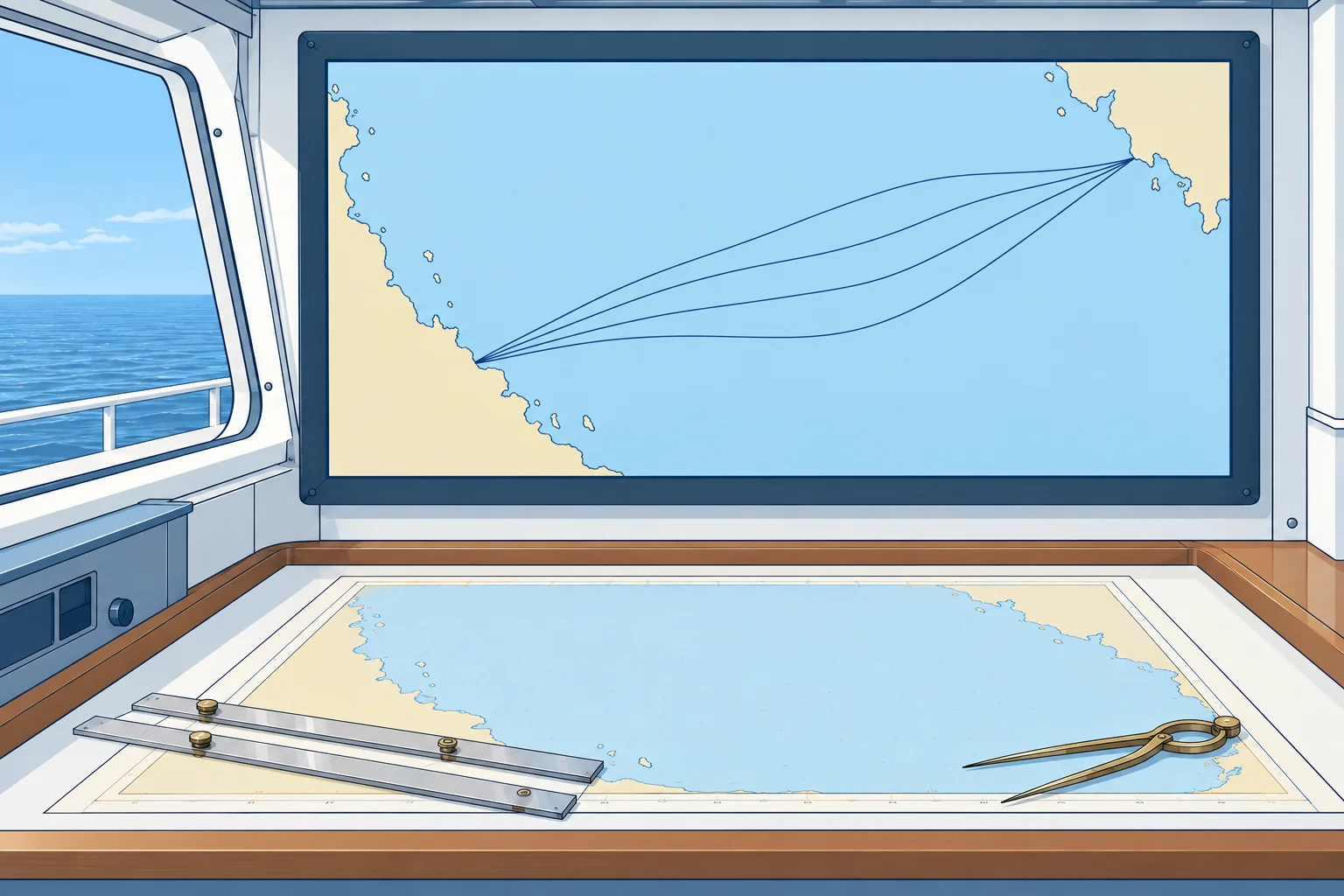
One forecast gives one future; an ensemble gives many. GRIB and weather models shows how ensembles are made and what their spread means. For routeing, the question changes from 'what will the weather be?' to 'how likely is my ship to meet conditions beyond her limits on this route, at these times?' The further ahead you look, the more weight the ensemble deserves over any single run.
Route against members
Test each candidate route against every ensemble member, using the same ship model and planned speed policy. Record arrival time, fuel use and the worst conditions encountered. Significant wave height (Hs) is the average height of the highest third of waves. On route A, 6 of 51 members exceed Hs 7 m; on B, 1 of 51: about 12 % and 2 %. These are model estimates, not calibrated guarantees; members share errors.
Set a threshold
Set safety limits first. Cost-loss analysis compares action cost C with the loss L it prevents. For full protection, act when event probability p > C/L. Cost 1 and avoidable loss 20 gives 5 %. This assumes the action removes that loss. If both routes retain exposure to the same loss, compare the reduction in probability with C/L. Check remaining risk separately against the voyage plan and ship-specific guidance. An economic threshold is not permission to exceed safety limits.
Timing and updates
Ensembles are re-run up to four times a day. Compare each run with the last: a signal that stays steady over several runs is more trustworthy than a sudden jump. Decide early, when a small change of course or speed moves you well clear, not late, when only large changes help. Tropical cyclones have their own avoidance rules, covered in Tropical revolving storms.
What ensembles miss
Ensembles share their model's blind spots: small intense lows, squalls, steep seas where waves meet a strong current, such as the Agulhas Current, and shallow water. Use them for the big picture of risk, then check official warnings and your own observations. A low probability is not a guarantee.
2Key data
- Hs
- Significant wave height: average of the highest third of waves
- Model-estimated exceedance probability
- Members exceeding the limit ÷ total members
- Worked example
- Model estimates: 6/51 ≈ 12 %; 1/51 ≈ 2 %; shared errors remain
- Decision rule
- For full protection: act when p > C/L; safety limits still apply
- Updates
- Compare successive runs; trust a steady signal
3Key points
- 1
Run every candidate route through every member, at your planned speeds.
- 2
Model-estimated exceedance probability = members beyond the limit ÷ all members; shared errors remain.
- 3
If action prevents the loss, use p > C/L; otherwise compare risk reduction. Check remaining risk against safety limits.
- 4
Decide early; check warnings and observations, which see what models miss.
4Frequent mistakes
Wrong: Weather at departure is enough to compare the routes.
Right: Match each forecast to the time your ship reaches each point on each route.
Wrong: Only change route when the probability of exceeding your limits is over 50 %.
Right: Use your stated cost-loss assumptions and safety limits; 50 % is not a general action threshold.
5Practice case & exam keys
In 4 days, 10 of 51 members exceed your Hs 8 m limit on your track; 2 of 51 do so 150 miles south. Diverting costs 8 hours. For this simplified comparison, treat exceedance as damage costing 30 times the delay; diversion changes only its probability. Do the economics justify diverting, and is that enough?
Show the answer
The model estimates are 10/51 ≈ 19.6 % and 2/51 ≈ 3.9 %. The reduction is 8/51 ≈ 15.7 percentage points, above C/L = 1/30 ≈ 3.3 %. The diversion is economically favoured in this model; 3.3 % is not a safety acceptance limit. Check remaining risk against your plan and ship-specific guidance. Consider safer timing or another route before accepting it. Decide early and log the forecasts and reasons.
Exam keys
- Model-estimated exceedance probability comes from the share of members exceeding a limit; shared errors remain.
- For full protection, act when p > C/L; otherwise compare risk reduction. Safety limits still apply.
- Decide early; ensembles miss small-scale and current-driven extremes.
Finish this unit
When you've read it, match the terms, then answer three questions. Get them all right to finish the unit; opening the page alone doesn't count.
My notes for this unit
No notes