

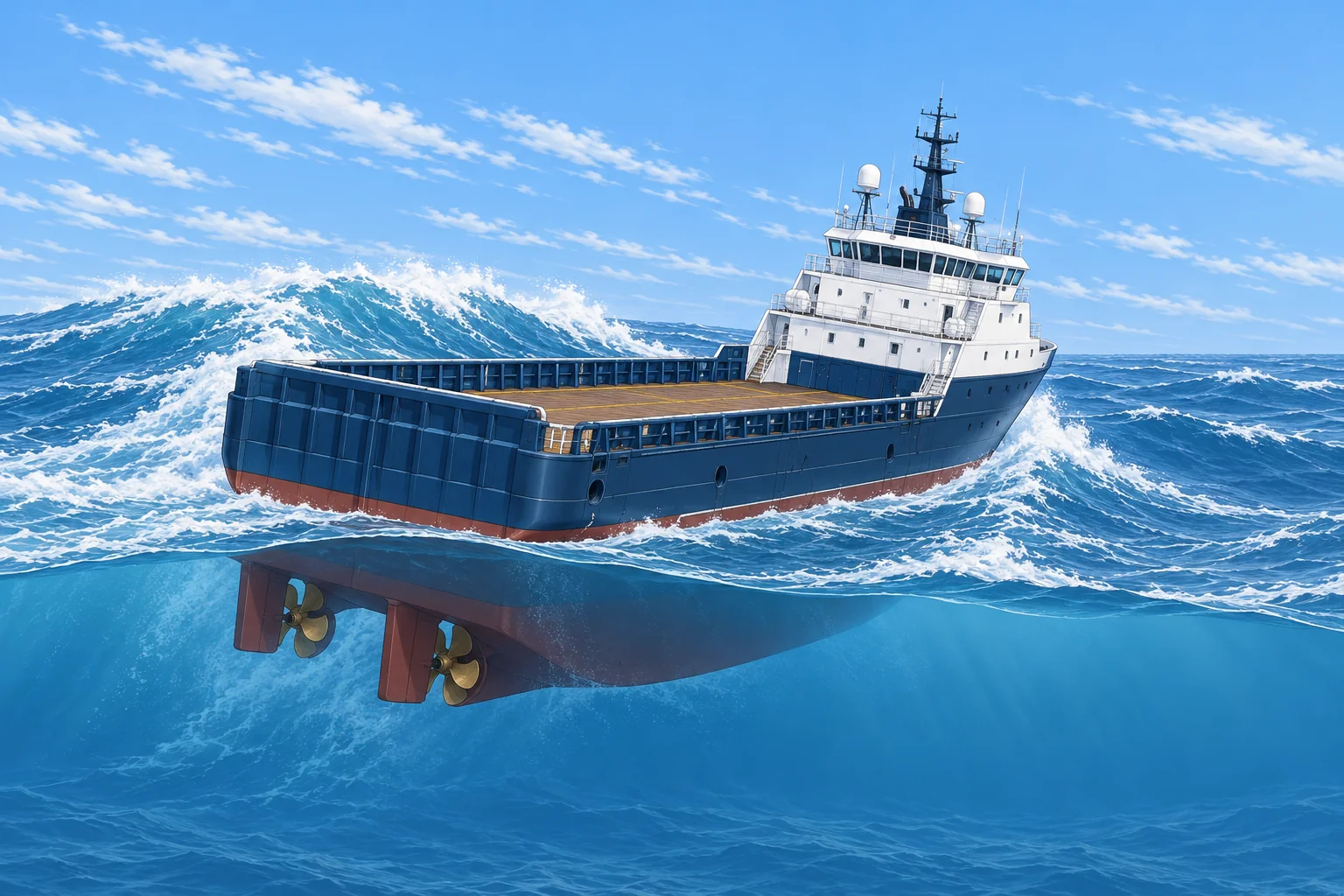
Following and quartering seas: surf-riding and successive high waves
1The lesson in plain words
IMO's MSC.1/Circ.1228 gives general speed and course guidance for following seas. You need wave period, wavelength and encounter period.
The guidance
MSC.1/Circ.1228 (2007) covers capsize and heavy-rolling hazards, including surf-riding, broaching, successive high waves and resonant rolling. It assumes compliance with applicable Intact Stability Code (IS Code) criteria. Its zones are general guidance, not guarantees. It does not assess slamming, hull stresses, shallow-water or current effects, collision or grounding. Check those separately and use any ship-specific operational guidance.
Measure the waves
Wave period Tw is the time between crests at a fixed place in the water. Track the same foam patch over several crest-to-crest cycles and divide elapsed time by the number of cycles. Wavelength λ is the distance between crests; estimate it against the ship's length or from suitable radar images. In deep water, λ = 1.56 × Tw² metres and wave speed ≈ 3 × Tw knots. For Tw = 10 s, λ ≈ 156 m and speed ≈ 30 knots.
Encounter period
The encounter period TE is the time between crests meeting your ship. In deep water without significant current, TE = 3Tw² ÷ (3Tw + V cos α). V is speed through the water in knots; α is where waves come from relative to the bow: 0° ahead, 180° astern. Use this form only with a positive denominator. For Tw = 10 s and V = 12 knots, TE ≈ 16.7 s astern and 7.1 s ahead. You can also time pitching.
Surf-riding
On the steep front of a high following wave the ship can be carried along at the wave's speed: surf-riding. She may then broach: swing suddenly beam-on to the sea and heel heavily, risking capsize. The circular warns of this when α is between 135° and 225° and the speed exceeds 1.8√L ÷ cos(180° − α) knots, with L the length between perpendiculars in metres. Keep speed, course or both outside that zone.
Successive high waves
When average wavelength exceeds 0.8 L and significant wave height exceeds 0.04 L, watch for dangerous behaviour and avoid TE about 1.8–3.0 times Tw. Your speed can then be close to the speed of a wave group, keeping you among its larger waves for longer. Repeated high waves can produce large motions and reduced stability. Reduce speed or change course to leave the zone.
2Key data
- Wavelength
- λ = 1.56 × Tw² m; a 10 s wave is about 156 m
- Wave speed
- About 3 × Tw knots
- Encounter period
- TE = 3Tw² ÷ (3Tw + V cos α); positive denominator only
- Surf-riding zone
- 135° < α < 225° and V > 1.8√L ÷ cos(180° − α) knots
- Successive high waves
- λ > 0.8 L and Hs > 0.04 L: avoid TE ≈ 1.8–3.0 × Tw
3Key points
- 1
Measure Tw by stopwatch; λ = 1.56 Tw² m; wave speed ≈ 3 Tw knots.
- 2
Deep water, little current: TE = 3Tw² ÷ (3Tw + V cos α); V through water, α = 0° ahead; positive denominator only.
- 3
Surf-riding risk: following or quartering sea and V above 1.8√L ÷ cos(180° − α).
- 4
Successive high waves: keep TE out of 1.8–3.0 × Tw when λ > 0.8 L and Hs > 0.04 L.
4Frequent mistakes
Wrong: Slowing down always makes a following sea safer.
Right: Slowing can clear the surf-riding zone but move you into the successive high-wave zone. Check both.
Wrong: Outside the circular's danger zones, the ship is safe.
Right: The guidance is general. A ship with poor stability can be unsafe outside the zones.
5Practice case & exam keys
Your offshore supply vessel has L = 64 m. You run before a gale, sea right astern (α = 180°), at 15 knots. Tw = 8 s and Hs is 4 m. Should you slow to 12 knots?
Show the answer
Surf-riding limit: 1.8 × √64 = 14.4 knots, so 15 knots is in the zone. Successive waves apply: λ ≈ 100 m > 51 m and Hs 4 m > 2.6 m. At 12 knots TE = 192 ÷ 12 = 16 s, twice Tw: inside the 1.8–3.0 zone. Go below about 10.5 knots, where TE is under 1.8 Tw, or change course, checking both zones again.
Exam keys
- λ = 1.56 Tw²; wave speed ≈ 3 Tw knots.
- Deep water, little current: TE = 3Tw² ÷ (3Tw + V cos α); V through water; positive denominator only.
- Surf-riding: 135°–225° and V > 1.8√L ÷ cos(180° − α); successive waves: TE 1.8–3.0 Tw.
Finish this unit
When you've read it, match the terms, then answer three questions. Get them all right to finish the unit; opening the page alone doesn't count.
My notes for this unit
No notes