

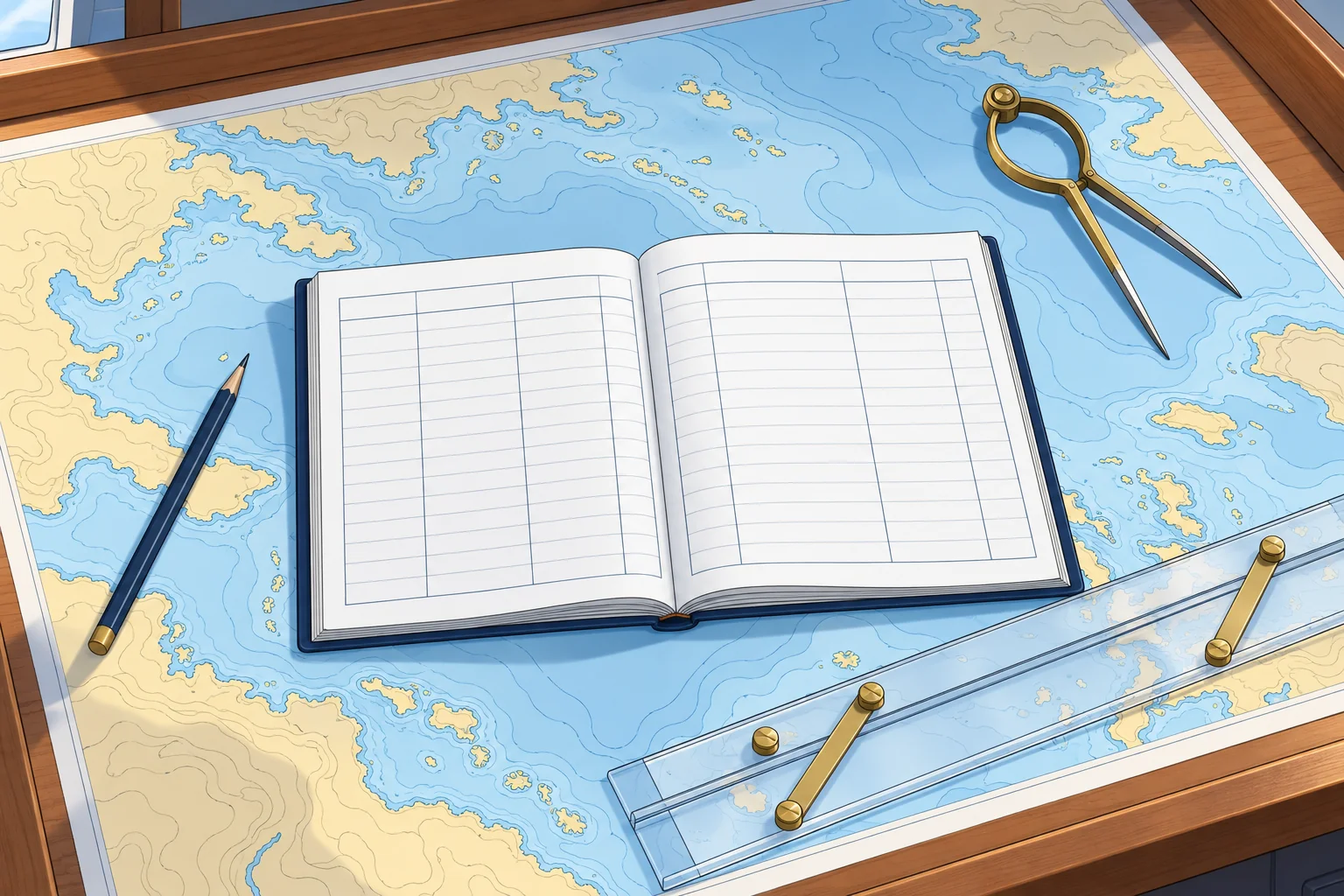
The compass error book and using the results
1The lesson in plain words
Every check goes in the compass error book. Read the record for trends: a steady error you can apply, a sudden change you must investigate.
Why a record
SOLAS chapter V, regulation 19, requires every ship to have a means of correcting headings and bearings to true at all times. On a ship, that means knowing the current gyro and magnetic compass errors. Flag states and company procedures usually require a compass error book, or record of compass errors, kept on the bridge. Most flags also require a deviation card for the magnetic compass.
What to write
For each check, record the date, time and position, the ship's head by gyro and by magnetic compass, and the method used. Add the object or body observed, its true bearing, its gyro bearing and the gyro error. Then add the magnetic compass error, the variation and the resulting deviation. Sign it. A check that is not written down cannot help the next watch.
Reading the trend
A healthy gyro shows a small error that stays steady from watch to watch, typically a fraction of a degree. A sudden jump, an error that keeps growing, or an unexpected gyro–magnetic change after allowing for variation and deviation calls for an independent check. If you suspect a heading-equipment failure, notify the master immediately and use a verified independent heading source. Check corrector inputs, alarms and repeaters, and log the findings.
Applying the error
Apply the latest checked error to headings and bearings. With gyro error 1.0° E, a gyro heading of 090° means a true heading of 091° T. Wind and current may make your track different. A bearing of 270° by gyro is 271° T. After a corrector change or restart, check the error again before applying it.
Magnetic deviation
Compare the gyro, corrected for its checked error, with the standard compass on several headings. Allow for current variation to check the deviation card. Deviation can change with heading, cargo, structural work or equipment near the compass. Confirm an unexpected difference by another observation and check for interference. Investigate persistent differences; excessive or erratic deviation may require adjustment under flag-state and company requirements.
2Key points
- 1
SOLAS V/19 requires a means of correcting headings and bearings to true at all times.
- 2
Log every check: time, position, method, true and observed bearings, gyro error, deviation and signature.
- 3
A steady small error is normal. A sudden or growing change means investigate and report.
- 4
Apply only a current, checked error. Check again after any restart or corrector change.
3Frequent mistakes
Wrong: If the gyro error is small, there is no need to write it down.
Right: Log every check. The record shows the trend that reveals a developing fault, and the next watch relies on it.
Wrong: An error found last week can still be applied today.
Right: Apply the latest checked error. After a restart, a corrector change or a big manoeuvre, check again before relying on it.
4Practice case & exam keys
The error book shows the gyro error steady at 0.5° E for a week. This morning's amplitude gives 2.5° W, while the gyro–magnetic difference on the same heading has also changed by about 3°. What do you do?
Show the answer
Notify the master immediately and use a verified independent heading source. Repeat the check independently. Check corrector inputs, alarms and repeaters, and log the findings. A repeat observation confirms the error only at that moment; it does not prove the gyro is stable. Continue using the verified independent heading source under the master’s orders until gyro reliability is established.
Exam keys
- SOLAS V/19: means of correcting headings and bearings to true at all times.
- The compass error book records each check: time, position, method, bearings, gyro error, deviation.
- Steady small error: apply it. Suspected heading failure: notify the master immediately, use a verified independent heading source, then investigate and log.
Finish this unit
When you've read it, match the terms, then answer three questions. Get them all right to finish the unit; opening the page alone doesn't count.
My notes for this unit
No notes