

Repeaters, corrector inputs and the heading feed
1The lesson in plain words
The master gyro supplies bridge headings. A master or input fault can affect many systems; a repeater can be wrong on its own.
Master and repeaters
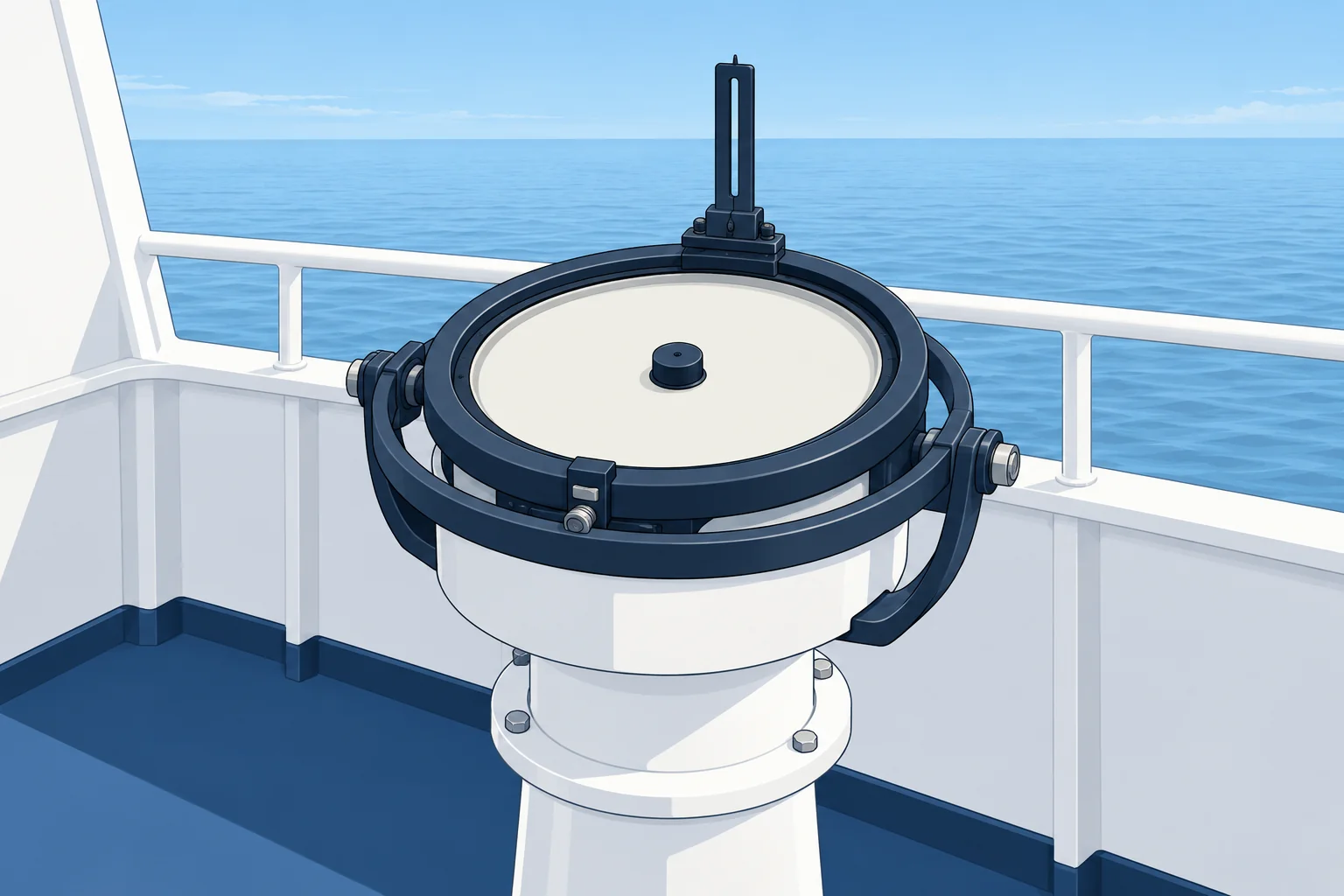
The master compass is the gyro unit. A steering repeater shows its heading at the helm; a bearing repeater lets you take bearings. SOLAS V/19.2.5.1–.3 requires ships of 500 GT (gross tonnage) and upwards to carry a gyro or other non-magnetic heading means, a heading repeater or other means giving visual heading information at an emergency steering position if fitted, and a gyro bearing repeater or other means for bearings through 360°. Below 1,600 GT, the bearing-repeater provision applies as far as possible.
Keep them aligned
A.424(XI) allows repeaters to differ from the master by not more than 0.5°. Older step repeaters can fall out of step after a power break and then show a wrong heading steadily. Compare every repeater with the master at the start of each watch, after any power interruption or alarm, and before taking bearings. Realign any that disagree, using the maker's procedure.
Corrector inputs
The speed and latitude correctors remove the errors from the previous lesson. On many gyros, speed comes from the speed log (a speed sensor) or a global navigation satellite system (GNSS); latitude comes from GNSS. The log/GNSS source and ground/water mode must match the maker's instructions. If an input is lost or wrong, the correction is wrong too. Check the values shown on the gyro's control panel each watch. If the GNSS input fails, set speed and latitude by hand as the manual describes.
Who uses the heading
Gyro heading feeds the autopilot, radar and automatic radar plotting aid (ARPA), electronic chart display and information system (ECDIS), automatic identification system (AIS), and voyage data recorder (VDR). A wrong heading can misorient heading-stabilised radar displays, misalign the radar overlay on ECDIS and mislead automatic steering. Investigate heading faults promptly.
GNSS compasses
A satellite compass, or GNSS compass, measures heading from two or more antennas. It settles quickly and has no speed error. It can be type-approved as a transmitting heading device (THD). It depends on satellite signals, so jamming or spoofing can take it away or falsify it. Treat it as a useful cross-check; whether it can replace a gyro is the flag state's decision.
2Step by step
Heading check at the start of the watch
- 1
Read the master gyro heading and compare every repeater with it.
A repeater out of step gives wrong steering and bearings while looking normal.
- 2
Check the speed and latitude values used by the gyro's correctors.
A frozen or wrong input leaves speed and latitude errors uncorrected.
- 3
Check the latest gyro error in the compass error book.
You apply that error to courses and bearings during the watch.
- 4
Compare gyro and magnetic headings, allowing for the checked gyro error, variation and deviation on this heading. Log the result.
An unexpected remaining difference needs an independent check; a changed raw difference alone does not prove a fault.
- 5
Confirm the heading shown on radar, ECDIS and the autopilot.
For each system using this gyro, check that its received heading matches, allowing for any configured correction.
3Key points
- 1
Repeaters may differ from the master by not more than 0.5°. Compare them every watch.
- 2
Check repeaters after a power break. Realign any that disagree with the master, using the manual.
- 3
Check the speed and latitude inputs to the correctors, especially after a GNSS fault.
- 4
A faulty shared heading feed can mislead the autopilot, radar/ARPA, ECDIS, AIS and VDR.
4Frequent mistakes
Wrong: If the master gyro is right, every repeater must be right.
Right: Repeaters can lose step, especially after a power break. Compare each one with the master before using it.
Wrong: A satellite compass is independent of GNSS problems.
Right: It measures heading from GNSS signals, so jamming or spoofing affects it. Keep the gyro and magnetic compass as checks.
Wrong: A heading fault only matters for the helmsman.
Right: A wrong heading can misorient bridge displays, misalign the radar overlay and mislead the autopilot.
5Practice case & exam keys
After a short blackout and restart, the port bridge-wing repeater reads 4° more than the master gyro. The steering repeater agrees with the master. The second officer wants to take a fix by bearings from the port wing. What do you do?
Show the answer
Do not use the port repeater. First confirm that the master has settled and check its error independently. Until then, use a verified alternative heading source. Check all repeaters, corrector inputs and heading feeds. Once the master is reliable, realign the port repeater by the maker’s procedure. Use gyro bearings only after the master is verified and the chosen repeater agrees. Log and report the fault.
Exam keys
- SOLAS V/19.2.5.1–.3: ships ≥500 GT need non-magnetic heading, a heading repeater or other visual heading means at an emergency steering position if fitted, and a gyro bearing repeater or other means for 360° bearings (as far as possible below 1,600 GT).
- A.424(XI): repeater divergence from master ≤ ±0.5°; means for correcting speed and latitude errors.
- Heading feeds autopilot, radar/ARPA, ECDIS, AIS, VDR; a GNSS compass is a THD that depends on GNSS.
Finish this unit
When you've read it, match the terms, then answer three questions. Get them all right to finish the unit; opening the page alone doesn't count.
My notes for this unit
No notes