

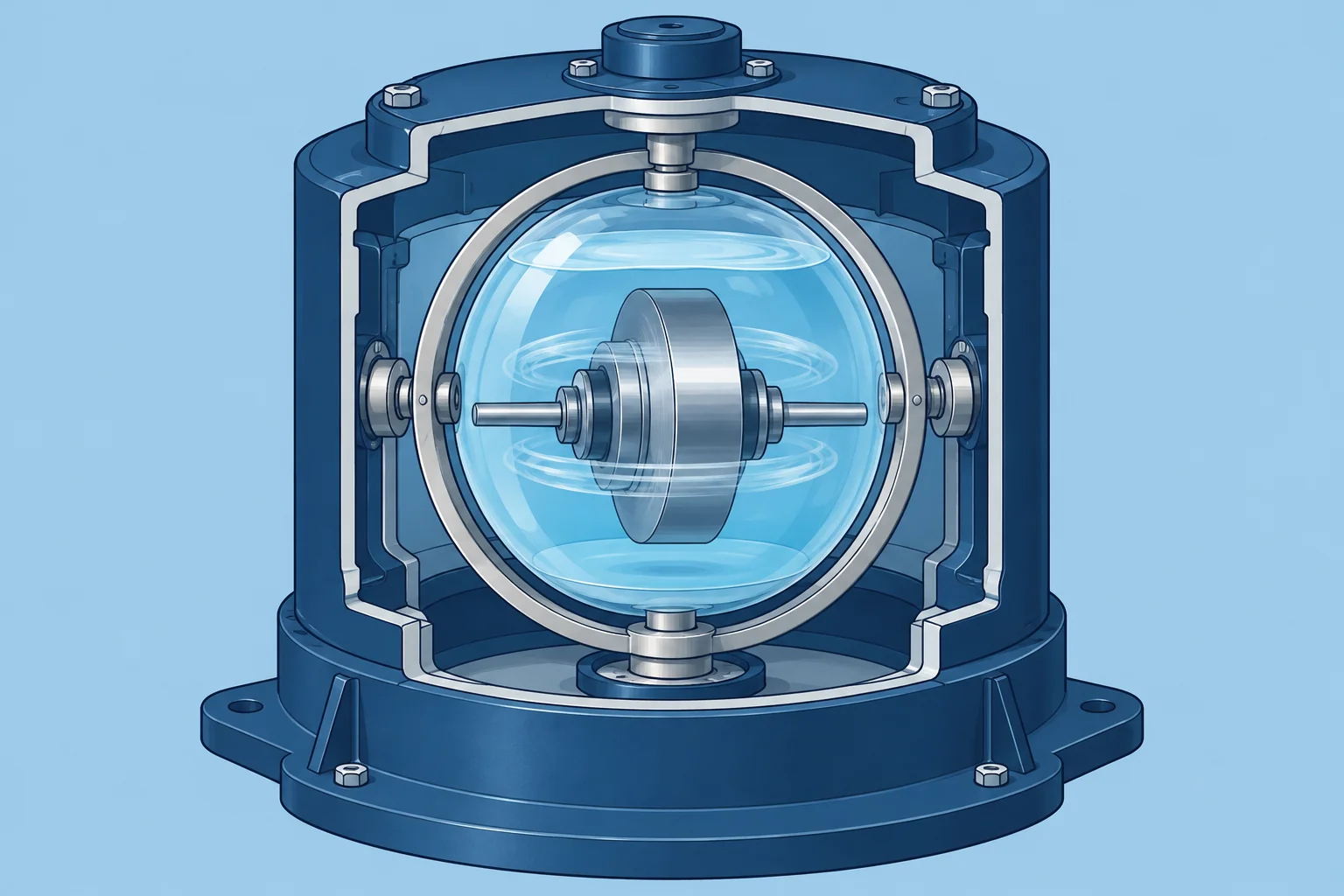
How a gyro compass finds true north
1The lesson in plain words
Gyroscopic inertia holds the spin axis steady. Gravity control and damping make the gyro settle on the true meridian, the north–south line.
Two properties
A gyroscope is a fast-spinning rotor free to turn about its axes. Gyroscopic inertia, or rigidity in space, means its spin axis keeps pointing in the same direction in space. A turning force, called torque, applied about one axis makes the gyro turn about a third axis. This is precession. That third axis is at right angles to both the spin axis and the torque axis. A gyro compass uses both properties.
Why a free gyro wanders
The Earth turns about 15° an hour. A free gyro holds its direction in space while Earth turns beneath it. For a horizontal axis, drift in azimuth (horizontal direction) is about 15° × sin φ per hour, where φ is latitude. Tilt depends on axis direction: its maximum rate is about 15° × cos φ per hour, with the axis east–west; it is zero north–south. These are apparent motions, not north-seeking.
Gravity control
The maker adds gravity control: a pendulous weight or a linked liquid system. When the axis tilts, gravity produces a torque, and precession turns that torque into movement in azimuth, towards the meridian. The axis now swings to and fro across the meridian, east and west, without stopping. This makes the gyro north-seeking.
Damping and settling
Damping shrinks each swing until the axis comes to rest on, or very close to, the meridian: the gyro has settled. Settle point error is the difference between its mean settled indication and true heading. Settling takes time after switching on. The IMO performance standard, resolution A.424(XI), allows up to six hours in latitudes up to 60°. Many modern units are quicker. Switch on early, by the maker's figure, before you need the heading for departure.
Strengths and limits
A settled gyro gives true headings: no variation or deviation. Its north-seeking force grows weaker towards the poles, roughly with cos φ, so errors grow in high latitudes; check the manual for the working limit. It depends on electrical power and the rotor support. It needs a standard magnetic compass as the independent backup, and its error must still be checked.
2Key data
- Earth's rotation
- About 15° an hour (15.04° per hour)
- Free gyro drift (horizontal axis)
- About 15° × sin latitude per hour
- Free gyro maximum tilt
- About 15° × cos latitude per hour; horizontal east–west axis
- Settling time (A.424)
- Within 6 hours, latitudes up to 60°
- Settle point error (A.424)
- Not more than 0.75° ÷ cos latitude
3Key points
- 1
Gyroscopic inertia holds the axis steady in space. Precession changes its direction under an applied turning force.
- 2
A free gyro drifts and tilts as the Earth turns. Gravity control makes it seek the meridian.
- 3
Damping stops the swinging, so the gyro settles. Allow the maker's settling time.
- 4
A gyro shows true north, but it weakens near the poles and still has small errors.
4Frequent mistakes
Wrong: A gyroscope by itself points to true north.
Right: A free gyro only holds its direction in space. Gravity control and damping make it seek and settle on the meridian.
Wrong: The gyro is ready as soon as the rotor is up to speed.
Right: It must settle first, which can take hours. Switch on early and compare with the magnetic compass before relying on it.
Wrong: A gyro has no errors because it has no variation or deviation.
Right: It has small errors of its own, such as speed-and-course error, and these grow in high latitudes. Check it every watch.
5Practice case & exam keys
Your ship has been in dry dock with the gyro switched off. Departure is planned for 0800 and the electrician offers to start the gyro at 0730. What do you say?
Show the answer
Do not assume 30 minutes is enough. Check the maker’s settling time and readiness indications. Arrange startup early enough to meet them. Before using the gyro for departure, confirm it has settled and check its error against an independent reference.
Exam keys
- Gyroscopic inertia and precession; gravity control gives north-seeking, damping gives settling.
- A.424(XI): settle within 6 h up to 60° latitude; settle point error ≤ 0.75° ÷ cos latitude.
- Horizontal free gyro: drift 15° sin φ/h; maximum tilt 15° cos φ/h with the axis east–west, zero north–south. Directive force falls towards the poles.
Finish this unit
When you've read it, match the terms, then answer three questions. Get them all right to finish the unit; opening the page alone doesn't count.
My notes for this unit
No notes