

Compass error and deviation from Polaris, worked
1The lesson in plain words
Take a compass bearing of Polaris, compare it with its true azimuth from the almanac, and you have the compass error. Remove variation to get deviation.
Compass error
Compass error is the total difference between a compass reading and true: error = true bearing − compass bearing. Across 000°, add 360° to the smaller bearing before subtracting. A positive result is named east, a negative one west. It is the sum of variation and deviation (Compass basics). Spanish courses call it the corrección total (Ct): Ct = azimut verdadero (Zv) − azimut de aguja (Za).
Taking the bearing
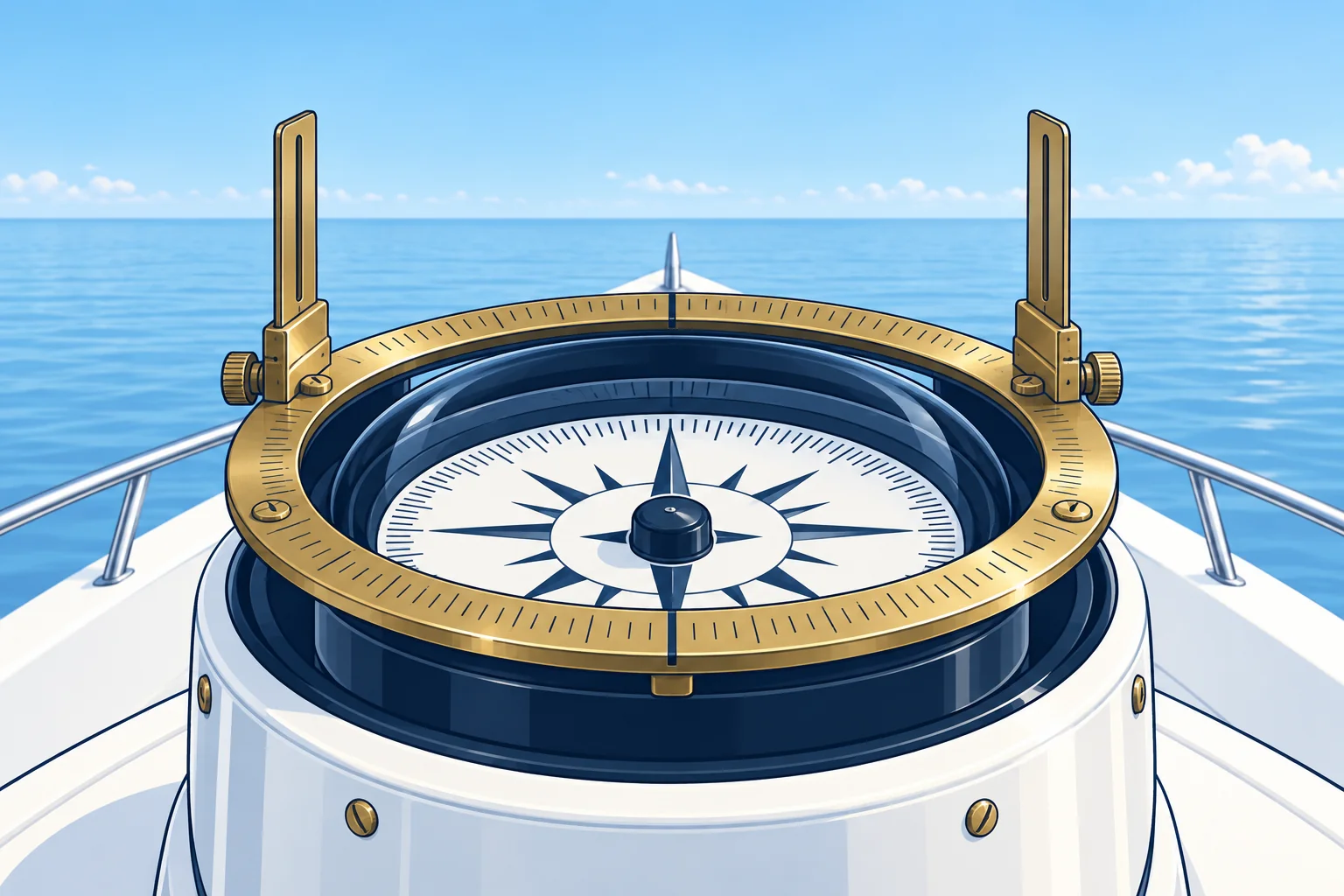
To check the steering compass, steady the boat on the heading you want to test and take Polaris's bearing over the compass, using an azimuth mirror or another sight designed for that altitude. Note the heading and the exact UT. A hand-bearing compass checks only itself. Its deviation can change with your position aboard and the boat's heading; it does not give the steering compass's deviation.
Worked example
At 41°N, on a heading of 090°C, Polaris bears 002.0°C. With the UT of the bearing you find LHA Aries, and the Polaris table gives a true azimuth of 359.4°T. Treat 002.0° as 362.0°: error = 359.4 − 362.0 = −2.6°, so 2.6°W.
Deviation
The chart's compass rose, updated to this year, gives a variation of 0.5°E (+0.5). Deviation = error − variation = −2.6 − (+0.5) = −3.1°: 3.1°W on a heading of 090°C. Write it on the deviation card for that heading. Spanish books write it the same way: desvío = Ct − declinación magnética (dm).
Make it count
One bearing gives the error on one heading only, because deviation changes with heading. Repeat on several headings, about every 45°, to check a whole card. At about 40° elevation, you may need an azimuth-mirror attachment; check that your compass's sight can observe that high. An ordinary bearing ring may not allow it.
2Step by step
Compass error from Polaris
- 1
Steady on the heading to check and note it.
Deviation belongs to the boat's heading, not to the bearing direction.
- 2
Take Polaris's compass bearing and note the UT to the minute.
The true azimuth depends on the time through LHA Aries.
- 3
Find LHA Aries: GHA Aries for that UT ± your longitude.
It is the entry, with latitude, to the Polaris azimuth table.
- 4
Read the true azimuth from the almanac's Polaris table.
Polaris is up to about a degree off north at mid-latitudes.
- 5
Subtract compass from true. If above +180°, subtract 360°; if below −180°, add 360°. Positive is E; negative is W.
This is the total correction, variation plus deviation.
- 6
Deviation = error − variation, for that heading.
Variation comes from the chart; what remains is the boat's own error.
3Key data
- Compass error
- True − compass, wrapped to −180°–+180°; + = E, − = W
- Deviation
- Compass error − variation (east +, west −)
- Worked error
- 359.4 − 362.0 = −2.6°: 2.6°W
- Worked deviation
- −2.6 − (+0.5) = 3.1°W on 090°C
- Spanish terms
- Ct = Zv − Za; desvío = Ct − dm
4Key points
- 1
Compass error = true − compass: wrap across 000° if needed; positive east, negative west.
- 2
Deviation = compass error − variation, for the heading you were on.
- 3
Check the steering compass on the heading you are testing, with the exact UT.
- 4
Repeat on several headings: one bearing gives one heading's deviation.
5Frequent mistakes
Wrong: Compass error = compass bearing − true bearing.
Right: Error = true − compass. Treat 002.0° as 362.0°: 359.4 − 362.0 = −2.6°, so 2.6°W.
Wrong: Record the deviation against the bearing of Polaris, about north.
Right: Deviation depends on the boat's heading. Record it against the heading you were steering, here 090°C.
Wrong: Use a hand-bearing compass to find the steering compass's deviation.
Right: Each compass has its own deviation. Take the bearing over the compass you are checking.
6Practice case & exam keys
On heading 200°C at 38°N, Polaris bears 358.5°C over the steering compass; its true azimuth is 000.7°T. Variation is 1.0°W. A crew member wants to record the deviation against 000°C. Calculate the error and deviation, and decide where to record it.
Show the answer
Error = true − compass = 000.7 − 358.5. Treat 000.7 as 360.7: 360.7 − 358.5 = +2.2°, so 2.2°E. Deviation = error − variation = +2.2 − (−1.0) = +3.2°, so 3.2°E on a heading of 200°C. Record 3.2°E against 200°C, not 000°C: deviation belongs to the boat's heading.
Exam keys
- Compass error (corrección total) = true azimuth − compass azimuth.
- Deviation = compass error − variation; east +, west −.
- Deviation belongs to the boat's heading at the time of the bearing.
- Across 000°, add 360° to the smaller figure before subtracting.
Finish this unit
When you've read it, match the terms, then answer three questions. Get them all right to finish the unit; opening the page alone doesn't count.
My notes for this unit
No notes