

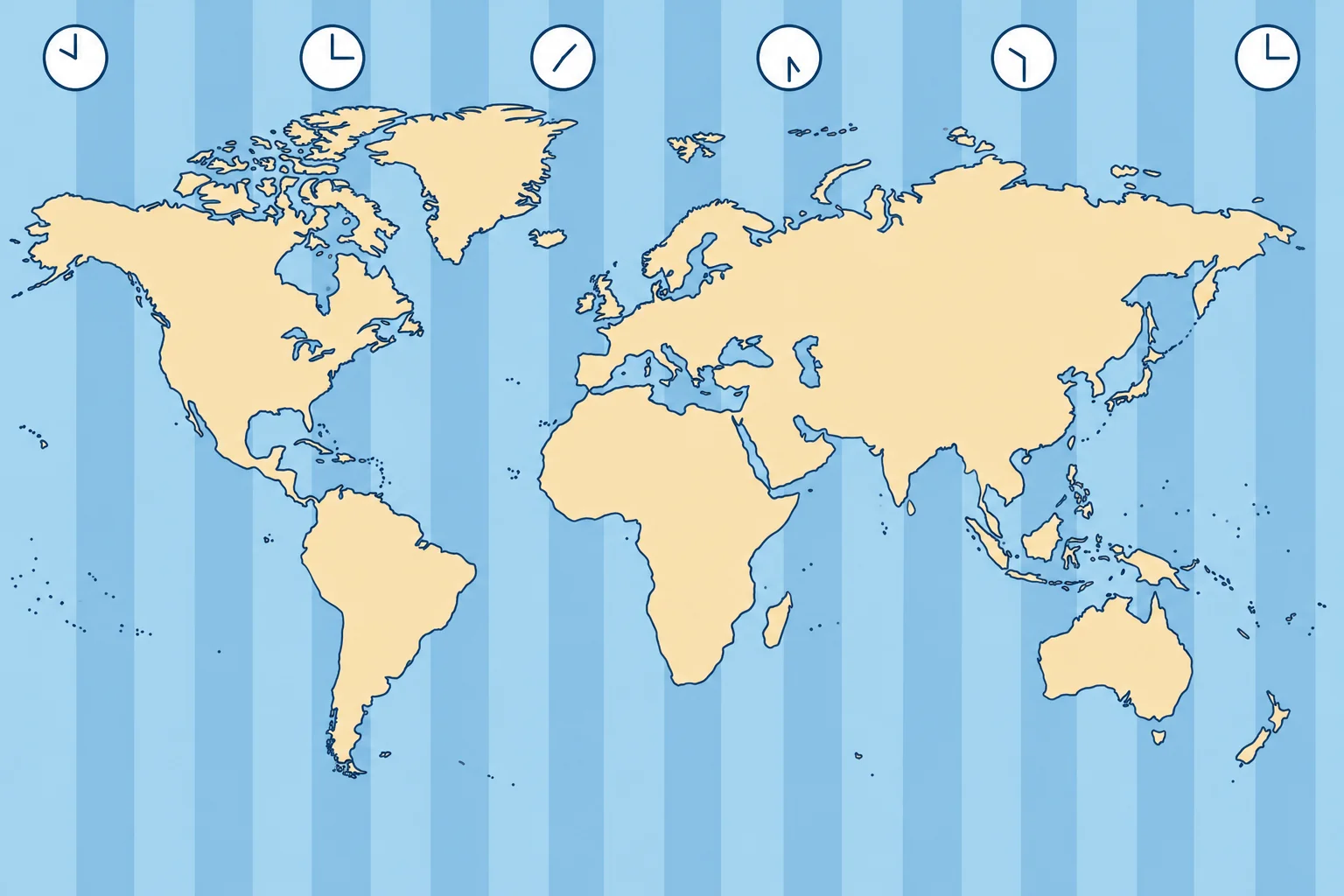
UT, zone time and the zone description
1The lesson in plain words
For nautical zone time, UT = ZT + ZD. The zone description (ZD) is positive west and negative east of zone 0. Ships may keep UT instead.
Universal Time
Universal Time (UT) follows Earth's rotation and is referenced to Greenwich. The almanac's tables use it. Your satellite navigator and radio time signals give UTC (Coordinated Universal Time). Occasional leap seconds keep UTC within 0.9 s of UT1, the rotation-based time scale. For this compass check, treat UTC as UT. GMT is the older name you may hear.
Time zones
At sea the world is divided into 24 time zones, each 15° of longitude wide, centred on multiples of 15°. Zone 0 runs from 7.5°W to 7.5°E. Each zone keeps the time of its central meridian: zone time (ZT). Divide your longitude by 15 and round to the nearest whole number to get your zone.
The zone description
The zone description (ZD) is the number of hours you add to zone time to get UT: UT = ZT + ZD. West of Greenwich clocks are behind UT, so ZD is plus; east of it they are ahead, so ZD is minus. A zone at 30°W is +2; one at 135°E is −9. Turn the rule round for the other way: ZT = UT − ZD.
Worked examples
At 024°20′W, 24.3 ÷ 15 = 1.6, so ZD is +2. Zone time 2215 on 3 March gives UT 2215 + 2 h = 0015 on 4 March: watch the date. At 140°E the ZD is −9: ZT 0800 on 5 June gives UT 2300 on 4 June. Log the UT of every bearing you will work with the almanac.
Changing zones
If your ship keeps nautical zone time, put clocks back an hour when moving one zone west, or forward when moving one zone east. The master decides when, often at night or a change of watch. Many ocean sailors keep the log in UT throughout to avoid mistakes.
2Key data
- UT
- Time at Greenwich; UTC from radio and GNSS, within 0.9 s
- Zone width
- 15° of longitude; zone 0 from 7.5°W to 7.5°E
- Rule
- UT = ZT + ZD; ZT = UT − ZD
- Sign of ZD
- West longitude +, east longitude −
- Example
- 024°20′W: ZD +2; ZT 2215 → UT 0015 next day
- Spanish terms
- Tiempo universal (TU), huso horario, hora del huso
3Key points
- 1
The almanac runs on UT; GNSS and time signals give UTC, close enough for navigation.
- 2
Each zone is 15° wide; zone = longitude ÷ 15, rounded.
- 3
UT = ZT + ZD: ZD is plus in west longitude, minus in east.
- 4
Check the date whenever adding the ZD passes midnight.
4Frequent mistakes
Wrong: East longitude zones have a positive zone description.
Right: East of Greenwich, clocks are ahead of UT, so you subtract: ZD is minus.
Wrong: Change the hour but not the date when converting near midnight.
Right: 2215 ZT on 3 March with ZD +2 is 0015 UT on 4 March.
Wrong: Use the zone time of a bearing to enter the almanac.
Right: Convert to UT first. The almanac's tables are in UT.
5Practice case & exam keys
At 038°10′W, your watch reads 2230 ZT on 10 August. A crew member labels the Polaris bearing 0130 UT, 10 August. Can you use that almanac entry? Explain.
Show the answer
No. 38°10′ ÷ 15 rounds to ZD +3. UT = 2230 + 3 h = 0130 on 11 August. The hour is right but the date is wrong. Correct the date before using the almanac.
Exam keys
- UT is the almanac's time scale; UTC within 0.9 s, treated as UT.
- Zones are 15° wide; ZD = longitude ÷ 15, rounded; west +, east −.
- UT = ZT + ZD; watch the date across midnight.
- For nautical zone time, ships reset clocks an hour at a time when changing zones.
Finish this unit
When you've read it, match the terms, then answer three questions. Get them all right to finish the unit; opening the page alone doesn't count.
My notes for this unit
No notes