

Legal time, summer time and the date line
1The lesson in plain words
Legal time is set by the country and may differ from nautical zone time. Check summer time, the time basis of tide tables, and date changes at sea.
Legal time
Your legal or official time is the time set by the country, including summer time when it applies. Standard time is the time without that summer adjustment. Most of mainland Spain lies in nautical zone 0 but keeps Central European Time (CET), UT + 1, in winter. Spanish textbooks call nautical zone time hora del huso and official time hora oficial.
Spain and the Canaries
Mainland Spain, the Balearics, Ceuta and Melilla keep Central European Time (CET), UT + 1, or Central European Summer Time (CEST), UT + 2. The Canaries keep Western European Time (WET), UT + 0, or Western European Summer Time (WEST), UT + 1. They are always one hour behind the mainland. So 1000 summer time in Valencia is 0800 UT and 0900 in Las Palmas.
Summer time
Across the EU, summer time runs from 01:00 UT on the last Sunday of March to 01:00 UT on the last Sunday of October (Directive 2000/84/EC). Spain has asked the EU to end the twice-yearly change, but as of October 2026 no decision has been taken, so the change continues. Tide tables state their time basis: add one hour only when converting local standard time to local summer time.
Zone and shore together
Off western Galicia, west of 7.5°W, a boat keeping zone time is in zone +1 while the shore keeps UT + 2 in summer: three hours apart. At 0600 ZT there, UT is 0700 and Spanish clocks read 0900. Keep the log in one stated time, and give times by radio in UTC or say which local time you mean.
The date line
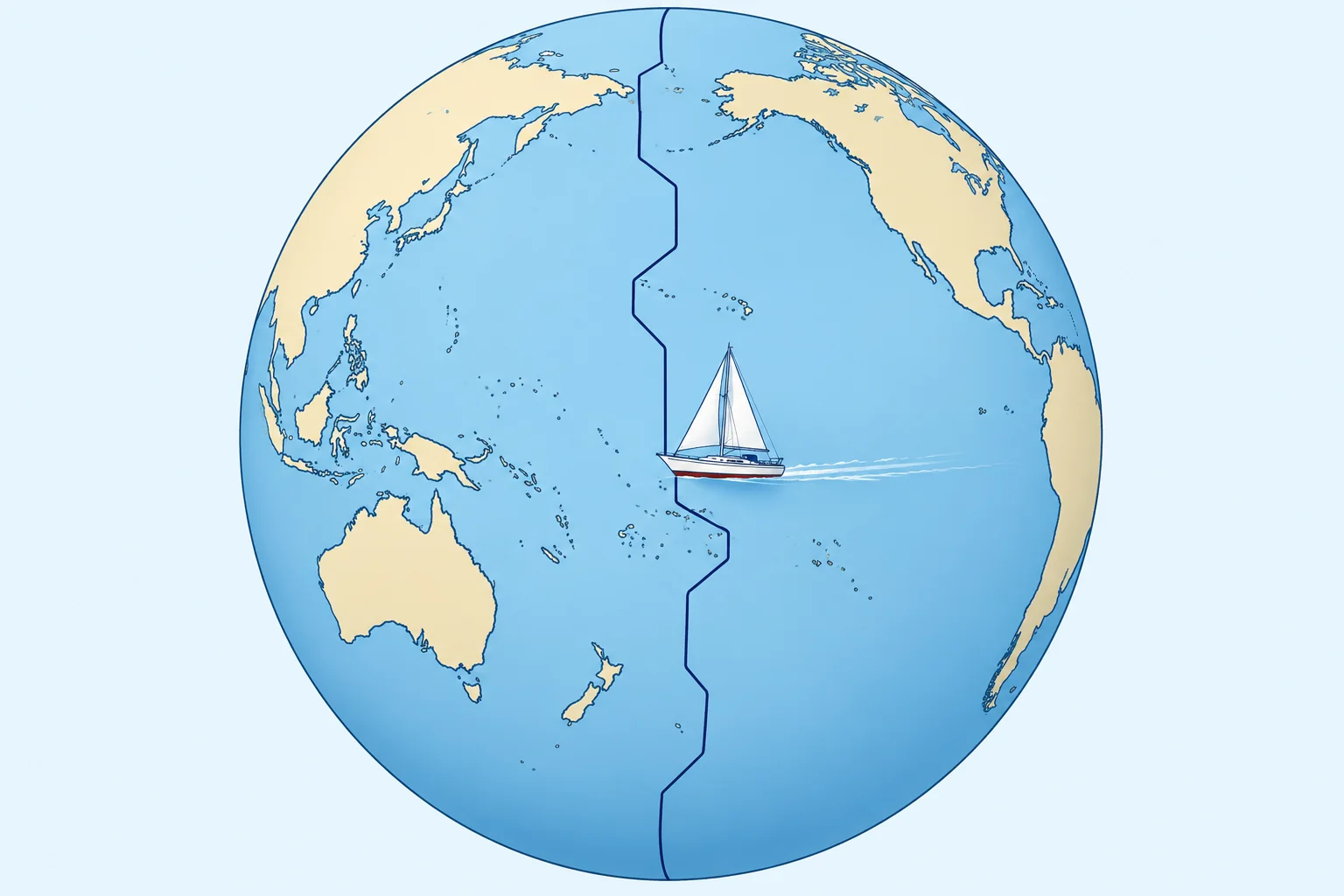
Nautical zone 12 is split at 180°: 172.5°E–180° has ZD −12; 180°–172.5°W has ZD +12. Across this split, clock time is unchanged but dates differ by a day. Crossing westward, add a day; eastward, subtract a day. The International Date Line bends around island states. Do not assume its bends follow the nautical-zone split or that official clock times stay unchanged.
2Key data
- Mainland Spain, Balearics
- CET UT + 1; CEST UT + 2 in summer
- Canary Islands
- WET UT + 0; WEST UT + 1 in summer
- EU summer time
- Last Sunday March to last Sunday October, 01:00 UT
- Date line westward
- Add a day: Monday becomes Tuesday
- Date line eastward
- Go back a day: the date repeats
- Spanish terms
- Hora del huso, hora oficial, línea de cambio de fecha
3Key points
- 1
Legal time is set by each state and may not match the nautical zone.
- 2
Mainland Spain: UT + 1, UT + 2 in summer; the Canaries one hour less.
- 3
Check the table's time basis; add one hour only to convert local standard time to local summer time.
- 4
Crossing the date line westward add a day; eastward subtract one.
4Frequent mistakes
Wrong: Mainland Spain keeps zone time 0 because it lies near Greenwich.
Right: Mainland Spain keeps CET, UT + 1, or CEST, UT + 2. That is one or two hours ahead of nautical zone 0, but two or three ahead of zone +1.
Wrong: The Canaries keep the same time as Madrid.
Right: The Canaries are one hour behind the mainland all year: UT + 0 in winter, UT + 1 in summer.
Wrong: Crossing the date line, change the clocks by 24 hours.
Right: At the nautical 180° split, change the date by one day; zone time stays the same on either side.
5Practice case & exam keys
Heading west at 179°W, ZD +12, it is 1000 ZT on Monday 12 October. Two hours later you cross 180° into ZD −12. A crew member logs 1200 Monday. Is that entry correct? Give the correct time and date.
Show the answer
No—the date must advance. Two hours later it is 1200 ZT Monday, which is 0000 UT on Tuesday 13 October. West of the line, ZT = UT − ZD = 0000 + 12 h = 1200. Same clock time, but you crossed westward, so the date advances: 1200 on Tuesday 13 October.
Exam keys
- Legal (official) time: set by each state; Spain CET/CEST, Canaries WET/WEST.
- EU summer time: last Sunday of March to last Sunday of October, 01:00 UT.
- Zone 12: 172.5°E–180° has ZD −12; 180°–172.5°W has ZD +12.
- Date line westward: add a day; eastward: repeat a day.
Finish this unit
When you've read it, match the terms, then answer three questions. Get them all right to finish the unit; opening the page alone doesn't count.
My notes for this unit
No notes