

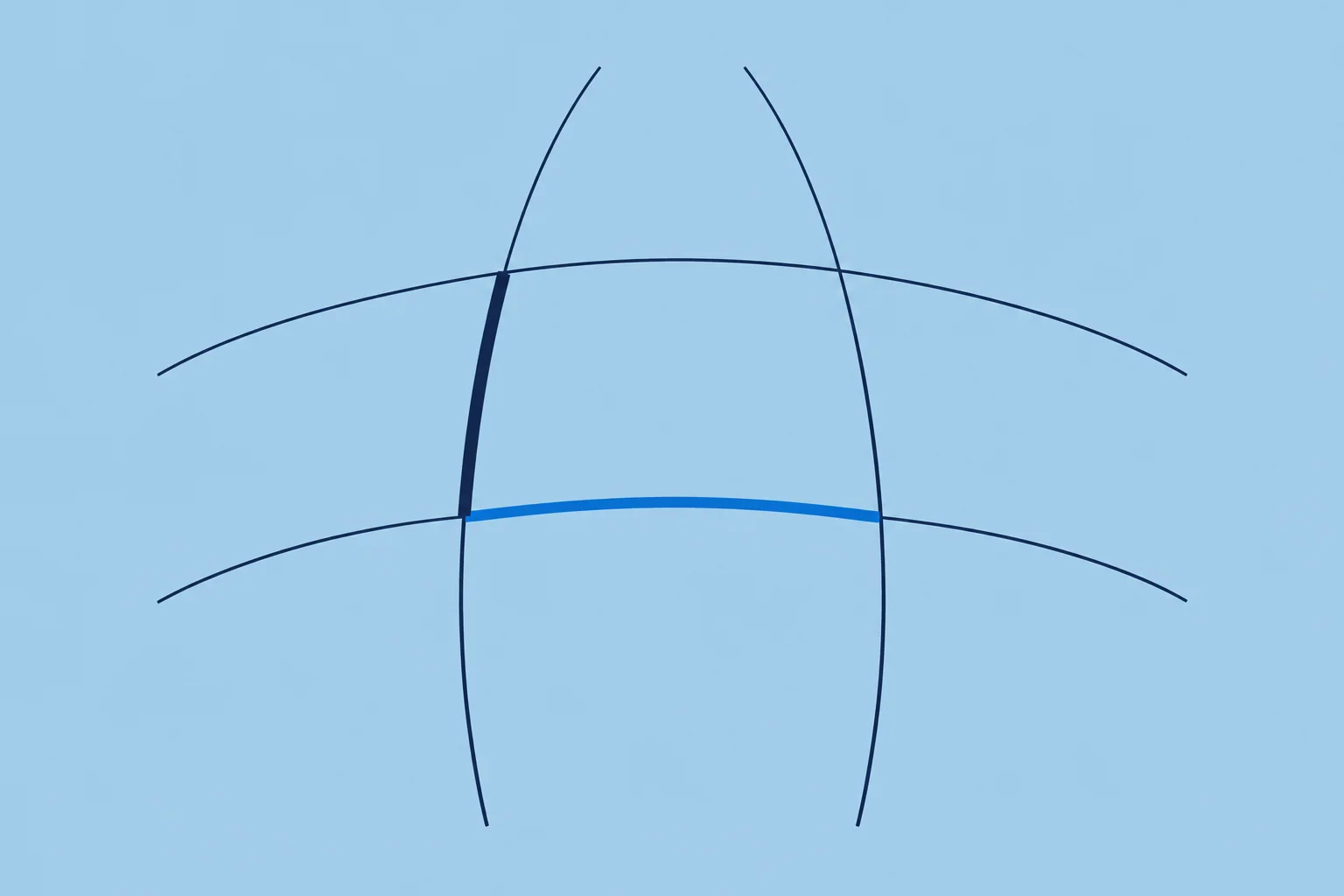
Difference of latitude, difference of longitude and departure
1The lesson in plain words
Calculating a rhumb line needs three quantities: d.lat and departure in miles, and d.long in minutes of arc. Name each one N, S, E or W.
Why calculate
On a chart you lay off a rhumb line with a ruler (Chart basics). Across several charts or on a small-scale chart, calculation can be quicker. Its accuracy depends on the method you use. Spanish courses call this estima analítica, the analytical solution of the derrota loxodrómica. A rhumb line crosses every meridian at the same angle, so it is one steady course. It is also how you check the DR of a long run (Dead reckoning unit).
d.lat and d.long
Difference of latitude (d.lat) is the arc of a meridian between two parallels, in minutes; each minute is one nautical mile. Difference of longitude (d.long) is the arc of the equator between two meridians, also in minutes of arc. But a minute of d.long is a mile only at the equator. Name both by the direction you travel: d.lat N or S, d.long E or W.
Departure
Departure (dep) is the distance you make east or west, in nautical miles. Along a parallel, dep = d.long × cos latitude: at 60° a minute of longitude is only half a mile. Departure is a distance, d.long an angle, so never add one to the other or put one in place of the other. Spanish: apartamiento.
Same and opposite names
When both latitudes have the same name, both N for example, d.lat is their difference; with opposite names, one N and one S, add them. Do the same with longitudes on either side of Greenwich. If d.long comes out over 180°, take it from 360° and reverse its name: the short way crosses the 180° meridian.
Naming the course
Formulas give a course angle from 0° to 90°, measured from north or south. Write it in quadrant form first, such as S 66° W, then convert to three figures: N x E = x; S x E = 180 − x; S x W = 180 + x; N x W = 360 − x. So S 66° W is 246°. Spanish courses call the quadrant form the rumbo cuadrantal.
2Key data
- d.lat
- Minutes of latitude = miles; named N or S
- d.long
- Minutes of arc of longitude; named E or W
- Departure
- Along a parallel: dep = d.long × cos lat
- Quadrant to three figures
- N x E = x; S x E = 180 − x; S x W = 180 + x; N x W = 360 − x
- Over 180° of d.long
- Use 360° − d.long and reverse its name
- Spanish terms
- Diferencia de latitud y de longitud, apartamiento, latitud media
3Key points
- 1
d.lat in minutes equals miles; d.long is an angle, not a distance.
- 2
Departure is east–west distance. Along a parallel: dep = d.long × cos latitude.
- 3
Same names subtract, opposite names add; over 180° of d.long, go the other way.
- 4
Name the course by quadrant first, then convert to three figures.
4Frequent mistakes
Wrong: Treat d.long in minutes as miles.
Right: Only d.lat minutes are miles. Along a parallel, convert d.long to departure with the cosine of the latitude.
Wrong: Subtract the latitudes when one is N and the other S.
Right: With opposite names, add them: from 5°N to 3°S, d.lat is 8° S.
Wrong: Write a quadrant course S 30° E as 210°.
Right: S x E = 180 − x: S 30° E is 150°. S 30° W would be 210°.
5Practice case & exam keys
You leave 2°10′N 178°40′E for 1°50′S 177°20′W. A crew member proposes d.lat 4° S and d.long 356° W. Would you use both?
Show the answer
No. Use d.lat 4° S, but d.long 4° E. Latitudes have opposite names: 2°10′ + 1°50′ = 4°00′ S, 240′ S. Longitudes also have opposite names: 178°40′ + 177°20′ = 356°00′. Over 180°, use 360° − 356° = 4°00′ and reverse W to E: 240′ E. The short way crosses the 180° meridian.
Exam keys
- d.lat: minutes = miles; d.long: minutes of arc; departure: miles east–west.
- Along a parallel: dep = d.long × cos lat.
- Same names subtract, opposite names add; d.long over 180°: 360° minus it, name reversed.
- Quadrant course to three figures: S x E = 180 − x, S x W = 180 + x, N x W = 360 − x.
Finish this unit
When you've read it, match the terms, then answer three questions. Get them all right to finish the unit; opening the page alone doesn't count.
My notes for this unit
No notes