

Finding set and drift from a fix
1The lesson in plain words
Plot where your boat would be without a stream, then compare it with a fix. The difference gives set and drift, together with any input errors.
The idea
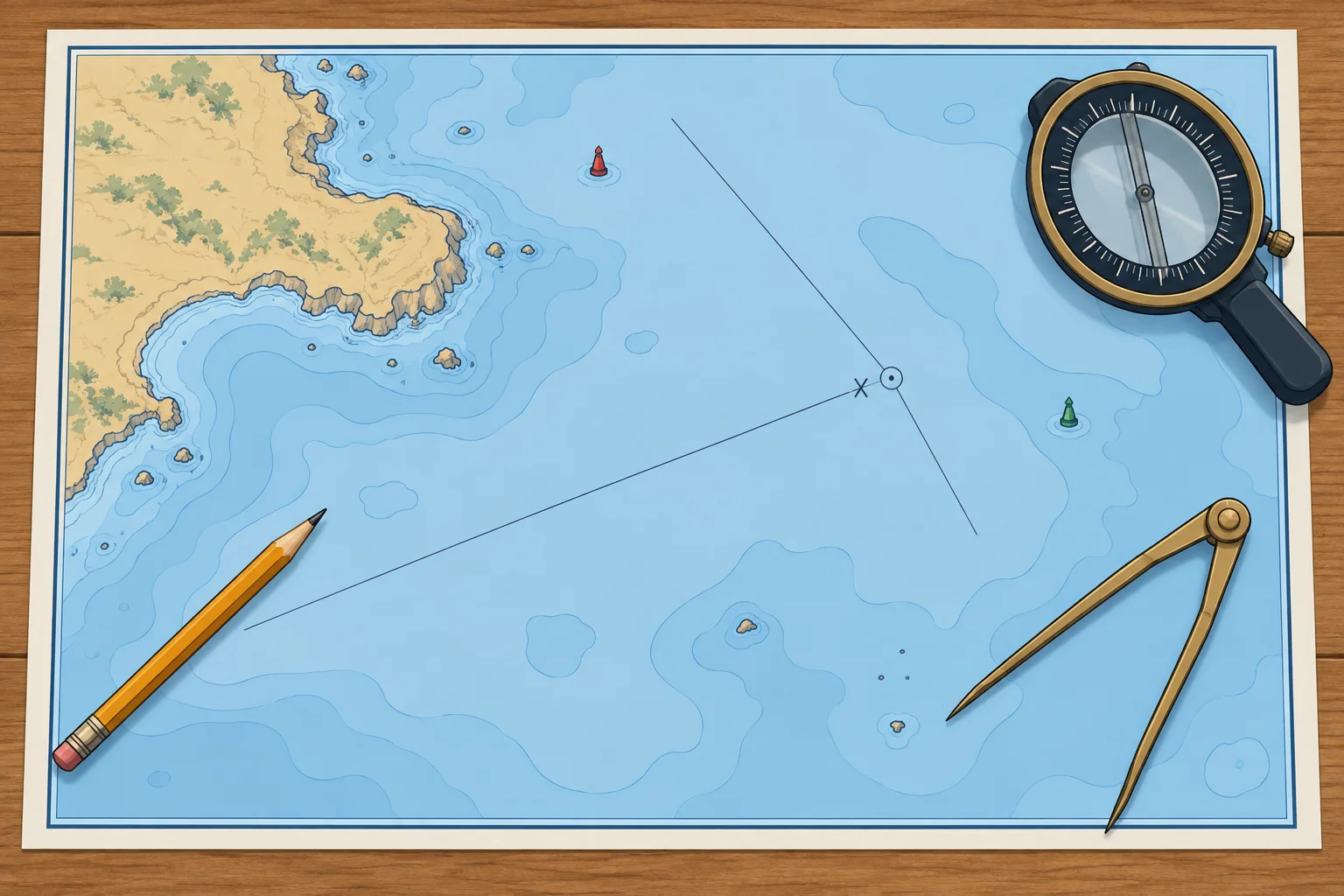
From your last fix, lay off your water track (heading corrected for leeway) and the distance run on the log. This gives the position you would have reached with no stream; the Dead reckoning unit names this kind of position and its symbol. Compare this with your checked fix for the same time. The line from the no-stream position to the fix shows the stream plus any input errors: its direction is the set, its length the drift.
Rate
Drift is a distance over the time elapsed. Divide it by the hours to get the rate: 2.1 M of drift in 1 h 30 min is 2.1 ÷ 1.5 = 1.4 kn. Use the checked measurement alongside the next leg's predicted stream when updating your course to steer.
Worked example
At 0900 you fix your position at A; the log reads 10.0 M. You hold a water track of 270°T. At 1030 the log reads 17.5 M: 7.5 M through the water. Plot 7.5 M along 270°T from A to W. The 1030 fix lies 2.1 M from W in the direction 030°T. So the stream set 030°T, drift 2.1 M, rate 1.4 kn.
What else it holds
The residual (the remaining offset) holds every other error too: a wrong leeway estimate, a log that reads high or low, compass error and poor steering. A poor fix gives a false answer as well. Check the inputs before relying on the result, then repeat the measurement.
Use it ahead
The measured vector averages the current over the elapsed interval and includes errors. Compare it with the prediction for the same interval and area. For the next leg, start with its predicted set and rate; adjust only for a checked discrepancy likely to persist. A measured 1.4 kn against a predicted 1.0 kn does not prove that the next hour will also be stronger. Measure again.
2Key data
- Set
- Direction from the no-stream position to the fix
- Drift
- Distance from the no-stream position to the fix
- Rate
- Drift ÷ hours elapsed
- Example
- 030°T, 2.1 M in 1.5 h = 1.4 kn
3Key points
- 1
Plot the no-stream position from water track and log distance, then fix.
- 2
No-stream position → fix: direction = set, length = drift.
- 3
Rate = drift ÷ time. 2.1 M in 1.5 h = 1.4 kn.
- 4
The result includes leeway, log and compass errors: check before you trust it.
4Frequent mistakes
Wrong: Measure from the fix back to the no-stream position.
Right: Measure from the no-stream position to the fix. The other way gives the reciprocal, 180° wrong.
Wrong: The line from the last fix to the new fix shows the stream.
Right: That line gives the direction and distance made good between fixes, not the stream.
Wrong: The measured vector is pure tidal stream.
Right: It also contains leeway, log and compass errors, and any error in the fix.
5Practice case & exam keys
At 1400 you fix at A, then steer 180°T at 5.0 kn STW, log checked. You plot your no-stream position using 180°T with no leeway allowance. At 1500 the fix lies 1.0 M east of it. The atlas predicted 0.5 kn east. A west wind is blowing. What can you conclude?
Show the answer
The residual is 1.0 M east in one hour: set 090°T, rate 1.0 kn. It includes any unallowed leeway and other errors, so it does not establish a 1.0 kn tidal stream. Check the inputs and estimate leeway before attributing the remainder to current. Use the next leg's predicted stream with a justified adjustment; do not add leeway again to the full residual. Repeat the measurement.
Exam keys
- Set and drift: from the no-stream position to the fix.
- Rate = drift ÷ elapsed time.
- Last fix to new fix = direction and distance made good, not stream or the full path.
- Measured vector includes leeway, log, compass and fix errors.
Finish this unit
When you've read it, match the terms, then answer three questions. Get them all right to finish the unit; opening the page alone doesn't count.
My notes for this unit
No notes