

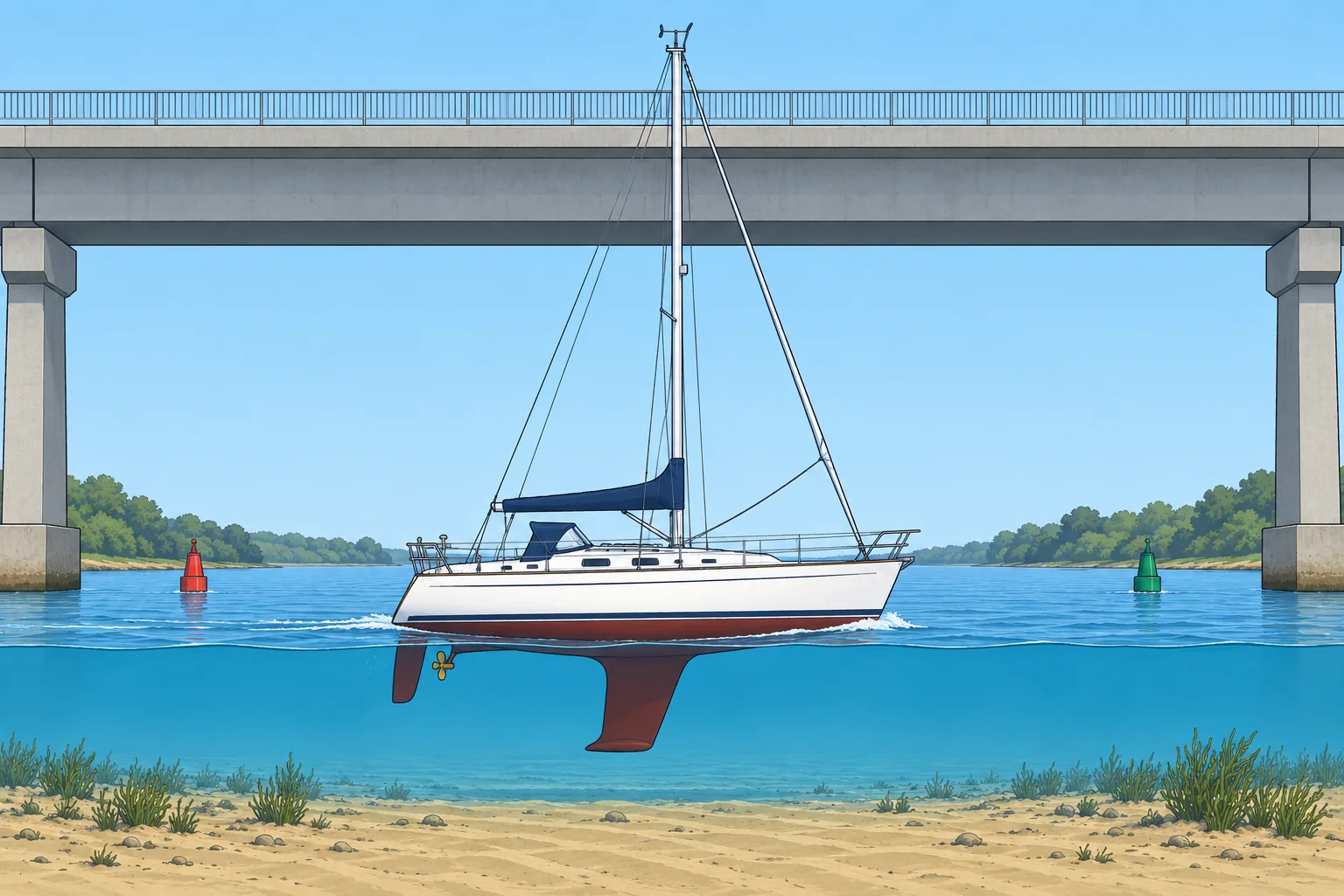
Clearances: bridges, air draught, shoals and drying heights
1The lesson in plain words
Under a bridge you need air above the masthead; over a shoal, water under the keel. Both depend on the height of tide and the chart's datums.
Air draught
Air draught is the height of your boat's highest point above the waterline: masthead, VHF aerial, wind instrument or light. Measure it or get it from the builder, add whatever is fitted on top, and write it in the boat's papers. Spanish courses call it the calado aéreo. A lightly loaded boat floats a little higher, so take the figure for the lightest condition.
Clearance under a bridge
Read the chart's stated vertical-clearance datum first. Many Admiralty charts use HAT, highest astronomical tide; other charts use different levels, such as MHWS. For clearance above HAT, clearance now = charted clearance + HAT − height of tide. HAT and tide height must share chart datum. Under power cables, distinguish physical clearance from safe vertical clearance, which includes an allowance for electrical discharge, a spark jumping to your mast. Use the published safe value and local instructions.
Bridge worked example
A bridge has a charted clearance of 12.0 m above HAT; HAT there is 5.4 m. At the time you pass, the height of tide is 3.2 m: clearance = 12.0 + (5.4 − 3.2) = 14.2 m. Your air draught is 15.0 m and you want 1.0 m spare, so you need 16.0 m. The tide must be no higher than 5.4 − (16.0 − 12.0) = 1.4 m. Swell and wash make the mast pitch, so keep the margin generous.
Under-keel clearance
Under-keel clearance (UKC) is the water between your keel and the seabed. Over a sounding, depth = charted depth + height of tide. Over a drying height, shown underlined and measured above chart datum, depth = height of tide − drying height. Then UKC = depth − draught. Decide your minimum UKC first: more over rock, in swell, at speed and where the survey is old.
Shoal worked example
You draw 1.8 m and want 0.5 m under the keel over a bank drying 1.2 m. Needed height of tide = 1.2 + 1.8 + 0.5 = 3.5 m. Over a 2.4 m sounding with a height of tide of 1.6 m, depth = 4.0 m and UKC = 2.2 m. Turn each needed height into a time window with the tidal curve, and widen the margin when the barometer is high.
2Key data
- Bridge clearance now (above HAT)
- Charted clearance + (HAT − height of tide)
- Depth over a sounding
- Charted depth + height of tide
- Water over a drying height
- Height of tide − drying height
- UKC
- Depth − draught
- Needed height over a drying bank
- Drying height + draught + UKC wanted
- Spanish terms
- Calado aéreo, gálibo, resguardo bajo la quilla
3Key points
- 1
Know your air draught, aerials included, before you meet a bridge.
- 2
For clearance above HAT, you gain HAT minus the height of tide.
- 3
Over a drying height, water = height of tide − drying height.
- 4
Set the UKC you need first, then find the time window from the tidal curve.
4Frequent mistakes
Wrong: Compare your air draught with the charted clearance alone.
Right: Read the chart's clearance datum first. For clearance above HAT, add HAT minus the height of tide, then check your margin.
Wrong: Add a drying height to the height of tide.
Right: A drying height is above chart datum: subtract it from the height of tide.
Wrong: Measure air draught to the top of the mast only.
Right: Include the aerial, wind instrument and masthead light, which often add half a metre or more.
5Practice case & exam keys
A bridge's charted clearance is 10.5 m above HAT; HAT is 4.8 m. Your air draught is 13.0 m and you want 1.0 m spare. The height of tide falls through 2.0 m at 1340. Can you pass at 1400?
Show the answer
You need 14.0 m of clearance. The maximum height of tide is 4.8 − (14.0 − 10.5) = 1.3 m. At 1340, clearance is only 10.5 + 4.8 − 2.0 = 13.3 m. The height at 1400 is not given, so you cannot confirm passage then. Use the curve to find when the tide falls to 1.3 m or lower, and check conditions before passing.
Exam keys
- Clearance now = charted clearance (above HAT) + HAT − height of tide.
- Depth = charted depth + height of tide; over a drying height, height of tide − drying height.
- UKC = depth − draught; needed height over a bank = drying height + draught + UKC.
- Check the chart's notes for the clearance datum.
Finish this unit
When you've read it, match the terms, then answer three questions. Get them all right to finish the unit; opening the page alone doesn't count.
My notes for this unit
No notes