

The rule of twelfths and where it fails
1The lesson in plain words
The rule of twelfths checks a smooth, symmetrical six-hour tide. Double or distorted tides break the pattern; in small ranges, weather may dominate.
The rule in brief
The rule of twelfths splits the rise or fall into six equal time steps carrying 1, 2, 3, 3, 2 and 1 twelfths of the range; the calculator on /navigation/tides works it through. With a 3.6 m range, after two steps 3/12 of it, 0.9 m, has come in. The rule assumes a smooth, symmetrical tide lasting about six hours. If the real duration differs, divide the actual duration by six. In a regular port it stays close to the curve.
Double tides
Some tides are not one smooth wave. Between Swanage and Selsey, the Admiralty special curves are referenced to LW. Southampton has double high water, two high-water peaks; other ports have a long stand, when the level changes little. Portland has double low water, while Le Havre has a long HW stand. Use each port's published curve and reference time; do not assume one timing convention or duration of rise applies everywhere. The twelfths do not reproduce these shapes.
Microtides
In much of the Mediterranean the astronomical range is less than half a metre; the northern Adriatic and the Gulf of Gabès are exceptions. There the weather matters as much as the Moon. Air pressure raises or lowers the sea by about 1 cm per hPa, so a deep low can add 0.2 m or more, and wind can pile water up against a coast or blow it away. Use official predictions and observed levels; weather can overwhelm a 0.3 m astronomical range.
Shallow water and rivers
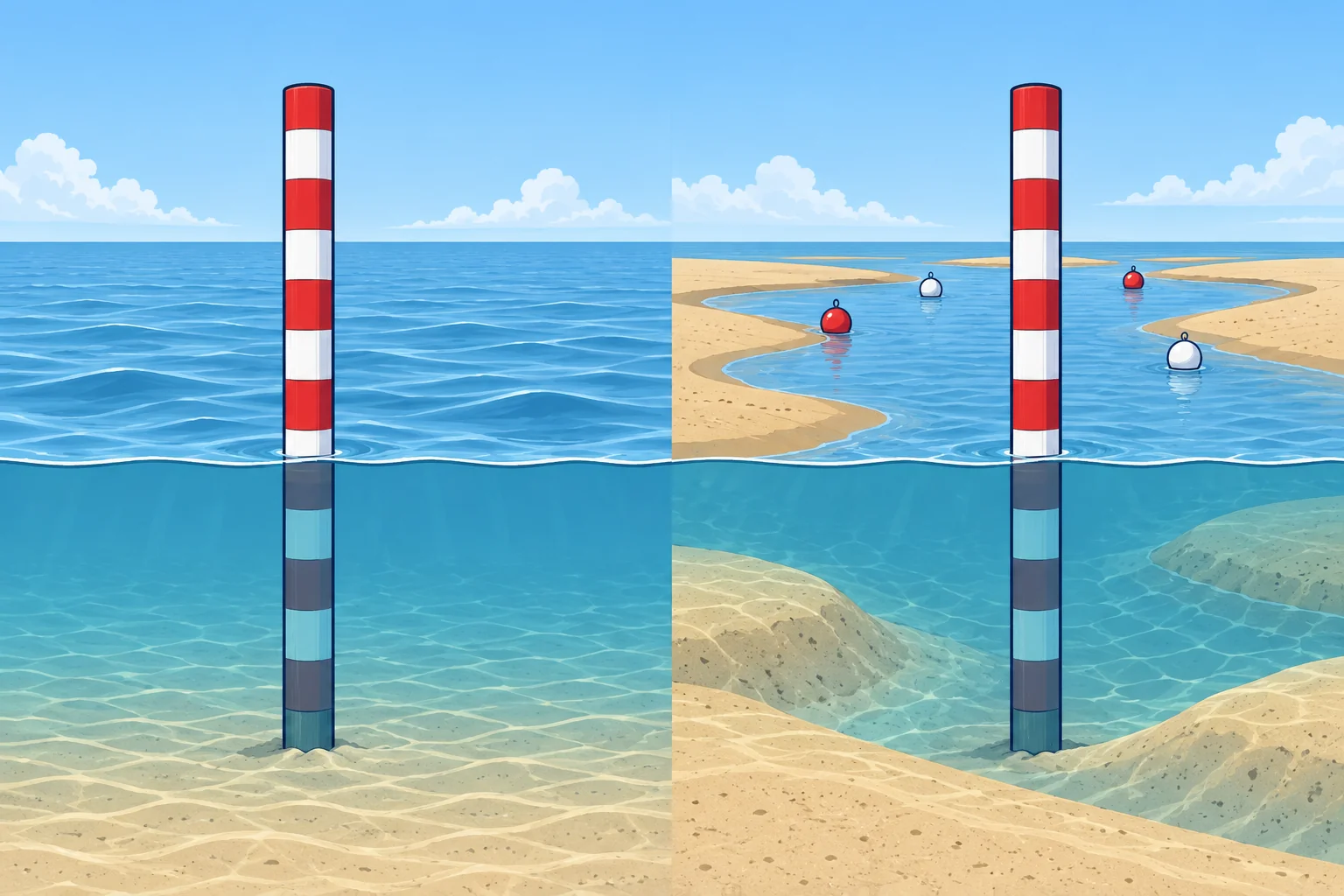
Shallow water can distort the tide: the rise and fall may take different times, and the height may change unevenly within each period. Low water may occur later upriver, and heavy rain can raise low-water levels. Even with adjusted time steps, the twelfths may not fit the local curve. Use the port's own curve, local tables or harbour information.
Use it as a check
Work real decisions with the curve or official predictions, then use the twelfths to catch a gross error, such as a misread table or a mistaken sign. Where the tables print a warning or a special curve, follow it. If the sounder shows less water than expected, slow down and investigate before relying on your planned clearance.
2Key data
- Twelfths per sixth
- 1, 2, 3, 3, 2, 1 twelfths of the range
- Assumes
- About 6 h duration, smooth and symmetrical
- Swanage to Selsey
- Special curves timed from LW; double HW or long stand
- Air pressure
- About 1 cm per hPa; low pressure raises the sea
- Mediterranean
- Range often under 0.5 m; weather can dominate
3Key points
- 1
The twelfths assume a smooth, symmetrical tide of about six hours.
- 2
Double high waters and stands, as round the Solent, need the tables' special curves.
- 3
In microtidal seas, pressure and wind can matter as much as the predicted range.
- 4
Use the twelfths to check a calculation, not to make a close-margin decision.
4Frequent mistakes
Wrong: Apply the rule of twelfths at Southampton like anywhere else.
Right: The Solent has double high waters and stands. Use the special curves timed from LW.
Wrong: Ignore the barometer where the range is small.
Right: In a 0.3 m range, a deep low or a strong wind can change the level by as much as the tide itself.
Wrong: Always use six one-hour steps.
Right: Divide the actual duration from LW to HW by six; in an estuary even that is only rough.
5Practice case & exam keys
You plan to enter a shallow Mediterranean marina with 0.2 m to spare at mean sea level. The predicted range is 0.3 m, the barometer reads 1032 hPa and a fresh offshore wind has blown for two days. Is the margin enough?
Show the answer
No. High pressure about 20 hPa above average lowers the sea roughly 0.2 m, and a lasting offshore wind can lower it further near the coast. Your margin could vanish whatever the tide does. Check the marina's or port authority's sea-level information, wait for better conditions, or choose a deeper berth.
Exam keys
- Twelfths: 1/12, 2/12, 3/12, 3/12, 2/12, 1/12 of the range over six equal time intervals.
- Double tides and distorted estuary curves defeat the pattern; in microtides, weather may dominate.
- About 1 cm of sea level per hPa: low pressure raises, high pressure lowers.
- Use the port's curve or official predictions for real decisions.
Finish this unit
When you've read it, match the terms, then answer three questions. Get them all right to finish the unit; opening the page alone doesn't count.
My notes for this unit
No notes