

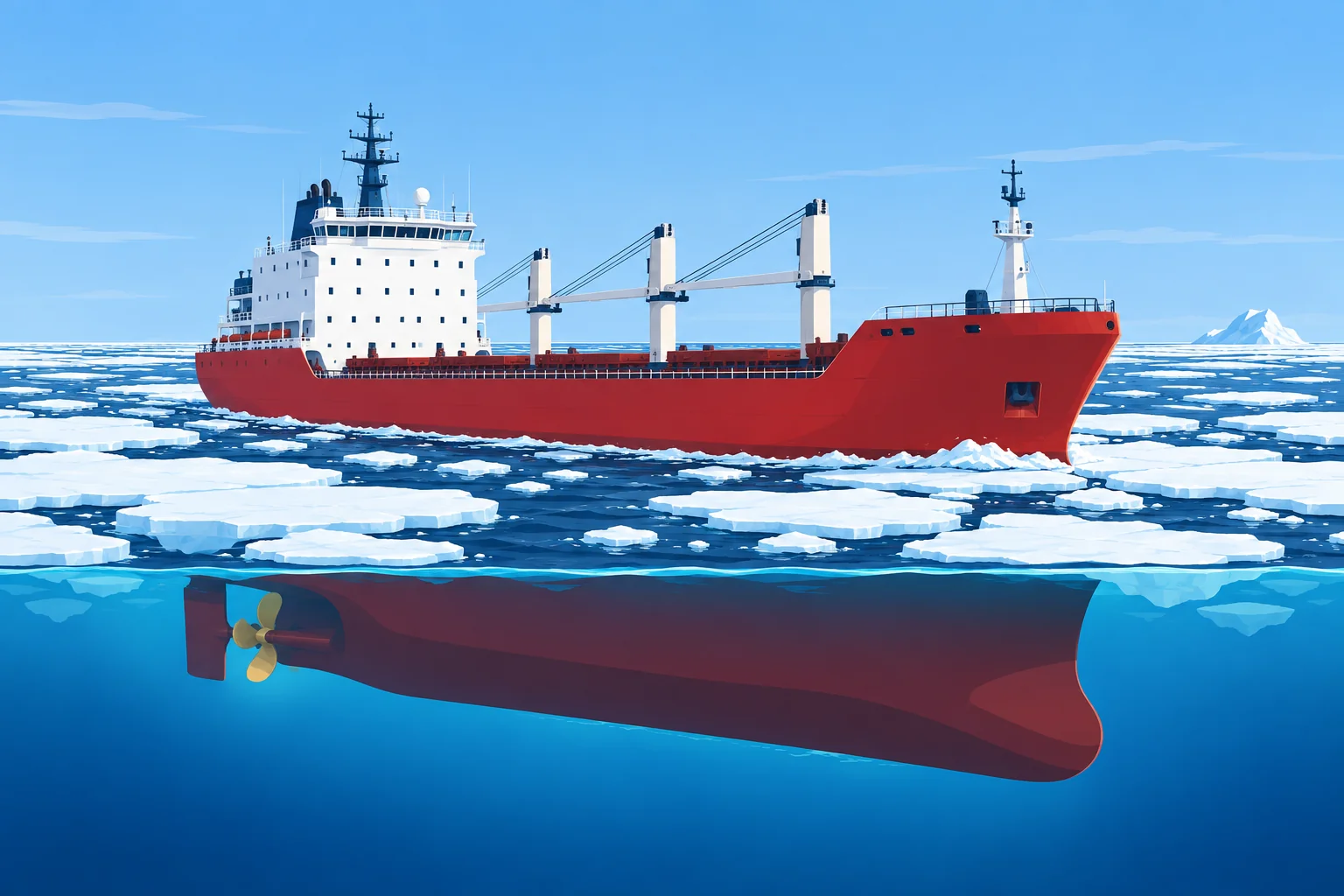
Ice navigation: the Polar Code, PWOM and POLARIS
1The lesson in plain words
In polar waters the ship's certificate, manual and an ice-risk assessment set your limits. Plan with ice information, not just with the chart.
The Polar Code
The IMO Polar Code entered into force on 1 January 2017 through SOLAS and MARPOL. It covers Code-defined Arctic waters and the Antarctic area, south of 60° S. Check which safety and pollution provisions apply to your ship; their scopes differ. Ships subject to the full SOLAS safety regime need a Polar Ship Certificate showing their category and ship-specific limits.
Categories and limits
Category A ships are designed for at least medium first-year ice, possibly with old-ice inclusions. Category B ships are not Category A and are designed for at least thin first-year ice, possibly with old-ice inclusions. Category C ships are designed for open water or ice less severe than A and B. These categories do not replace the ship-specific certificate and PWOM limits.
The PWOM
Ships subject to the full SOLAS safety regime carry a Polar Water Operational Manual (PWOM). It gives the ship's capabilities and limits, and procedures for normal operation and emergencies in ice and low temperatures. It includes the method the ship uses to assess its operational limits in ice. The plan must stay within the certificate and the PWOM.
POLARIS
POLARIS is an IMO-accepted method in MSC.1/Circ.1519. An ice regime is the mix of ice types and open water around the ship. Describe it from ice charts and observation. Include every ice type and open water, with concentrations in tenths totalling ten. Each component has a risk index value (RIV) for your ice class. The risk index outcome is RIO = sum of concentration × RIV. RIO of zero or above means normal operation. Negative values mean elevated risk or special consideration, depending on class and value.
Planning in ice
The Polar Code's voyage planning chapter asks you to consider current ice information and forecasts, statistical ice and temperature data, places of refuge, areas of limited survey, marine mammals and protected areas, and the limited search and rescue support. Plan to avoid ice where you can, and to slow down in ice and in poor visibility. The Global winds, ocean weather and sea ice unit covers ice terms and icebergs.
Qualified officers
STCW regulation V/4 sets basic and advanced training for ships in polar waters. In open waters, officers on tankers and passenger ships need basic training. In other ice-covered waters, the master and chief mate need advanced training and the officers of the watch basic training. Handling a ship in ice is covered in the ship-handling units.
2Key data
- Polar Code in force
- 1 January 2017 (SOLAS chapter XIV and MARPOL)
- Antarctic area
- South of 60° S
- Category A / B / C
- A: medium first-year; B: thin, not A; C: less severe than A/B
- POLARIS
- RIO = Σ C × RIV; include open water; Σ C = 10
- RIO ≥ 0
- Normal operation
- Polar training
- STCW V/4: basic and advanced
3Key points
- 1
Where the full SOLAS safety regime applies, carry a Polar Ship Certificate (A/B/C) and PWOM.
- 2
POLARIS: include ice and open water, totalling ten tenths. RIO = Σ C × RIV for your ice class; RIO ≥ 0 is normal.
- 3
Plan with current ice information and forecasts, places of refuge and limited SAR support.
- 4
STCW V/4: beyond open water, masters/chief mates need advanced polar training; OOWs need basic training.
4Frequent mistakes
Wrong: Any ship with an ice class can go wherever the ice charts show a way through.
Right: Stay within the Polar Ship Certificate and the PWOM, and assess each ice regime, for example with POLARIS.
Wrong: The voyage plan in polar waters can rely on charted depths alone.
Right: Many polar areas have limited or old surveys. Allow wide margins and use ice, weather and survey information together.
5Practice case & exam keys
Your Category B cargo ship plans an Arctic voyage in autumn. The latest ice chart shows a band of mixed ice across the planned route. The charterer wants the shortest track. What must you do before deciding the route?
Show the answer
Check the Polar Ship Certificate and PWOM limits for this ship. Describe the ice regime on each part of the route from the latest ice charts and forecasts, and work out the RIO with POLARIS for your ice class. Route around regimes with a negative RIO unless the PWOM allows them with conditions. Plan places of refuge, reduced speeds, survey margins and communications, and confirm the officers' polar training.
Exam keys
- Polar Code (1 Jan 2017): Arctic waters and Antarctic area; Polar Ship Certificate categories A, B, C; PWOM.
- POLARIS (MSC.1/Circ.1519): RIO = Σ Ci × RIVi; RIO ≥ 0 normal operation; negative → elevated risk or special consideration.
- STCW V/4: basic (Table A-V/4-1) and advanced (Table A-V/4-2) training.
Finish this unit
When you've read it, match the terms, then answer three questions. Get them all right to finish the unit; opening the page alone doesn't count.
My notes for this unit
No notes