

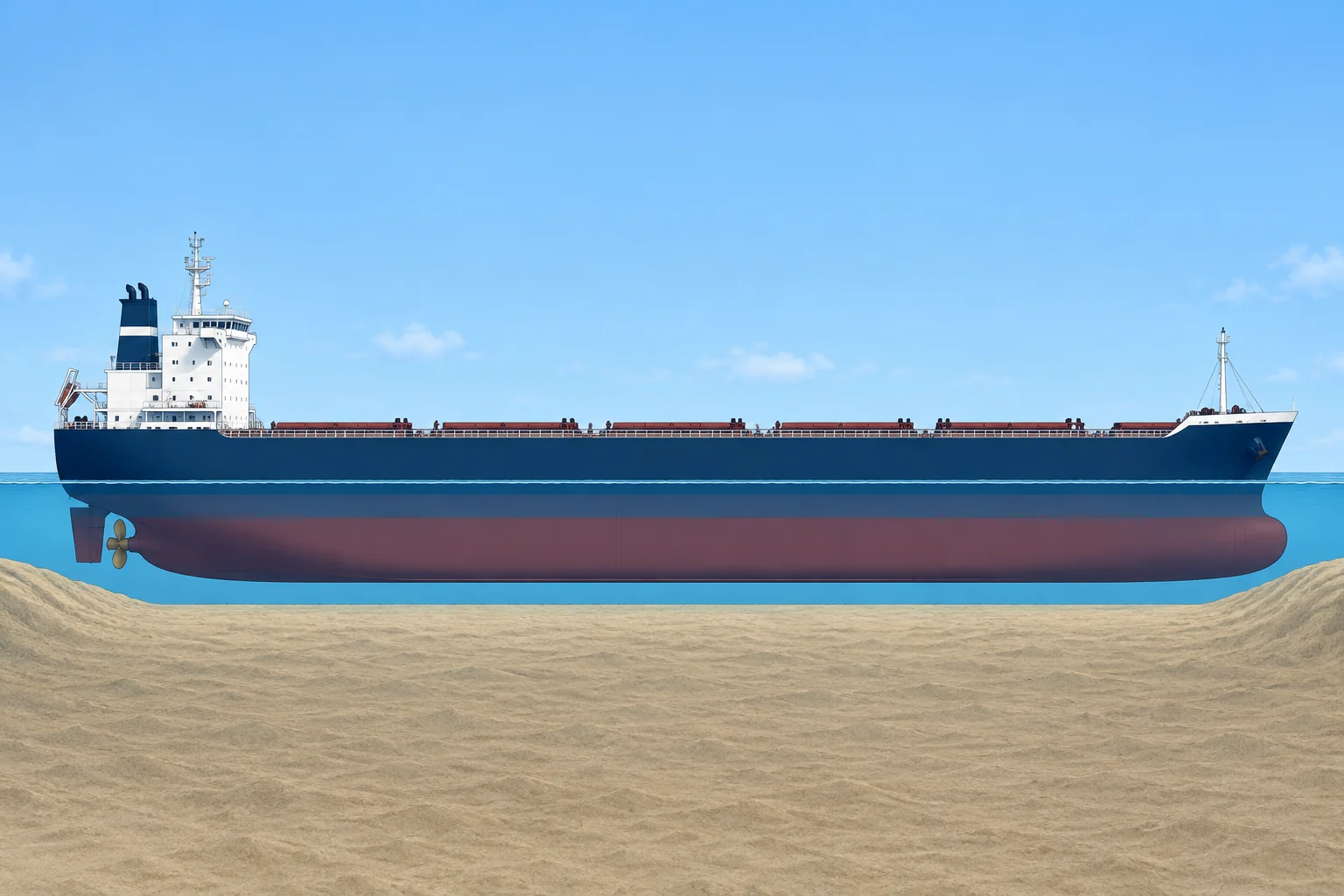
Restricted waters and the under-keel clearance policy
1The lesson in plain words
Under-keel clearance is what is left after every static and moving allowance. Plan it for the worst point, at the planned speed and time.
What it is
Under-keel clearance (UKC) is the water between the keel and the seabed. The static UKC is depth of water minus the ship's draught at rest. Depth of water = charted depth + height of tide. Allow for the accuracy of the survey, using the zone of confidence, and for water density, trim and list. Static UKC is what you have before the ship moves.
Dynamic allowances
A moving ship needs more. Squat, the sinkage and trim change caused by speed in shallow water, grows roughly with the square of speed. Wave response, heave, pitch and roll in swell, takes more. Heel in a turn or from wind lowers the bilge. What is left after these is the dynamic UKC, and that is what must meet the policy.
The policy
Companies and port authorities set a minimum UKC. It is often a percentage of draught, a fixed figure in metres or both, and different for open sea, approaches and port. Use the stricter of the company and port figure. Check least depths and every leg at its expected transit time, allowing for speed and conditions; the lowest remaining dynamic UKC controls.
Squat estimate
A common rule of thumb by Barrass gives maximum squat in metres ≈ Cb × V² ÷ 100 in open shallow water. In a confined channel it is about twice that: Cb × V² ÷ 50. Cb is the block coefficient, a measure of how full the hull is, and V is speed through the water in knots. Treat it as an estimate; the Ship handling unit is the home of squat.
Worked example
Charted depth 14.0 m + tide 1.2 m − draught 12.5 m gives static UKC 2.7 m. With Cb 0.80 in a confined channel, squat at 10 knots is 1.6 m, leaving 1.1 m: below the 10 % policy minimum of 1.25 m. At 8 knots, squat is about 1.02 m, leaving about 1.68 m before other allowances. Accept that speed only if all remaining allowances leave at least 1.25 m and steering remains adequate. Recheck tide at the revised transit times.
2Key data
- Depth of water
- Charted depth + height of tide
- Static UKC
- Depth of water − draught at rest
- Squat, open shallow water
- ≈ Cb × V² ÷ 100 metres (V in knots)
- Squat, confined channel
- ≈ Cb × V² ÷ 50 metres
- Dynamic allowances
- Squat, wave response, heel
3Key points
- 1
Static UKC = charted depth + tide − draught, with allowances for survey accuracy, density, trim and list.
- 2
Subtract squat, wave response and heel to find dynamic UKC, which must meet the policy.
- 3
Squat ≈ Cb × V² ÷ 100 in open shallow water, about double in a confined channel.
- 4
Speed is the quickest lever: halving speed cuts squat to about a quarter.
4Frequent mistakes
Wrong: If static UKC meets the policy, the transit is safe at any speed.
Right: Squat, wave response and heel reduce UKC under way. Check the dynamic UKC at the planned speed.
Wrong: Squat grows in proportion to speed.
Right: It grows roughly with the square of speed: reducing from 10 to 8 knots cuts it by more than a third.
Wrong: Charted depths can be trusted to the decimetre everywhere.
Right: Survey accuracy varies with the zone of confidence and survey age. Add an allowance where the survey is poor or old.
5Practice case & exam keys
Least charted depth 12.5 m, tide 0.9 m. Draught 11.0 m, Cb 0.82, planned 9 knots in a confined channel. Port rule: dynamic UKC at least 1.0 m. Is the plan acceptable?
Show the answer
Not yet demonstrated safe. Depth 13.4 m; static UKC 2.4 m. Squat at 9 knots is about 1.33 m, leaving about 1.07 m before other allowances: only about 0.07 m above the port minimum. Check company policy and survey, tide, draught, density, trim/list, wave and heel allowances. Assess lower speed or more tide; recalculate at revised transit times and confirm steering before approval. Record and brief the final limits.
Exam keys
- Static UKC = (charted depth + height of tide) − draught; allow for survey accuracy, density, trim, list.
- Dynamic allowances: squat, wave response, heel; policy uses the stricter of company and port rules.
- Barrass estimate: squat ≈ Cb V² ÷ 100 (open shallow water), ≈ Cb V² ÷ 50 (confined channel).
Finish this unit
When you've read it, match the terms, then answer three questions. Get them all right to finish the unit; opening the page alone doesn't count.
My notes for this unit
No notes