

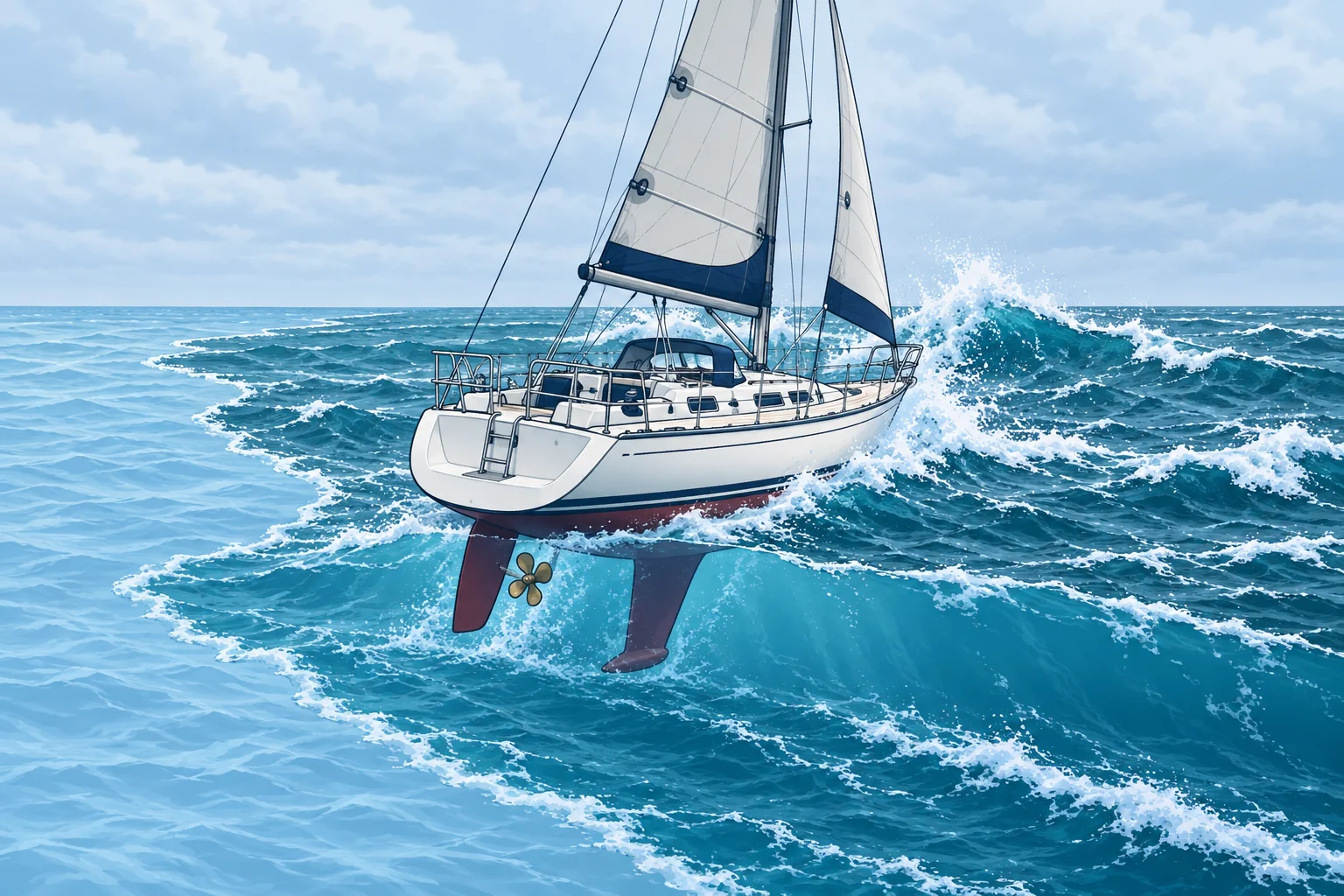
Rogue waves, wind against current and breaking seas
1The lesson in plain words
A rogue wave is more than twice Hs, the significant wave height. Waves opposing a strong current or entering shallow water can become dangerously steep.
Rogue waves
A rogue wave, also called a freak wave, is more than twice the significant wave height. On 1 January 1995, a laser on the Draupner platform in the North Sea recorded a 25.6 m wave in a sea with Hs of about 12 m. Rogue waves are rare and short-lived. They can arrive from a different direction from the surrounding waves.
Why they form
Waves of different speeds and directions sometimes line up their crests: the heights add for a moment. Waves can also be focused where they run against a current, which shortens and steepens them. The Agulhas Current flows mainly south-west along South Africa’s east coast. Strong south-westerly winds drive waves against it and can produce steep, breaking seas. The Gulf Stream has a similar hazard with opposing northerlies.
Wind against current
When wind and waves run against a current, the waves slow, shorten and steepen, and more of them break. Strong northerly winds opposing the north-going Florida Current and Gulf Stream can produce dangerous breaking seas. Avoid that combination. Assess wind strength, current and existing waves together.
Shallow water
Below about half a wavelength in depth, waves begin to feel the seabed. They slow and shorten; closer in, shoaling can make them taller and steeper. Height around 0.8 times the depth is a rough breaking estimate, but waves can break at smaller ratios. It is not a safe-entry threshold. A bar is a shallow ridge near an entrance; a shoal is a shallow patch. Long swell can break there even on a calm day. Avoid exposed bars and entrances in large swell.
Planning around dangerous seas
Read the wave forecast as well as the wind: Hs, swell period and direction. Find the currents and shoals on your route. Assess remaining swell even when the wind runs with the current, and stay clear of shallow banks in heavy swell. Choose a later departure or another route if dangerous seas are forecast along your passage.
2Key data
- Rogue wave
- Height more than 2 × Hs
- Draupner wave, 1 January 1995
- 25.6 m high in a sea of Hs about 12 m
- Wind against current
- Shorter, steeper, breaking waves
- Waves feel the bottom
- Depth less than about half the wavelength
- Breaking in shallow water
- Rough breaking estimate: height ≈ 0.8 × depth; can break lower
3Key points
- 1
A rogue wave is more than twice the significant wave height.
- 2
The Draupner wave of 1995 measured 25.6 m in a sea of Hs about 12 m.
- 3
Wind against a strong current, such as a northerly over the Gulf Stream, can produce short, steep, breaking seas.
- 4
Check wind, waves, currents and shoals before departure. Delay or reroute if dangerous seas are forecast.
- 5
Shoaling can steepen swell over bars and shoals. Height ≈ 0.8 × depth is a rough breaking estimate; waves can break lower.
4Frequent mistakes
Wrong: Rogue waves are a myth.
Right: They are measured fact: the Draupner wave reached 25.6 m in a sea of about 12 m Hs.
Wrong: A fair current always makes a passage easier.
Right: Wind or swell opposing a strong current can raise dangerous seas. Check wind, swell and current forecasts together before choosing a crossing window.
5Practice case & exam keys
You plan to cross the Gulf Stream from Florida to the Bahamas in a 12 m yacht. The forecast gives a cold front passing tonight, with north-easterly winds of 20–25 knots behind it for two days, then light south-easterlies.
Show the answer
Delay the crossing. North-easterlies of 20–25 knots opposing the north-going current can create short, steep, breaking seas. After the wind eases and changes direction, reassess the latest wave forecast, remaining swell and observed conditions; a fixed waiting period does not guarantee that the sea has settled. Check a recent current analysis before choosing your crossing window.
Exam keys
- Rogue wave: height more than 2 × Hs; Draupner, 1 January 1995, 25.6 m in Hs about 12 m.
- Strong wind against current (Gulf Stream with a northerly, Agulhas) can make steep, breaking seas; assess wind, swell and current together.
- Waves feel the bottom below roughly half a wavelength. Shoaling can increase height closer in; height ≈ 0.8 × depth is a rough breaking estimate, not a safe-entry threshold.
Finish this unit
When you've read it, answer three questions. Get all three right to finish the unit; opening the page alone doesn't count.
My notes for this unit
No notes