

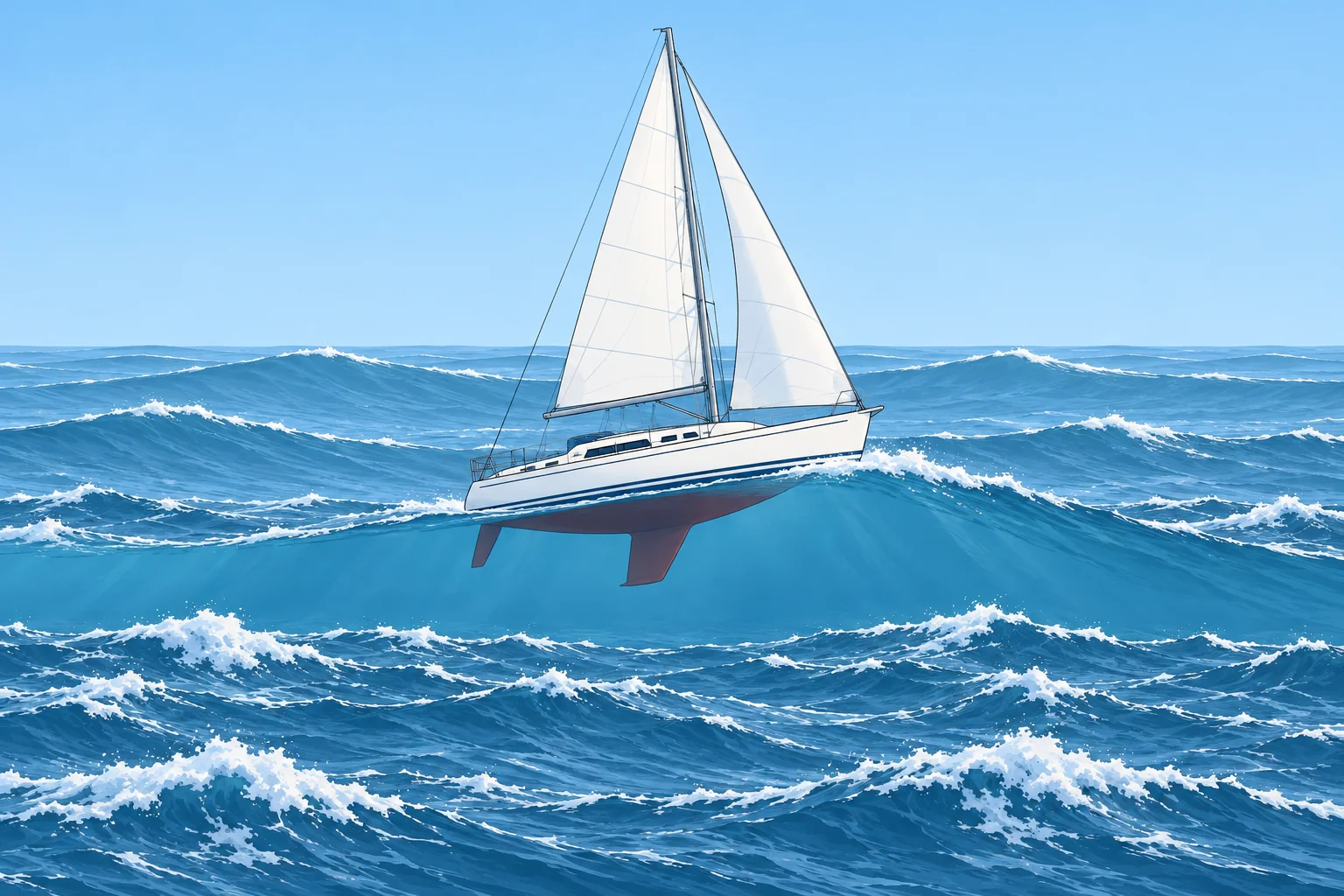
Wind waves, swell and wave height
1The lesson in plain words
Waves grow with wind speed, fetch and duration. Swell is old wind sea that has travelled away. Forecasts give significant wave height, not the biggest wave.
How waves grow
Wind waves grow with three things: wind speed, fetch (the distance of open water the wind blows over) and duration (how long it blows). Growth is limited when the wind is weak, the fetch is short or the duration is brief. Close to an upwind shore, short fetch can limit wave height even in strong wind. When fetch and duration are long enough, the sea is fully developed and grows no more for that wind speed.
Sea and swell
Wind sea is still driven by the local wind. It is usually shorter, steeper and less regular than swell. Swell is waves that have left the wind that made them. Swell is usually longer, smoother and more regular than local wind sea, and can cross an ocean. It may arrive from another direction, even after the generating wind has eased.
Period and length
Wave period is the time between two crests passing a point. Wavelength is the distance between successive crests. Here, deep water means depth greater than about half the wavelength. In deep water, wavelength in metres is about 1.56 × period², and crests travel at about 3 × period knots. A 10-second swell has crests about 156 m apart, moving at about 30 knots. Long-period swell carries energy far.
Significant wave height
Wave height is measured vertically from trough (lowest point) to crest (highest point). Significant wave height (Hs) is the average height of the highest third of the waves. Among about 1,000 waves, the likely highest is roughly 1.9 × Hs; the elapsed time depends on period. This is a statistical estimate, not an upper limit. With Hs of 3 m, that estimate is about 5.7 m.
Reading a wave forecast
Forecasts give the total Hs and often the wind sea and swell separately, each with its period and direction. Wave directions normally name where waves come from. Total Hs is not the sum: it is the square root of the sum of squares. Wind sea of 2.0 m with swell of 1.5 m gives √(4 + 2.25) = 2.5 m. Sea state words and the Beaufort table are in Meteorology.
2Key data
- Wave growth
- Wind speed, fetch and duration can each limit growth
- Deep-water wavelength
- About 1.56 × T² metres (T = period in seconds)
- Deep-water crest speed
- About 3 × T knots
- Significant wave height (Hs)
- Average height of the highest third of waves
- Likely highest of ~1,000 waves
- About 1.9 × Hs; statistical estimate, not an upper limit
- Total Hs
- √(wind sea² + swell²)
3Key points
- 1
Wave growth depends on wind speed, fetch and duration; short fetch or duration can limit it.
- 2
Swell has left its generating wind: usually longer and more regular, and often from another direction.
- 3
Hs is the average of the highest third of the waves.
- 4
Among about 1,000 waves, the likely highest is roughly 1.9 × Hs; this is not an upper limit.
- 5
Total Hs = √(sea² + swell²), not the sum.
4Frequent mistakes
Wrong: A forecast Hs of 2 m means no wave will be higher than 2 m.
Right: Hs is an average of the highest third. Among about 1,000 waves, the likely highest is roughly 1.9 × Hs. Larger waves remain possible.
Wrong: Add wind sea and swell heights to get the total sea.
Right: Combine them as the square root of the sum of squares: 2 m and 1.5 m make 2.5 m, not 3.5 m.
Wrong: No wind means no waves.
Right: Swell from a distant storm can arrive in calm weather, and rear up at a harbour entrance.
5Practice case & exam keys
Your offshore forecast gives north-easterly wind sea of 1.5 m at 5 s and north-westerly swell of 2.0 m at 12 s. A crewmate says the total is 3.5 m and that height alone describes the sea. Do you agree?
Show the answer
No. Total Hs is √(1.5² + 2.0²) = 2.5 m. The likely highest among about 1,000 waves is roughly 4.8 m, not an upper limit. Height alone misses the short 5-second wind sea and the longer swell arriving from another direction. Read both systems’ heights, periods and directions.
Exam keys
- Wave growth: wind speed, fetch, duration; fully developed sea.
- Sea vs swell; deep-water wavelength L ≈ 1.56 T² m, crest speed C ≈ 3 T knots (T in seconds).
- Hs = mean of highest third; likely highest among about 1,000 waves ≈ 1.9 Hs, not an upper limit; total Hs = √(sea² + swell²).
Finish this unit
When you've read it, answer three questions. Get all three right to finish the unit; opening the page alone doesn't count.
My notes for this unit
No notes