

What drives ocean currents
1The lesson in plain words
Steady winds push the sea surface, the Earth’s rotation turns that flow aside, and continents close the loop into huge gyres.
Wind first
An ocean current is a flow of seawater. Most large surface currents are driven by wind stress: the drag of wind on the sea surface. Steady winds, such as the trade winds and westerlies, help maintain these flows. Their strength and direction can vary with location and season.
Coriolis and Ekman
Earth’s rotation deflects moving water right in the northern hemisphere and left in the southern. This is the Coriolis effect. In the ideal Ekman model, surface water moves about 45° right of the wind in the north. Ekman transport, the net movement summed through the wind-driven layer, is about 90° right. Actual surface currents also depend on mixing, coasts, density structure and sea-surface slopes.
Gyres
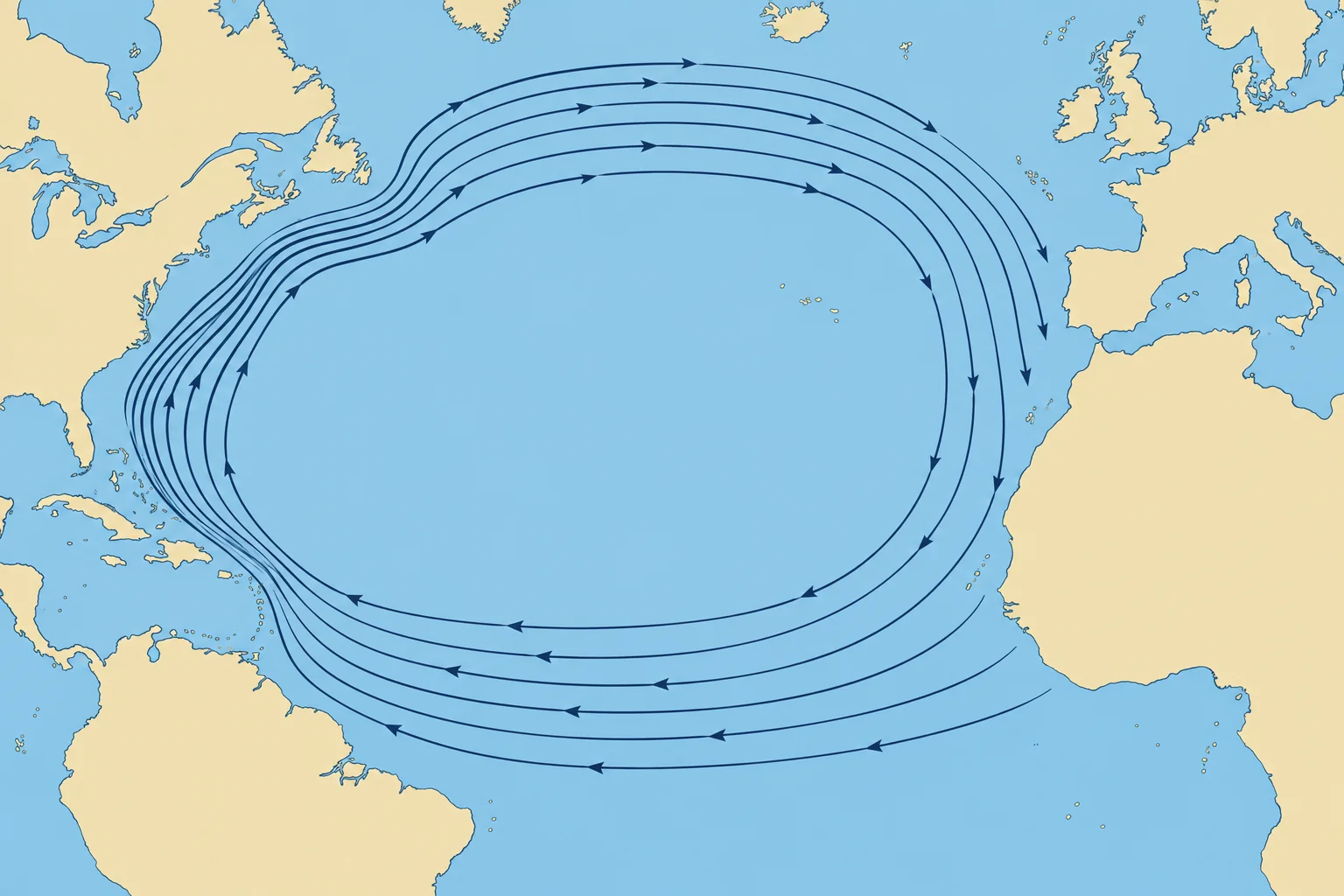
The trade winds blow from the east in the tropics and the westerlies from the west further north. Turned by Coriolis and blocked by continents, the water forms a huge loop called a gyre. In the North Atlantic the subtropical gyre turns clockwise, round a dome of warm water near the Sargasso Sea; southern-hemisphere subtropical gyres turn anticlockwise.
Western intensification
The North Atlantic subtropical gyre is not symmetrical. Its western side, along North America, is narrow, deep and fast; its eastern side, off Europe and Africa, is broad, shallow and slow. That is why the Gulf Stream runs at several knots while the Canary Current off Africa is usually much slower.
Density and naming
Differences in temperature and saltiness also move water. Cold, salty water sinks in the far North Atlantic and spreads slowly at depth, the thermohaline circulation. This deep flow mainly affects climate; use surface-current information for your passage. A current’s set is the direction it flows towards: a current setting 090° flows east. Winds are named for where they come from.
2Key data
- Coriolis deflection
- To the right in the northern hemisphere, left in the southern
- Surface current vs wind
- Ideal model: about 45° right of the wind (northern hemisphere)
- Ekman transport
- Net through wind-driven layer: about 90° right (northern hemisphere)
- North Atlantic subtropical gyre
- Turns clockwise
- Current direction
- Named for where it flows to (its set)
3Key points
- 1
Steady winds drive most surface ocean currents.
- 2
Coriolis turns moving water to the right in the northern hemisphere.
- 3
Ekman transport sums movement through the wind-driven layer: about 90° right of the wind in the north.
- 4
The North Atlantic subtropical gyre turns clockwise; its western side is the fastest.
- 5
A current’s set is where it flows towards; a wind is named for where it comes from.
4Frequent mistakes
Wrong: Surface water flows straight downwind.
Right: In the ideal Ekman model, northern-hemisphere surface flow is about 45° right of the wind. Net transport through the wind-driven layer is about 90° right. Actual surface flow varies.
Wrong: A current setting north comes from the north.
Right: A current setting north flows towards the north. A northerly wind comes from the north.
5Practice case & exam keys
Offshore in the North Atlantic, a steady northerly has blown for several days. A crewmate uses the ideal 90° Ekman transport direction as your surface current’s set. Is that justified?
Show the answer
No. Ideal net transport is west, 90° right of the southward wind. Ideal surface flow is south-west, about 45° right. Neither is an observed set: mixing, density structure and sea-surface slopes also affect the actual surface current.
Exam keys
- Wind stress drives surface currents; Coriolis deflects to the right in the northern hemisphere.
- Ideal Ekman model, northern hemisphere: surface flow about 45° right of wind; net transport through the wind-driven layer about 90° right. Actual surface flow varies.
- North Atlantic gyre clockwise; western side narrow and fast (Gulf Stream), eastern side broad and slow (Canary Current).
Finish this unit
When you've read it, answer three questions. Get all three right to finish the unit; opening the page alone doesn't count.
My notes for this unit
No notes