

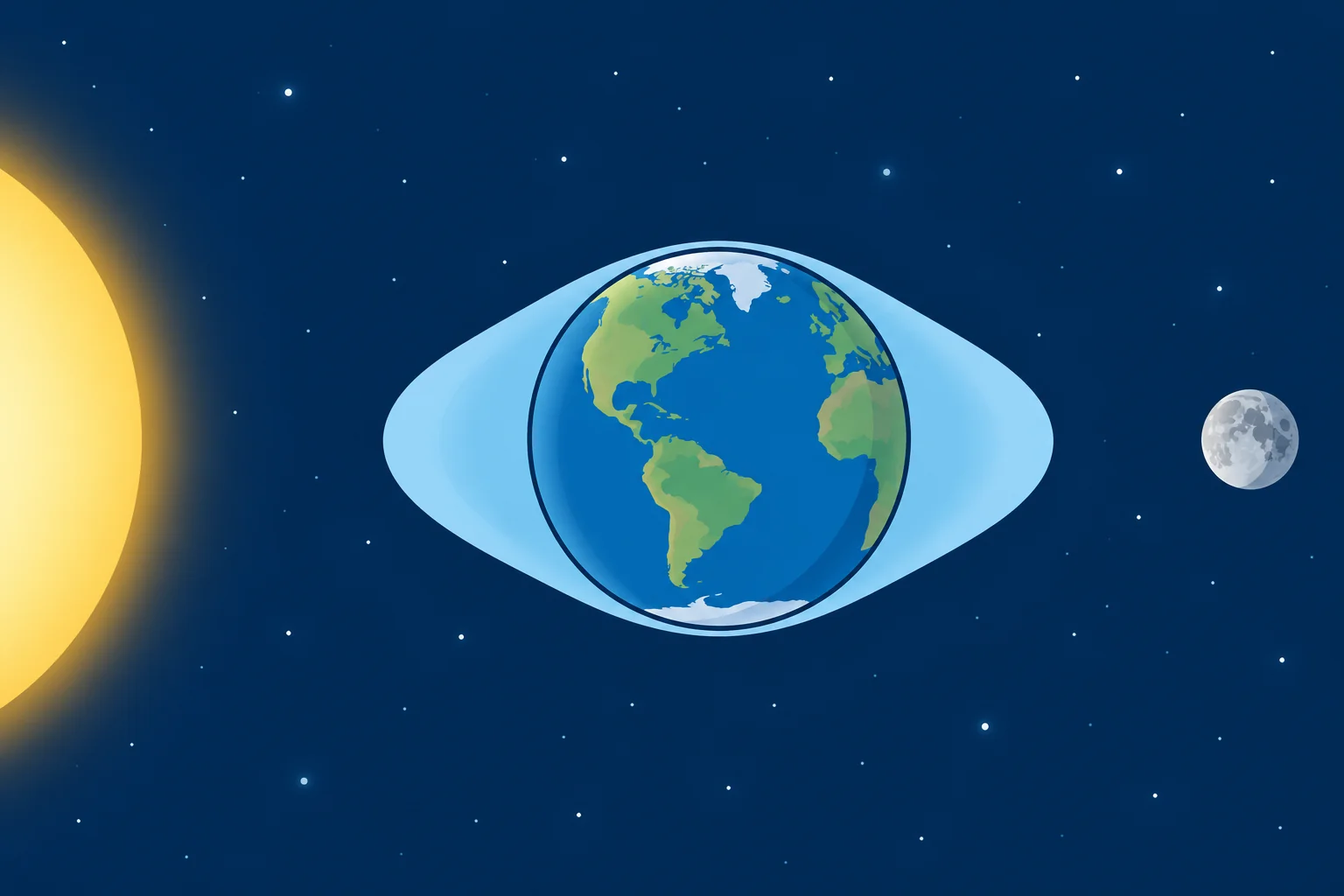
The tide-raising forces of the Moon and the Sun
1The lesson in plain words
Tides come from a difference: the Moon pulls the near side of the Earth harder than the far side. That stretches the ocean into two bulges.
A difference in pull
The Moon’s gravity pulls on every part of the Earth, but not equally. The side facing the Moon is nearer, so it is pulled a little harder than the Earth’s centre, and the far side a little less. This difference in pull across the Earth is the tide-raising force. It is tiny, about a ten-millionth of the Earth’s own gravity, but it acts on whole oceans.
Why the Moon wins
The tide-raising force grows with the body’s mass but falls with the cube of its distance. The Sun is about 27 million times heavier than the Moon, but about 390 times further away. The result: the Sun’s tide-raising force is a bit under half the Moon’s, about 46 %. The Moon sets the rhythm; the Sun makes it bigger or smaller.
Two bulges
Seen from the Earth’s centre, water on the near side is pulled towards the Moon more than the Earth is, so it heaps up. Water on the far side is pulled less than the Earth, so it is left behind and heaps up too. The result is two bulges, one under the Moon and one on the opposite side, with lower water in between.
Avoid the shortcut
Some books say the far bulge comes from “centrifugal force” of the Earth spinning. That is wrong: the Earth’s daily spin does not make tides. A careful version uses the Earth and Moon circling their common centre of mass, but the difference-in-pull picture above is simpler and complete. The same forces, mostly along the Earth’s surface, push water towards the two bulges.
The Earth turns underneath
In this simple model, the Earth turns beneath two bulges, giving two high waters and two low waters per lunar day. Real coastal tides depend on ocean basins and coastlines. The Around the world tab explains how.
2Key data
- Tide-raising force
- Difference in pull across the Earth; falls with distance cubed
- Sun’s effect
- About 46 % of the Moon’s
- Bulges
- Two: one under the Moon, one on the opposite side
- Earth’s daily spin
- Turns beneath the bulges in the model; does not create them
3Key points
- 1
Tides come from the difference in the Moon’s pull across the Earth.
- 2
The force falls with the cube of distance, so the Moon beats the far heavier Sun.
- 3
The Sun’s tide-raising force is about 46 % of the Moon’s.
- 4
There are two bulges: under the Moon and on the far side.
- 5
The Earth turns beneath the bulges in the simple model; real coastal tides depend on their basin.
4Frequent mistakes
Wrong: The far-side bulge comes from the Earth’s spin throwing water outwards.
Right: It comes from the far side being pulled less than the Earth’s centre. The daily spin does not cause tides.
Wrong: The Sun is so much bigger that it causes most of the tide.
Right: Tide-raising force falls with distance cubed. The Sun’s effect is only about 46 % of the Moon’s.
5Practice case & exam keys
A crewmate plans a beach landing for when the Moon is overhead. They say its pull guarantees high water then. Would you accept that plan?
Show the answer
No. The difference in pull explains the two-bulge model, but it does not give a real coast’s high-water time. Basins and coastlines change the response. Use local tide predictions before choosing the landing time.
Exam keys
- Tide-raising force = difference in the Moon’s (or Sun’s) pull across the Earth; varies with mass ÷ distance³.
- Sun’s tide-raising force is about 46 % of the Moon’s.
- Two bulges: near side pulled more, far side pulled less, than the Earth’s centre.
Finish this unit
When you've read it, answer three questions. Get all three right to finish the unit; opening the page alone doesn't count.
My notes for this unit
No notes