

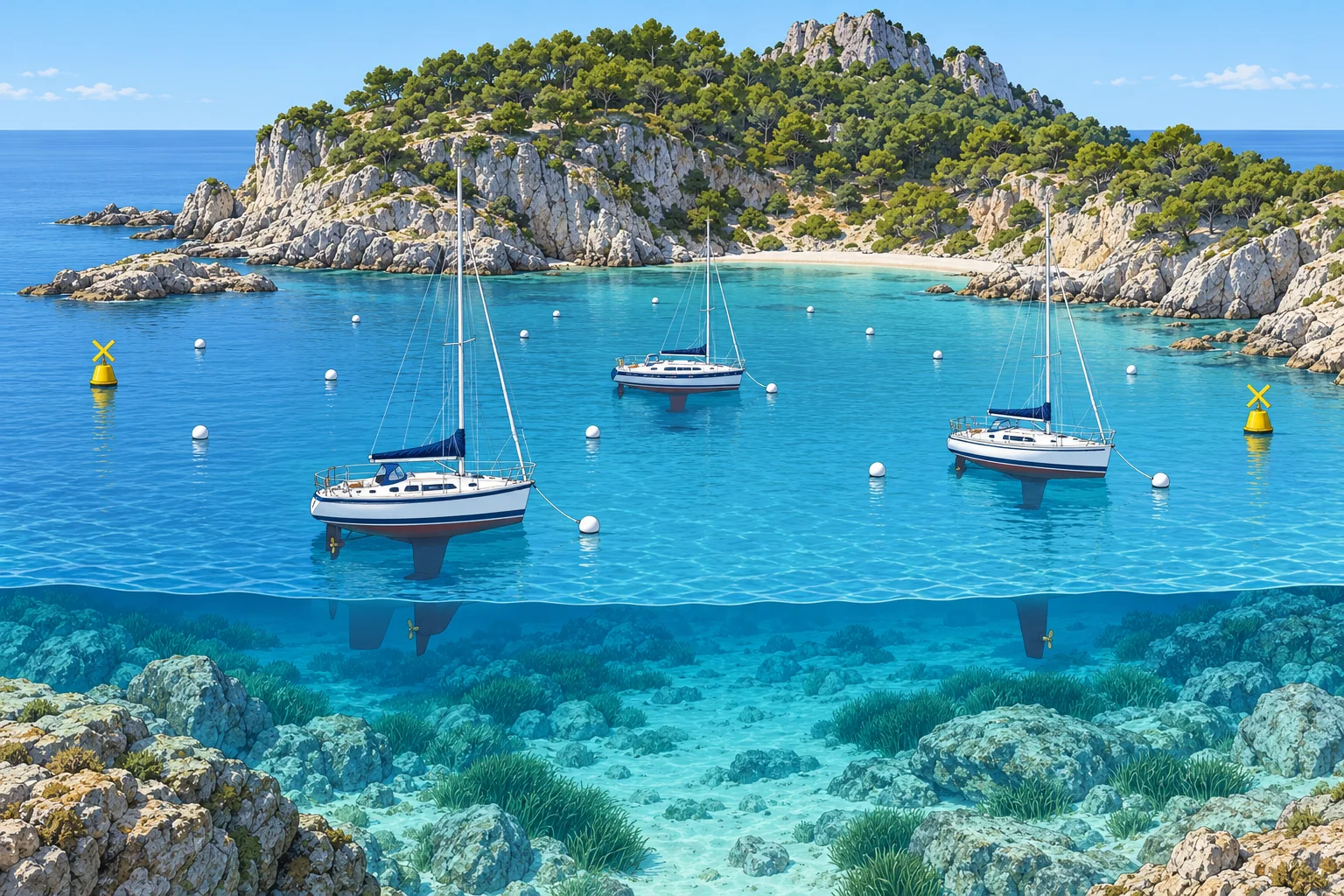
Marine protected areas: what they mean for your boat
1The lesson in plain words
A marine protected area limits what people may do in part of the sea. Before you enter one, find out its limits and its rules for boats.
What an MPA is
A marine protected area (MPA) is a stretch of sea, and often its coast, managed to protect nature. The level of protection varies a lot. A no-take reserve bans all fishing and collecting. Other areas allow most uses but limit a few, such as anchoring, speed or night-time access. The name alone does not tell you the rules: read them.
Kinds you will meet
National parks at sea, such as Cabrera in the Balearics or Port-Cros in France, often need a permit to enter, anchor or dive. Marine reserves protect fish stocks and usually ban fishing in a core zone. In the EU, Natura 2000 sites protect habitats such as seagrass. Around the Mediterranean, the Barcelona Convention lists SPAMIs (Specially Protected Areas of Mediterranean Importance), and the Pelagos Sanctuary protects whales and dolphins between France, Monaco and Italy.
Areas for shipping
The International Maritime Organization (IMO) can designate a PSSA (Particularly Sensitive Sea Area). Its associated protective measures may include routing, reporting or voluntary precautions. In 2023 the North-Western Mediterranean became a PSSA to cut collisions with fin and sperm whales. It asks ships to keep a lookout for whales and consider slowing down. Check which measures apply to your vessel.
Typical rules for boats
Expect some of these: entry or navigation permits, a maximum number of boats, speed limits near the coast, no anchoring outside set zones, moorings to be booked, no fishing or spearfishing, no landing on certain islands, and no jet skis. Fines can be heavy, and rangers patrol by boat. For Cabrera, obtain navigation authorisation and check the park’s current daytime mooring conditions; overnight buoy stays require a reservation.
Finding the limits
The chart shows many MPA limits as a dashed line with a note, and the pilot book and the park’s website give the rules. Official map viewers show zones and buoy fields. Limits and mooring zones may be marked with yellow special marks; the chart says what each one means. The IALA lesson on special marks explains these marks. Published restrictions apply even without a continuous buoy boundary. Check before every season, because rules change.
2Key data
- No-take reserve
- No fishing or collecting of any kind
- Pelagos Sanctuary
- Whale and dolphin sanctuary: France, Monaco, Italy
- NW Mediterranean PSSA
- Designated by the IMO in 2023 against whale strikes
- Where to find the rules
- Chart note, pilot book, park website, map viewer
3Key points
- 1
An MPA’s name does not tell you its rules; look them up before you go.
- 2
Marine national parks often need a permit to navigate, anchor or dive.
- 3
A no-take reserve bans all fishing and collecting.
- 4
A PSSA is an IMO designation with associated protective measures; these may include voluntary advice.
- 5
Find limits on the chart, in the pilot book and on official map viewers.
4Frequent mistakes
Wrong: If I am only passing through a park, its rules do not apply to me.
Right: Some parks need a permit just to navigate inside, and speed and anchoring limits apply to every boat.
Wrong: A protected area always means no boats allowed.
Right: Most MPAs allow boats with conditions. Read the rules to know what is allowed and where.
5Practice case & exam keys
You want to spend a summer day at Cabrera National Park, south of Mallorca, in your 10 m yacht, and swim from the boat. A friend says you can simply anchor in the main bay when you arrive.
Show the answer
Obtain Cabrera’s navigation authorisation online before you go. Check the park’s current daytime mooring conditions and use designated visitor buoys under those conditions. Do not anchor outside permitted zones. Overnight buoy stays require a reservation. Check prohibited navigation zones, speed limits and landing rules.
Exam keys
- MPA rules vary: read each area’s rules; national parks may need permits to navigate, anchor or dive.
- No-take reserve: no fishing or collecting; Natura 2000 protects habitats; Pelagos protects cetaceans.
- PSSA: IMO designation with area-specific protective measures, including voluntary advice; NW Mediterranean (2023): whale strikes.
Finish this unit
When you've read it, answer three questions. Get all three right to finish the unit; opening the page alone doesn't count.
My notes for this unit
No notes