

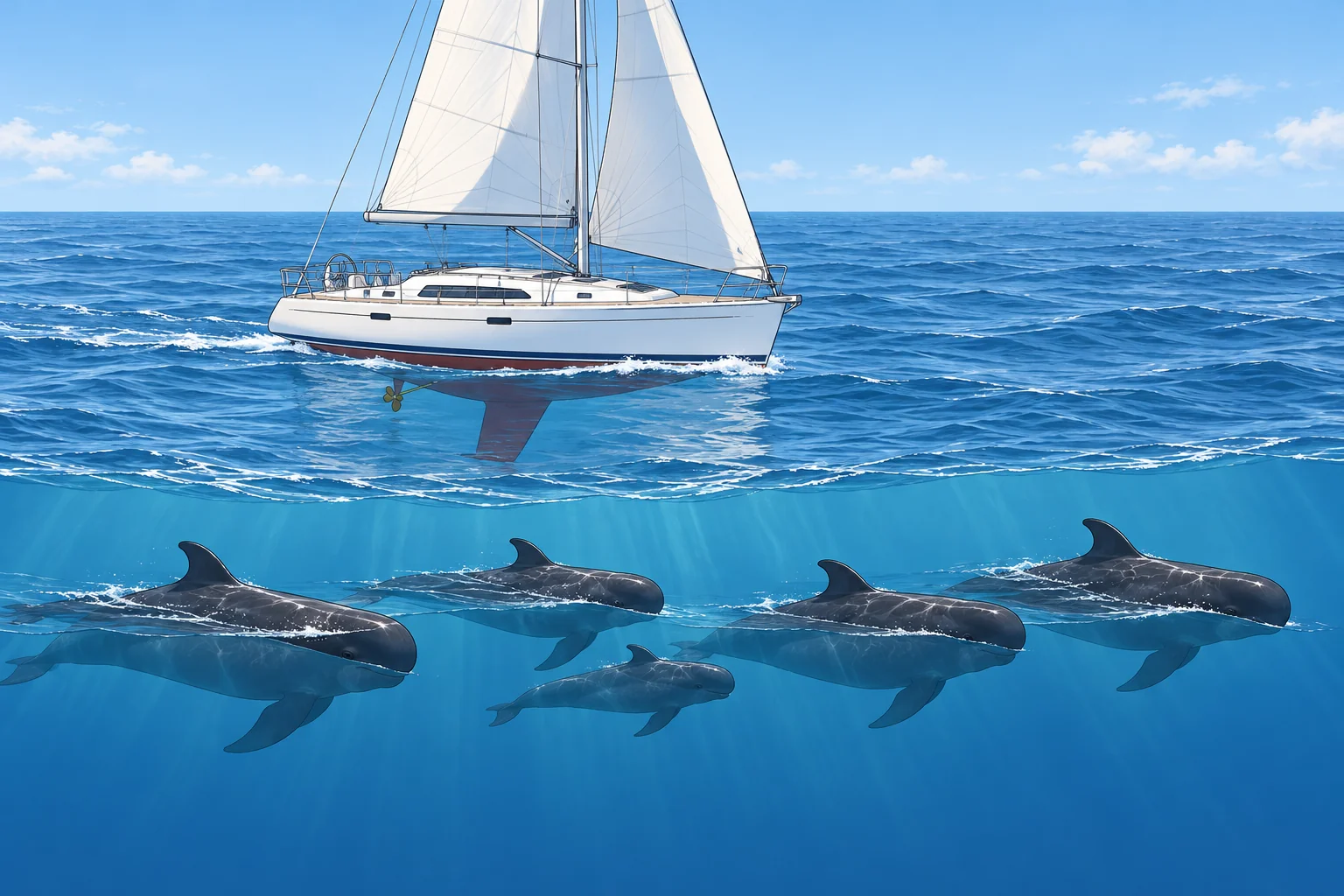
Watching whales and dolphins without harm
1The lesson in plain words
Keep your distance and approach slowly. Local law sets requirements; viewing guidance recommends further precautions.
Why rules exist
Cetaceans are whales, dolphins and porpoises. A boat that comes too close or too fast can stop them feeding, resting or nursing, split a mother from her calf, or hit them. Most countries protect them by law. Check local law and guidance before approaching. Keep a safe distance and follow the applicable close-encounter rules.
Spain
Spain’s Royal Decree 1727/2007 sets a protection space of 500 m round cetaceans. Inside it, keep a steady speed of 4 knots or less, no faster than the slowest animal. The restricted zone, 60–300 m, allows two boats at most, and none for an isolated adult–calf pair. Never enter the exclusion zone inside 60 m. If animals come within 60 m, go to neutral. Keep the propeller stopped until they leave the exclusion zone.
ACCOBAMS
ACCOBAMS is the agreement that protects cetaceans in the Mediterranean, the Black Sea and the nearby Atlantic. Its viewing guidance is advice, distinct from national law: do not deliberately approach closer than 100 m, and within 300 m keep a steady course at 5 knots or less, never faster than the slowest animal. Only one boat at a time should watch a group. National law, such as Spain’s, can be stricter.
United States
The US National Oceanic and Atmospheric Administration (NOAA) advises at least 100 yards (about 90 m) from large whales and 50 yards from dolphins, porpoises and seals. Federal law sets 500 yards from North Atlantic right whales anywhere in US waters. In Washington State waters, all boats, kayaks included, must stay 1,000 yards from Southern Resident killer whales since 1 January 2025.
How to approach and leave
Come in slowly from the side and slightly behind, on a course converging at about 30° with theirs. Never approach head-on or from straight behind, never chase, circle or cut through a group, and do not swim with them. Possible signs of disturbance include sudden changes of direction or speed, long dives, or tail slaps. If you see them, leave slowly the way you came.
2Step by step
Meeting cetaceans at sea
- 1
Before approaching, identify the applicable local rules and species-specific distances.
Requirements vary by location and species; check before closing.
- 2
Slow down early. In Spain’s 500 m protection space, stay at 4 knots or less and no faster than the slowest animal.
Speed increases noise, stress and collision risk.
- 3
Keep outside required exclusion distances and follow greater recommended distances. Where both apply, use Spain’s 4-knot limit and ACCOBAMS’ 100 m guidance.
Spain bans entry within 60 m; ACCOBAMS recommends at least 100 m. Guidance and law have different status.
- 4
In Spain, if animals come within 60 m, go to neutral and keep the propeller stopped until they leave the exclusion zone.
A turning propeller can injure an animal near the stern. Follow local rules elsewhere; orca interactions have their own advice.
- 5
Watch for a limited time, then leave slowly the way you came.
Long or crowded watching disturbs feeding and resting.
3Key points
- 1
Slow down and approach from the side and slightly behind; never head-on.
- 2
Spain: within 500 m, at most 4 knots, no faster than the slowest animal; never enter the 60 m exclusion zone.
- 3
ACCOBAMS guidance: no closer than 100 m; at most 5 knots within 300 m.
- 4
NOAA advice: 100 yd large whales, 50 yd dolphins; US federal law: 500 yd North Atlantic right whales.
- 5
Possible signs of disturbance are a warning to leave slowly and keep clear of the animals’ path.
4Frequent mistakes
Wrong: Dolphins ride the bow wave, so speeding up to meet them is fine.
Right: Never speed up or steer towards bow-riding dolphins. Follow the close-encounter instructions for your location.
Wrong: Getting in the water to swim with dolphins is harmless.
Right: Spain bans swimming or diving in the 60 m exclusion zone, and swimming with them stresses the animals.
Wrong: Driving in front of a whale gives the best view.
Right: Never cross in front or block their path. Stay to the side and let them pass.
5Practice case & exam keys
Off the coast of Almería you spot one adult pilot whale with a calf and no other whales nearby, about 400 m ahead and to starboard. You are motoring at 7 knots, and your crew wants to get close for photos.
Show the answer
Slow to 4 knots or less, and no faster than the animals. This is an isolated adult–calf pair, so do not enter the 60–300 m restricted zone. Watch from beyond 300 m without closing for photos. Leave slowly if they show possible signs of disturbance.
Exam keys
- Spain RD 1727/2007: within 500 m, at most 4 kn and no faster than the slowest animal; restricted 60–300 m (two boats, none for an isolated adult–calf pair); exclusion inside 60 m.
- ACCOBAMS guidance: not closer than 100 m; at most 5 kn within 300 m; one boat at a time.
- NOAA advice: 100 yd large whales, 50 yd dolphins; US federal law: 500 yd North Atlantic right whales. Washington law: 1,000 yd Southern Resident orcas since 2025.
- Approach from the side and slightly behind; never chase, circle, split groups or swim with them.
Finish this unit
When you've read it, answer three questions. Get all three right to finish the unit; opening the page alone doesn't count.
My notes for this unit
No notes