

 See units
Deck work safely: snap-back zones, working aloft and over the side, enclosed spaces and permits to work (ratings)
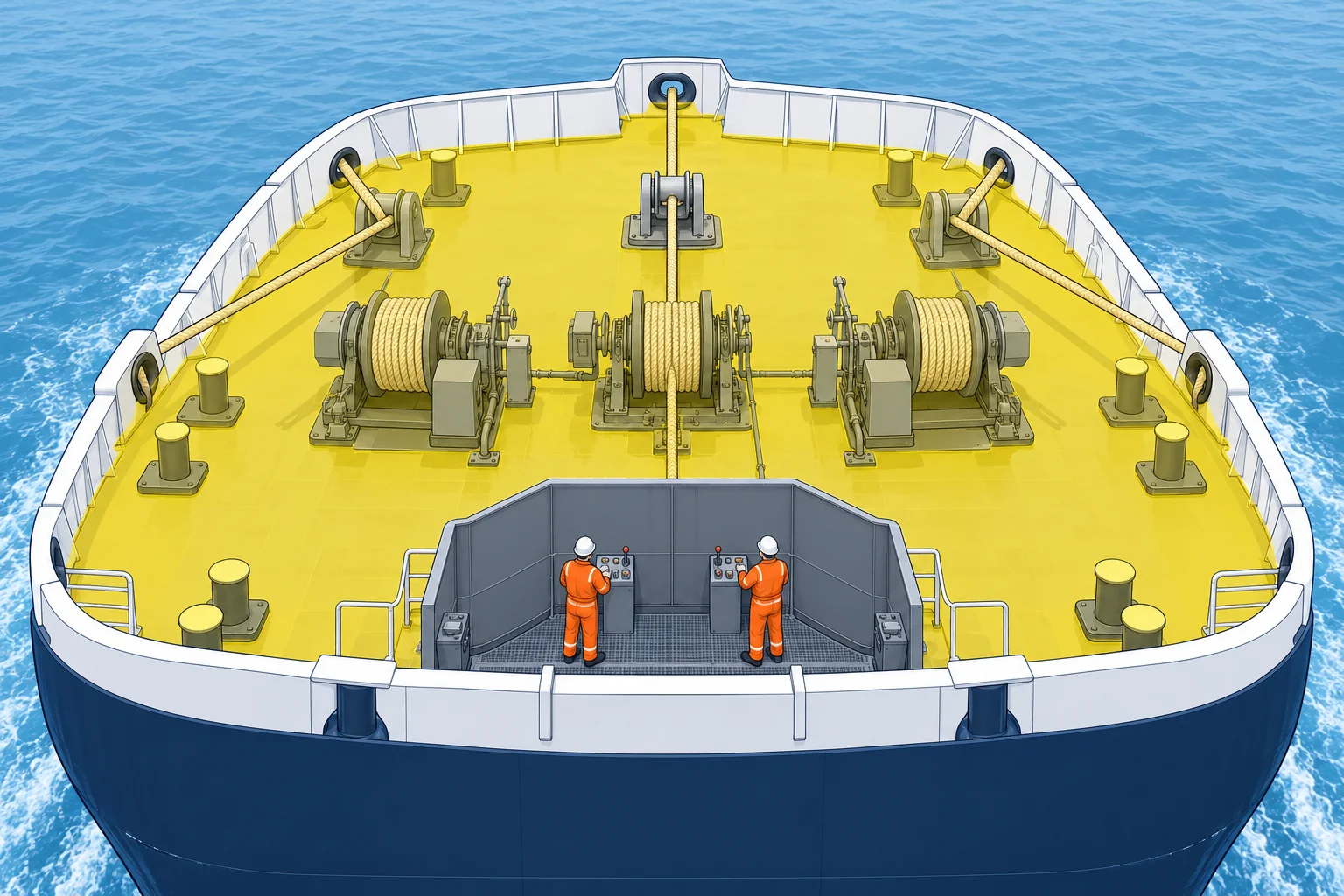
Snap-back: the whole mooring deck is a danger zone
1The lesson in plain words
A line under tension that breaks or slips can whip across the deck faster than you can move. Stay out of bights and line paths, everywhere on the deck.
What snap-back is
Snap-back is the sudden, violent recoil of a line under tension when it parts (breaks), slips off a fitting or comes free from a snag. Low-stretch lines recoil too, and a stiff line fitted with a tail, a short elastic rope section, can recoil hard over a large area. Snap-back kills and maims, and you will not have time to react.
The whole deck
IMO guidelines (MSC.1/Circ.1619) say mooring areas should be treated as potential snap-back zones, with signs saying so. The UK Code of Safe Working Practices for Merchant Seafarers (COSWP) says to consider the whole mooring deck dangerous, side decks included. Painted snap-back zones are no longer advised: they can give a false sense of security, because a line can part anywhere, in more than one place, and fly outside any painted area.
Leads change the zone
A line led round a pedestal fairlead, a raised fitting that guides the line, or a roller changes direction. If it parts, the free end can sweep a wider area. A snagged line that suddenly comes free can move sideways or upwards, or snake.
Where you stand
Never stand in a bight (a loop) of rope or wire, in line with a rope under strain, or on the inside of a turn round a fitting. Stand behind protective structures where they are provided, and stay well clear of a snagged or trapped line. Only the mooring party belongs on the mooring deck. If anything looks overloaded, shout and tell the officer so the load can be reduced at once.
Related lessons
Rope stretch and stored energy are explained in Ropes: rope materials. The mooring station itself, its winches and lines, is in Ropes: ship mooring and anchoring stations.
2Key data
- Snap-back zone
- Treat the whole mooring deck as one (COSWP, MSC.1/Circ.1619)
- Painted zones
- Not advised: they give a false sense of security
- Pedestal fairleads
- Change and widen the danger area if the line parts
3Key points
- 1
Treat the whole mooring deck, side decks included, as a snap-back zone.
- 2
Never stand in a bight, in line with a loaded line, or inside a turn round a fitting.
- 3
Painted zones mislead: lines can part anywhere and fly outside them.
- 4
Stay well clear of snagged lines and report any line or fitting that looks overloaded.
4Frequent mistakes
Wrong: Outside the painted zone you are safe.
Right: A line can part at any point and recoil beyond any paint. Treat the whole deck as dangerous.
Wrong: Low-stretch lines cannot snap back.
Right: Low-stretch synthetic lines and wire ropes recoil too, and an elastic tail on a stiff line can make snap-back worse.
Wrong: Step over a slack bight to save time.
Right: A slack line can come under load without warning. Walk round it.
5Practice case & exam keys
You are aft during unmooring. The stern line has snagged on a fender on the quay and the winch is still heaving. A shipmate walks to the rail beside the fairlead to see what is happening.
Show the answer
Call ‘Stop heaving!’ and warn your shipmate to move clear. Tell the officer that the line is snagged. Keep everyone clear while the officer arranges for the load to be removed and the snag released safely. Do not approach until the line is slack and the officer confirms it is safe.
Exam keys
- Snap-back: violent recoil of a tensioned line that parts, slips or comes free.
- Whole mooring deck = potential snap-back zone (MSC.1/Circ.1619; COSWP chapter 26).
- Painted zones can give false security; pedestal leads can widen the danger area.
- Never stand in bights or in line with loaded lines; keep clear of snagged lines.
Finish this unit
When you've read it, match the terms, then answer three questions. Get them all right to finish the unit; opening the page alone doesn't count.
My notes for this unit
No notes