

 See units
Deck work safely: snap-back zones, working aloft and over the side, enclosed spaces and permits to work (ratings)
Enclosed spaces: awareness for ratings
1The lesson in plain words
An enclosed space can kill with air that looks normal. Never enter without a permit and a tested atmosphere, and never rush in to rescue.
What they are
An enclosed space may contain hazardous air or lack oxygen and has at least one feature: limited entry or exit, poor ventilation, or no design for continuous human occupancy. Examples include cargo holds, ballast tanks, fuel tanks, chain lockers (spaces storing the anchor chain), and connected spaces. The air may lack oxygen or contain toxic or flammable gas, and you cannot see or smell the danger. A single breath of very low-oxygen air can make you collapse.
The rules
SOLAS requires ships to carry a portable atmosphere testing instrument (regulation XI-1/7) and to hold enclosed space entry and rescue drills at least every two months (regulation III/19). Under XI-1/7, the instrument must measure at least oxygen, flammable gases or vapours, hydrogen sulphide and carbon monoxide. The IMO's 2025 Revised Recommendations (resolution MSC.581(110)) add an enclosed space register listing every such space and forbid single-person entry.
Before entry
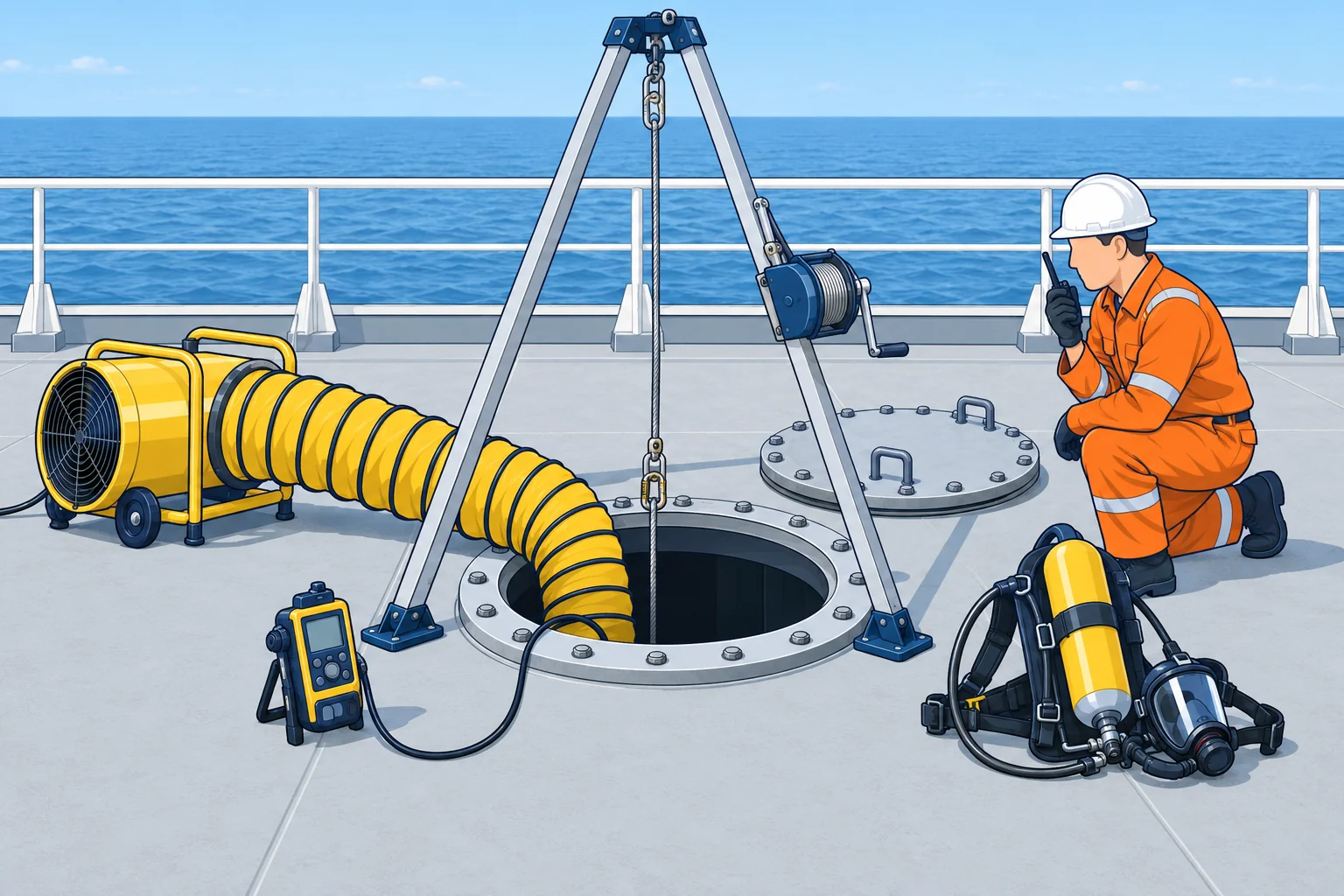
Entry needs an authorised officer's permit to work, valid for at most eight hours. Ventilate before entry and throughout occupancy. Test from outside and keep monitoring; leave if ventilation fails. Readings: 20.9 % oxygen; carbon dioxide below 0.5 %; flammables below 1 % of the lower flammable limit (LFL), the concentration at which gas can ignite; toxic gases below half their occupational exposure limit (OEL), the workplace limit. At least two people enter. A separate attendant stays outside with communications and rescue equipment ready.
If someone collapses
Raise the alarm at once. The attendant does not go in. Do not enter to help without self-contained breathing apparatus (SCBA) and the ship's rescue plan: many of those who die in enclosed spaces are would-be rescuers. The trained rescue team goes in with SCBA, harness and lifeline. The full entry procedure is in Law: personal safety.
2Key data
- Atmosphere tester
- SOLAS XI-1/7: portable instrument carried on board
- Entry and rescue drills
- At least every two months (SOLAS III/19)
- Atmosphere entry limits (MSC.581(110))
- 20.9% O2; CO2 <0.5%; flammable <1% LFL; toxic <50% OEL
- Entry permit (IMO)
- Valid for no more than 8 hours
- Entering alone
- Not permitted
3Key points
- 1
Testing and a permit do not change an enclosed space's status. Keep all entry precautions in force.
- 2
Entry needs a permit, ventilation, tested air, at least two entrants and a separate attendant outside.
- 3
Drills at least every two months; a portable atmosphere tester is carried under SOLAS XI-1/7.
- 4
Never enter to rescue without SCBA. Raise the alarm and follow the ship's rescue plan.
4Frequent mistakes
Wrong: If the air smells fresh, the space is safe.
Right: Low oxygen and many toxic gases have no smell. Only a test shows the atmosphere.
Wrong: The attendant goes in at once if the worker collapses.
Right: The attendant raises the alarm and stays out. Only the equipped rescue team enters.
Wrong: After an hour of ventilation no test is needed.
Right: Test after ventilating and keep testing while people are inside; conditions change.
5Practice case & exam keys
The bosun sends you to fetch a spare shackle from the forward chain locker. The hatch is open and the ladder looks fine, but nobody has mentioned a permit.
Show the answer
Do not go in. A chain locker is an enclosed space: rusting steel and mud can use up the oxygen. Tell the bosun and the officer that a permit, ventilation, an atmosphere test and an entry team and a separate attendant are needed first, or that the shackle should be fetched another way.
Exam keys
- Potentially hazardous air plus any of: limited access, poor ventilation, or no design for continuous occupancy.
- SOLAS XI-1/7 portable tester; III/19 entry and rescue drills at least every two months.
- MSC.581(110): permit of 8 h at most, 20.9 % O2, no single-person entry, enclosed space register.
- Rescue only with SCBA and the rescue plan; the attendant never enters.
Finish this unit
When you've read it, match the terms, then answer three questions. Get them all right to finish the unit; opening the page alone doesn't count.
My notes for this unit
No notes