

 See units
Deck work safely: snap-back zones, working aloft and over the side, enclosed spaces and permits to work (ratings)
Rigging the pilot ladder: SOLAS V/23 now and from 2028
1The lesson in plain words
Pilots and crew have died from badly rigged ladders. Rig it as designed, at the right height, on strong points, with a lifebuoy, line and light ready.
The rule
SOLAS regulation V/23 sets the rules for pilot transfer arrangements, together with IMO resolution A.1045(27) and the ISO 799 ladder standards. Deck ratings rig the pilot ladder under a responsible officer, who is in contact with the bridge and arranges an escort for the pilot by a safe route to and from the bridge.
Height and the 9 m rule
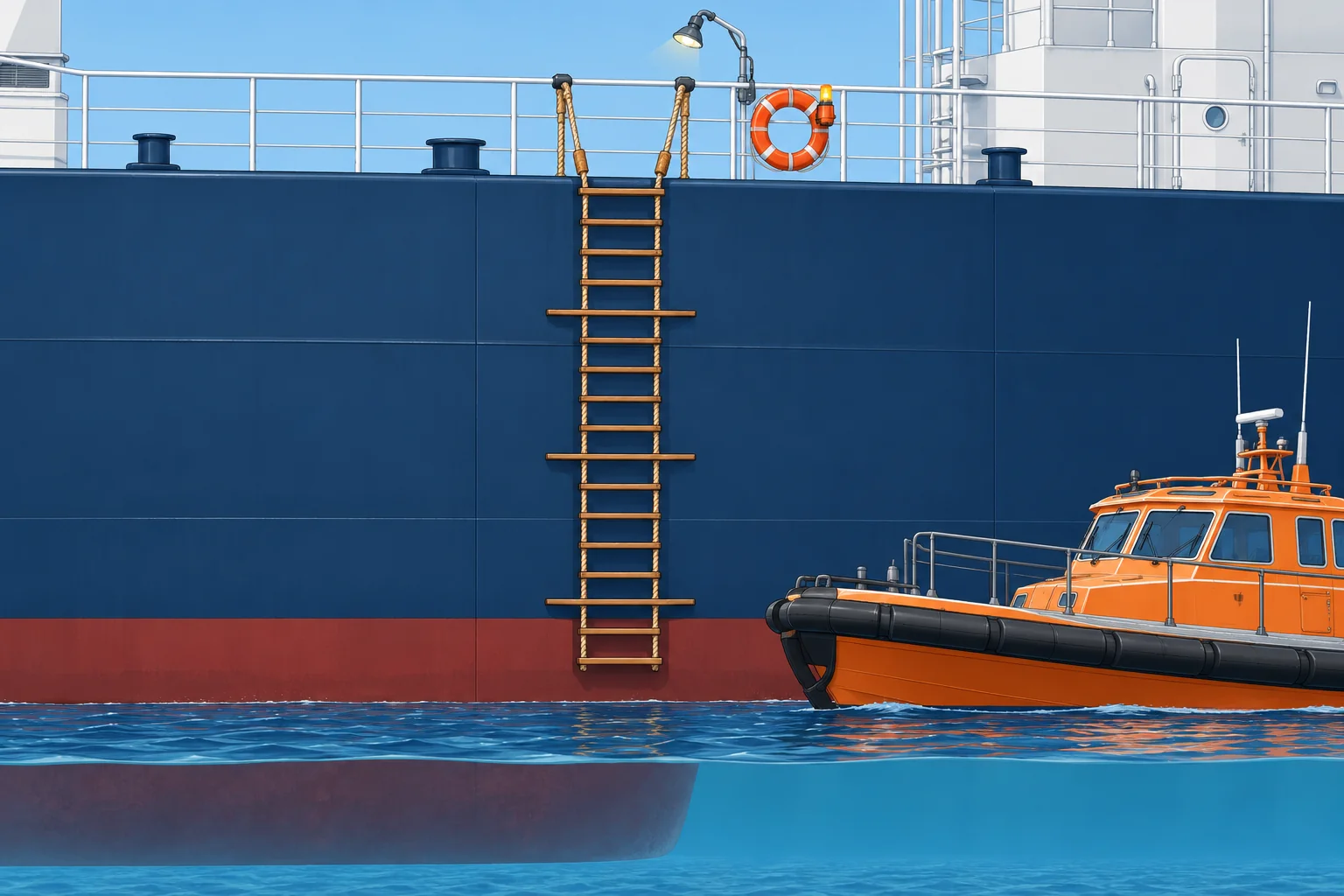
Rig the ladder's bottom at the height the pilot requests. Keep steps horizontal against the hull, clear of discharges and overhangs. If access is more than 9 m above water, use a combination arrangement: an accommodation ladder (boarding stairway) with a pilot ladder alongside. Keep the bottom platform horizontal, at least 5 m above water and secured to the hull. The pilot ladder must extend at least 2 m above it.
Securing
Secure the ladder's side ropes to the designated strong points on deck, never to rails, and never with shackles through the ladder. The steps and spreaders (long steps that resist twisting) must not carry the ladder's weight; make sure none is twisted or trapped. Under the new standards, strong points, shackles and securing ropes require 48 kN (kilonewtons, a unit of force), and intermediate-length securing devices need type approval. The transition dates are below.
Ready at the ladder
At the point of access keep a lifebuoy with a self-igniting light and a heaving line (a light throwing rope). At night, light the ladder and the ship's side with a forward-shining overside light. Wear a harness and safety line while rigging. Rig manropes, separate hand ropes, if the pilot asks for them. Before use, check for worn side ropes and loose or cracked steps, and keep the boarding area clear. Mechanical pilot hoists must not be used.
From 2028
Amendments to V/23 (resolution MSC.572(110)) and new performance standards (MSC.576(110)) enter into force on 1 January 2028. New installations must comply from then; existing SOLAS arrangements by the first survey on or after 1 January 2029. Stowage, maintenance and replacement rules apply to all ships from 2028: ladders are retired 30 months after entering service or 36 months after manufacture, whichever comes first. A spare is carried. Accommodation ladders and gangways: Ship: deck machinery.
2Key data
- Ladder alone
- Access point no more than 9 m above the water
- Combination
- Pilot ladder at least 2 m above the bottom platform
- At the access point
- Lifebuoy with self-igniting light, heaving line, lighting
- New rules in force
- New: 1 Jan 2028; existing SOLAS: first survey from 1 Jan 2029
- Ladder service life (2028)
- 30 months in service or 36 from manufacture, first reached
- Securing strength (new standards)
- 48 kN: strong points, shackles and securing ropes
3Key points
- 1
A responsible officer supervises rigging, stays in contact with the bridge and arranges a safe escort.
- 2
Keep steps horizontal against the hull. Access more than 9 m above water needs a combination arrangement.
- 3
Secure the side ropes to strong points, never rails; steps must not carry the ladder's weight.
- 4
Lifebuoy with self-igniting light, heaving line and lighting ready at the point of access.
- 5
New V/23 rules from 1 January 2028; existing SOLAS arrangements verified by the first survey from 2029.
4Frequent mistakes
Wrong: Tie the ladder to the handrail; it is close and looks strong.
Right: Secure it to the designated strong points. Rails are not designed for the load.
Wrong: Let the bottom spreader take the weight to keep the ladder tidy.
Right: Steps and spreaders are not suspension points. Secure both side ropes to the designated strong points.
Wrong: The 2028 rules apply only to ships built after 2028.
Right: Existing SOLAS arrangements must comply by the first survey on or after 1 January 2029, and maintenance rules apply to all ships from 2028.
5Practice case & exam keys
Loaded today, your tanker's point of access is 7 m above the water. Tomorrow, carrying ballast water instead of cargo, it will be 11 m. Both times the pilot asks for the bottom of the ladder 2 m above the water.
Show the answer
Today, access is 7 m above water: use the pilot ladder alone, secured to strong points, with its bottom 2 m above water. Tomorrow, access is 11 m: use a combination arrangement. Keep the accommodation ladder's bottom platform horizontal, at least 5 m above water and secured to the hull. The pilot ladder extends at least 2 m above the platform. A responsible officer supervises both.
Exam keys
- SOLAS V/23, A.1045(27), ISO 799; a responsible officer supervises, in contact with the bridge.
- Access point more than 9 m above water: use a combination; pilot ladder extends at least 2 m above its bottom platform.
- Strong points, not rails; lifebuoy with self-igniting light, heaving line, lighting.
- MSC.572(110)/576(110): in force 1 Jan 2028; existing SOLAS kit by first survey from 1 Jan 2029; ladder life 30/36 months.
Finish this unit
When you've read it, match the terms, then answer three questions. Get them all right to finish the unit; opening the page alone doesn't count.
My notes for this unit
No notes