

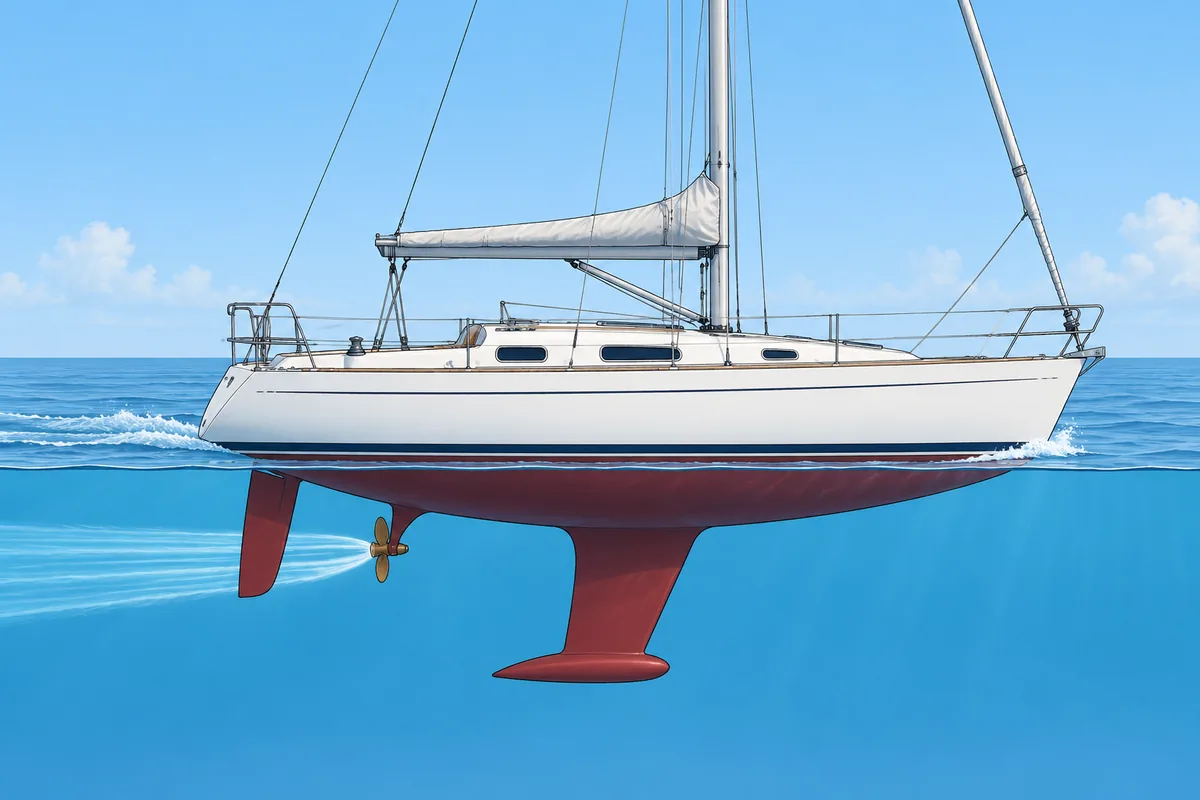
Thrust: how a propeller pushes a boat
See it in 3D
Drag to rotate, scroll or pinch to zoom. Try the controls to see how thrust changes. Double-click to reset the view.
1The lesson in plain words
A propeller accelerates water aft. The water pushes the boat ahead. This force is thrust; removing it does not stop a moving boat.
Action and reaction
A propeller accelerates water aft, towards the back of the boat. The water exerts an equal force in the opposite direction, pushing the boat ahead, forwards. This push is thrust. It is an example of action and reaction: pushing water one way pushes the boat the other way.
Thrust and resistance
Resistance is the force opposing your boat’s movement. It comes mainly from water friction, wave-making and swirling water, with wind also contributing. If thrust exceeds resistance, you speed up. At a steady speed through the water, thrust equals resistance. More thrust can give a higher steady speed, but resistance also rises as you go faster.
Astern thrust
Astern means backwards. Reversing a fixed-pitch propeller’s rotation makes it push water forwards, giving astern thrust. Most such propellers work better ahead than astern. Astern thrust is often about half to two thirds of ahead thrust, though the amount depends on the propeller and installation. Do not expect equal stopping power from the same engine setting.
Carrying way
In neutral, the engine no longer drives the propeller. It does not cancel your boat’s motion. The boat carries her way: she keeps moving until resistance or opposing thrust slows her. While you are still moving ahead, astern thrust first slows you; only after stopping can you move astern. Allow stopping room and begin slowing early. Learn your boat’s response in clear water.
2Key data
- Steady speed
- Thrust = resistance
- Typical astern thrust
- About half to two thirds of ahead thrust; installation-dependent
- Neutral
- Removes engine drive, not the boat’s movement
3Key points
- 1
A propeller accelerates water aft; the reaction pushes your boat ahead.
- 2
At a steady speed through the water, thrust equals resistance.
- 3
Astern thrust is generally weaker than ahead thrust.
- 4
In neutral your boat carries her way. Allow room and time to stop.
4Frequent mistakes
Wrong: Neutral stops the boat.
Right: Neutral removes engine drive. Your boat keeps moving until resistance or opposing thrust slows her.
Wrong: Selecting astern makes the boat move backwards immediately.
Right: While you still have forward way, astern thrust slows you first. Backwards movement begins only after you stop.
Wrong: The same engine setting gives equal thrust ahead and astern.
Right: A typical fixed-pitch propeller is less effective astern. Begin slowing early rather than relying on a late burst.
5Practice case & exam keys
You select neutral while moving towards a landing place. The engine idles, but the boat keeps moving ahead. Why, and what should you allow for?
Show the answer
Neutral removes engine drive, not your forward motion. Your boat is carrying her way. Astern thrust can slow her, but it is usually weaker than ahead thrust and needs distance to work. Allow stopping room and start slowing earlier on your next approach.
Exam keys
- Thrust is the reaction to water accelerated in the opposite direction.
- Steady speed through the water: thrust equals resistance.
- Astern thrust is usually weaker; neutral does not remove way. Stopping takes distance.
Finish this unit
When you've read it, answer three questions. Get all three right to finish the unit; opening the page alone doesn't count.
My notes for this unit
No notes