

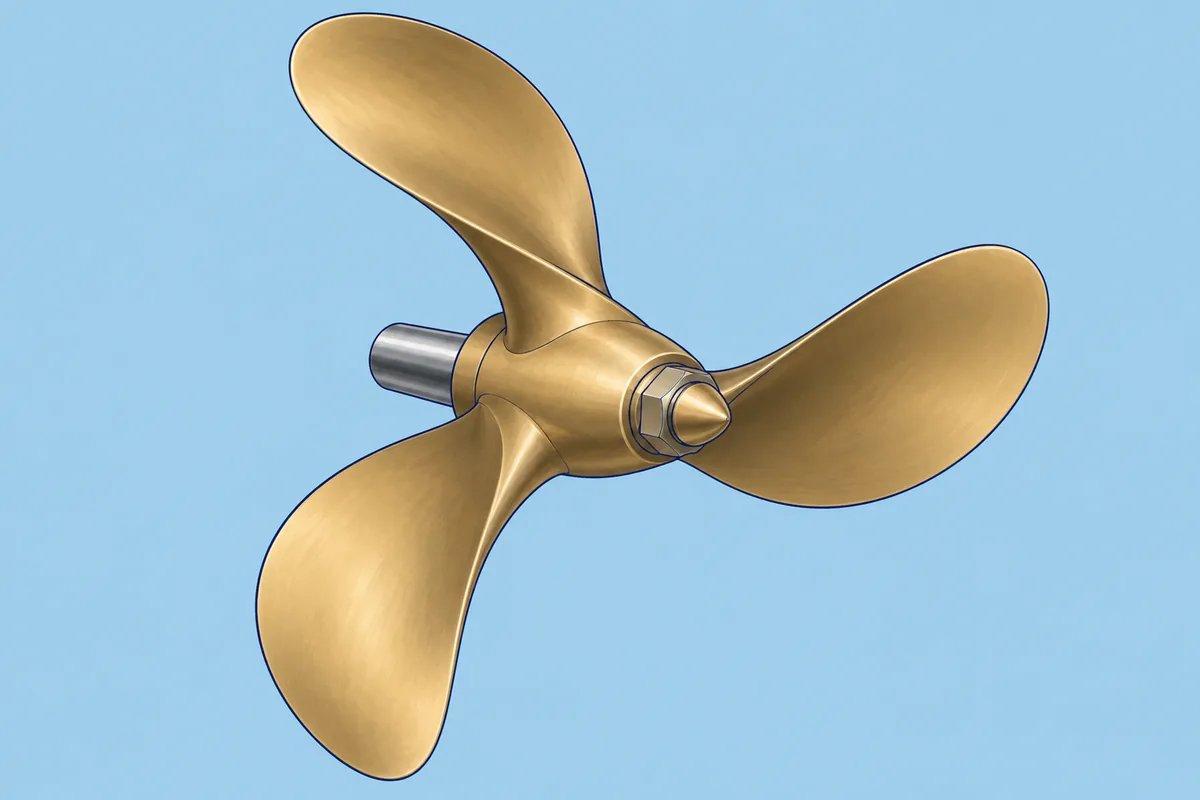
The propeller: parts, size and hand
See it in 3D
Drag to rotate, scroll or pinch to zoom. Try the controls to see how thrust changes. Double-click to reset the view.
1The lesson in plain words
Read a propeller as diameter × pitch. Its size, hand, blades and material must suit your engine and the way you use your boat.
Parts
The hub is the centre fitted to the shaft, the rod transmitting engine rotation. On a typical shaft drive, a key and nut secure it. Each blade has a root at the hub, an outer tip, a leading edge that meets the water first and a trailing edge where water leaves. In ahead operation, the face is the aft-facing pressure side pushing water back. The back is the forward-facing, lower-pressure side.
Diameter and pitch
Diameter is the width of the circle swept by the blade tips. Pitch is the theoretical forward advance in one revolution, with no slip. A 15 × 11 propeller has a 15-inch diameter and an 11-inch pitch; diameter comes first. One inch = 2.54 cm. rpm means revolutions per minute. Propeller rpm = engine rpm ÷ gear ratio. At 2,600 engine rpm with 2:1 reduction, the propeller turns at 1,300 rpm.
Speed and apparent slip
Theoretical knots = pitch in inches × propeller rpm ÷ 1,215. With 10-inch pitch at 1,300 rpm: 10 × 1,300 ÷ 1,215 ≈ 10.7 knots. Apparent slip compares this with ship speed through the water: apparent slip (%) = (theoretical − through-water speed) ÷ theoretical × 100. Typical values are 10–40 %, depending on hull and conditions. At 20 %, 10.7 knots becomes about 8.6 knots. Hull wake changes the water speed reaching the propeller, so real slip differs.
Right or left hand
Judge hand from astern: stand behind the boat, looking forwards, with the propeller driving ahead. Clockwise means right-handed; anticlockwise means left-handed. Looking from the other end reverses what you see. Check the marking or handbook rather than assuming the hand.
Matching the load
An overpropped boat has too much pitch or diameter for its engine: the load prevents it reaching the maker’s full-throttle rpm range. An underpropped boat has too little: the engine may exceed that range because the load is too light. Check with a clean hull and propeller and normal loading. More pitch only helps if the engine can turn it properly.
Blades and materials
More blades, commonly 3, 4 or 5, generally give smoother running and better low-speed grip; fewer can be more efficient. Aluminium is inexpensive but soft; stainless steel and bronze are stronger. Sailing yachts use folding blades that fold back, or feathering blades that turn edge-on, to reduce drag under sail. Folding propellers often give weaker astern thrust and may open late; test astern response before a tight manoeuvre.
2Key data
- 15 × 11
- Diameter 15 in, pitch 11 in
- Propeller rpm
- Engine rpm ÷ gear ratio
- Theoretical speed (knots)
- Pitch (in) × propeller rpm ÷ 1,215
- Apparent slip (%)
- (Theoretical − actual through-water speed) ÷ theoretical × 100
- Right-handed
- Clockwise seen from astern, driving ahead
- Typical apparent slip
- 10–40 %, depending on hull and conditions
3Key points
- 1
Read size as diameter × pitch. Pitch is advance per turn with no slip.
- 2
Use propeller rpm, not engine rpm, in the speed formula.
- 3
Judge hand from astern, driving ahead: clockwise means right-handed.
- 4
Overpropped: too much load, low rpm. Underpropped: too little load, possible over-revving.
- 5
Folding and feathering reduce sailing drag; folding propellers often give weaker astern thrust.
4Frequent mistakes
Wrong: You can judge hand from either end.
Right: Always look from astern with the propeller driving ahead. Clockwise is right-handed; anticlockwise is left-handed.
Wrong: More pitch always means more speed.
Right: Too much pitch overloads the engine. Match pitch and diameter to the maker’s full-throttle rpm range.
Wrong: The theoretical speed is the speed you will actually get.
Right: The formula assumes no slip. Calculate apparent slip from ship speed through the water; speed over ground includes current.
5Practice case & exam keys
Your propeller is 14 × 10. The engine turns at 2,600 rpm through 2:1 reduction. Your speed through the water is 7.5 knots. Find theoretical speed and apparent slip.
Show the answer
Propeller rpm = 2,600 ÷ 2 = 1,300. Use the 10-inch pitch: theoretical speed = 10 × 1,300 ÷ 1,215 ≈ 10.7 knots. Apparent slip = (10.7 − 7.5) ÷ 10.7 × 100 ≈ 30 %. Use speed through the water, since current changes speed over the ground.
Exam keys
- Diameter × pitch, in inches. Pitch is theoretical advance per revolution.
- Theoretical knots = pitch (in) × propeller rpm ÷ 1,215; apparent slip compares theoretical and actual through-water speed.
- Right-handed is clockwise from astern, driving ahead. Match propeller load to the engine’s specified rpm range.
- Blade count and material affect performance; folding and feathering reduce drag under sail.
Finish this unit
When you've read it, answer three questions. Get all three right to finish the unit; opening the page alone doesn't count.
My notes for this unit
No notes