

Cavitation, ventilation, fouling and speed
1The lesson in plain words
Bubbles, growth and a poor propeller match waste thrust. Hull shape also limits how much speed you gain from extra power.
Cavitation
Cavitation forms when pressure on a blade falls low enough for water to become vapour. The bubbles collapse, causing noise, lost thrust and pitting, tiny holes eroded in the metal. Excessive propeller speed, damaged edges or too little blade area for the load can contribute. The bubbles form from water itself, not air drawn from above.
Ventilation
Ventilation draws surface air, or sometimes exhaust gas, onto the blades. They lose grip, engine rpm rises and thrust falls. It can happen in tight turns, waves or when an outboard leg is trimmed too high. Trim is the leg’s running angle. Ease power, straighten the turn if safe and lower the leg’s trim as appropriate. The anti-ventilation plate above the propeller helps keep surface air away; it is often misleadingly called an anti-cavitation plate.
Fouling
Fouling is weed, barnacles and other growth on the hull or propeller. It increases resistance and spoils blade shape, costing speed and fuel. A fouled hull, heavy load or damaged blade can make the engine struggle, like too much propeller pitch. Clean and inspect before deciding that the propeller size is wrong.
Displacement and hull speed
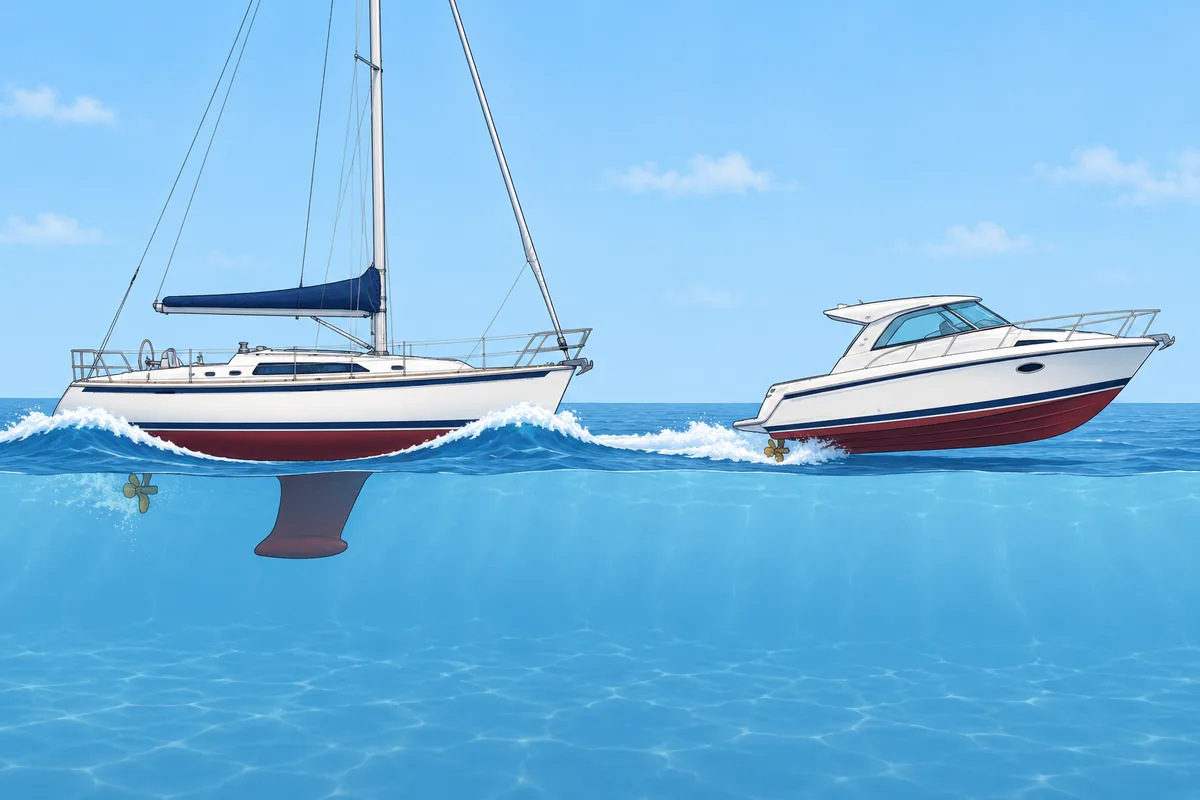
A displacement hull pushes water aside. Near hull speed, wave-making resistance rises steeply, so extra power buys little speed. Hull speed in knots ≈ 2.43 × √LWL with LWL in metres, or 1.34 × √LWL with LWL in feet. LWL is waterline length; √ means square root. At LWL 9 m: 2.43 × √9 = 2.43 × 3 ≈ 7.3 knots. This is a guide, not a hard limit; light, slender hulls can exceed it.
Planing
A planing hull gains lift from water flowing beneath it. With suitable shape and enough power, it rises and skims over the water, allowing much higher speeds than an ordinary displacement hull. Adding a bigger engine to a displacement boat does not turn it into a planing boat.
Matching engine and propeller
Check the maker’s full-throttle rpm range with a clean hull, sound propeller and normal load. Too much pitch or diameter can prevent reaching the range; too little can let the engine over-rev. First check fouling, loading and damage. A sudden rpm surge during a turn suggests ventilation, while steadily excessive rpm in normal straight running can suggest too little propeller load. Symptoms guide checks; they do not prove the cause.
2Key data
- Cavitation
- Water vapour bubbles; collapse can pit the blades
- Ventilation
- Air or exhaust gas on blades; rpm rises, thrust falls
- Hull speed (knots), LWL in metres
- ≈ 2.43 × √LWL
- Hull speed (knots), LWL in feet
- ≈ 1.34 × √LWL
- Example: LWL 9 m
- 2.43 × √9 ≈ 7.3 knots
3Key points
- 1
Cavitation forms vapour in low-pressure water; collapsing bubbles can pit blades.
- 2
Ventilation brings air or exhaust gas onto the blades, causing lost grip and an rpm surge.
- 3
Fouling increases resistance and can mimic too much propeller load. Clean before changing size.
- 4
Hull speed ≈ 2.43 × √LWL (m) knots. It is a guide for displacement hulls, not a hard limit.
- 5
Match the propeller to the maker’s full-throttle rpm range with a clean hull and normal load.
4Frequent mistakes
Wrong: Cavitation and ventilation are the same.
Right: Cavitation forms water vapour at low pressure and can pit blades. Ventilation draws air or exhaust gas onto them.
Wrong: A bigger engine will make any hull plane.
Right: Planing needs a suitable hull. Near hull speed, an ordinary displacement hull gains little speed from extra power.
Wrong: Low full-throttle rpm always means the propeller pitch is wrong.
Right: Growth, excess load or blade damage can give similar symptoms. Check those before changing pitch or diameter.
5Practice case & exam keys
Your boat is slower than in spring and now cannot reach its specified full-throttle rpm. There is weed on the hull and propeller. Should you immediately fit a lower-pitch propeller?
Show the answer
Clean the hull and propeller and inspect the blades first. Growth adds resistance and can overload the engine, mimicking too much pitch. Retest with normal loading against the maker’s rpm range. If rpm is still too low, investigate the engine and propeller match before changing the propeller.
Exam keys
- Cavitation: low-pressure vapour bubbles, noise, lost thrust and possible pitting. Ventilation: air or exhaust gas on blades.
- Fouling costs speed and fuel. Establish clean, undamaged conditions before judging propeller load.
- Hull speed ≈ 2.43 × √LWL (metres), or 1.34 × √LWL (feet), in knots; suitable planing hulls can go much faster.
- Full-throttle rpm should fall within the maker’s range under normal load; low rpm and high rpm need different checks.
Finish this unit
When you've read it, answer three questions. Get all three right to finish the unit; opening the page alone doesn't count.
My notes for this unit
No notes