

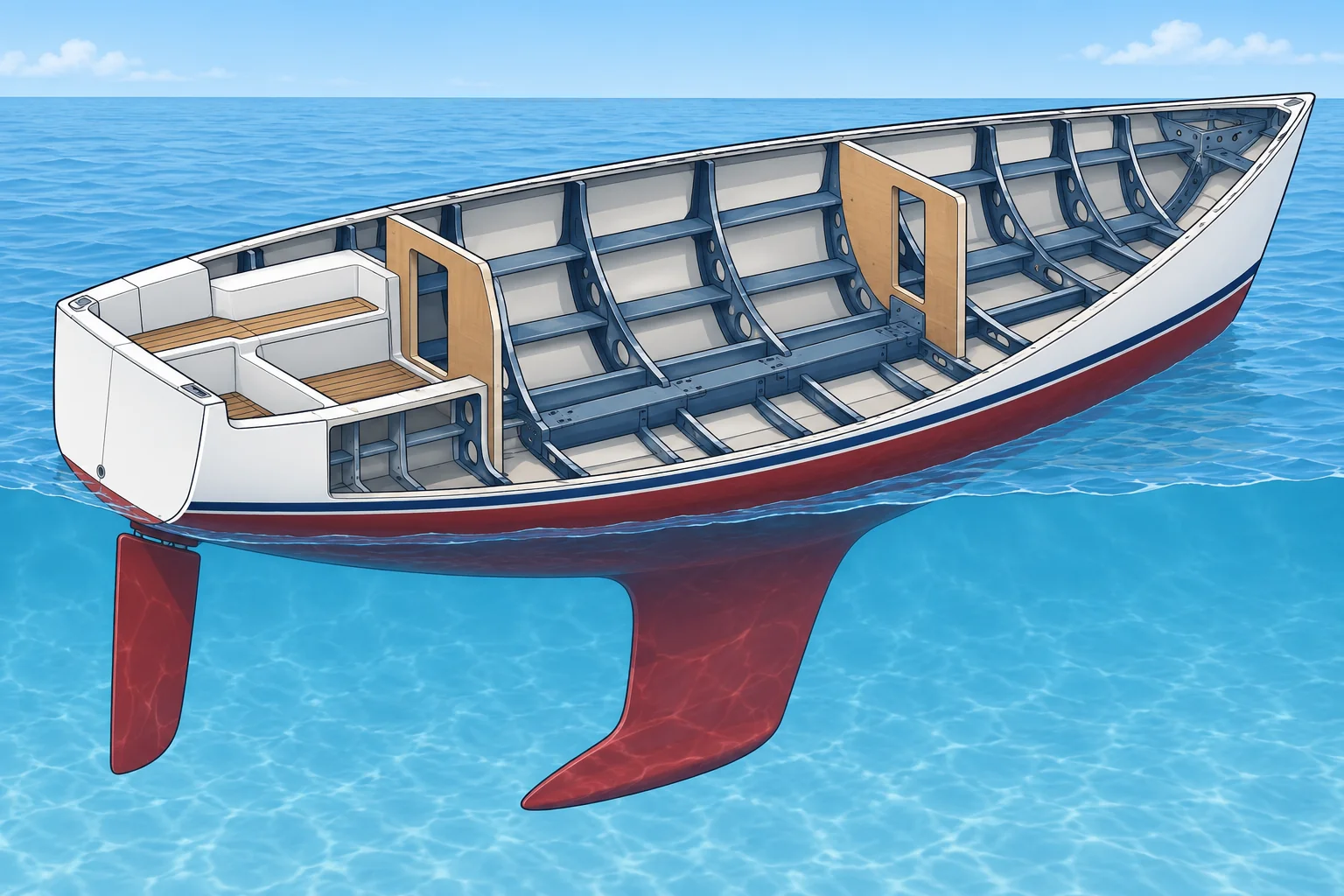
Directions and the parts of the hull
1The lesson in plain words
Bow, stern, port and starboard, then the parts that make a hull: keel, frames, bulkheads, deck and transom.
Directions
The bow is the front and the stern the back. Forward means towards the bow; aft means towards the stern. Ahead is in front of the boat; astern is behind her. Face the bow: port is your left, starboard your right. Amidships is the middle. Inboard means towards the centreline or inside the hull; outboard means away from it.
The hull shell
The hull is the watertight body. The bottom is the underwater part, the topsides the sides above the water. The bilge is the curve between bottom and side, and also the lowest space inside, where water collects. A hard corner there is a chine. The transom is the panel closing the stern; it may be flat or curved.
Backbone and frames
The keel runs along the bottom as the backbone; on a yacht a ballast keel carries weight below it. Frames are the ribs across the hull, and stringers run fore and aft to stiffen it. Bulkheads are internal partitions, often running across the hull. Watertight ones help contain flooding.
Deck and edges
The deck closes the top. The sheer is the line of the deck edge seen from the side. A coachroof raises the cabin above the deck. Scuppers and cockpit drains let water off. A bulwark is a raised solid side; a toerail is a low strip along the deck edge.
Below the water
The rudder steers. It may hang on the transom or behind a skeg, a fixed fin. A spade rudder is supported only from above by its stock, the shaft that turns it. Through-hull fittings pass water in and out. A seacock is a valve that closes a seawater opening; below-waterline openings need suitable shut-offs. See Systems for details.
2Key points
- 1
Face the bow: port left, starboard right. Forward is towards the bow; aft is towards the stern.
- 2
Keel is the backbone; frames and stringers stiffen the shell.
- 3
Bulkheads divide the hull; watertight ones limit flooding.
- 4
The bilge is both the turn of the hull and the lowest inside space.
- 5
Transom = stern panel; sheer = deck-edge line.
3Frequent mistakes
Wrong: Port and starboard change when you turn round aboard.
Right: They are fixed to the boat: port is always the left side when facing the bow.
Wrong: Every bulkhead is watertight.
Right: Many yacht bulkheads have doors and openings. Know which, if any, are watertight on your boat.
4Practice case & exam keys
A new crew member is told to check the bilge aft of the main bulkhead, then the starboard cockpit drain. Facing aft in the cockpit, she heads to her right-hand drain. Is she right?
Show the answer
No. Facing aft, her right hand is the boat’s port side. Starboard is the right side when facing the bow, so the starboard drain is on her left. The bilge aft of the main bulkhead is the low space inside the hull behind that partition, usually under the cabin floor.
Exam keys
- Forward/aft: towards bow/stern. Ahead/astern: in front of/behind the boat. Port/starboard: left/right facing the bow.
- Keel, frames, stringers, bulkheads, deck: the hull structure.
- Bilge: turn of the hull and lowest internal space. Chine: hard corner.
- Rudder types: transom-hung, skeg-hung, spade.
Finish this unit
When you've read it, answer three questions. Get all three right to finish the unit; opening the page alone doesn't count.
My notes for this unit
No notes