

Ship types you meet at sea, and how to read them
1The lesson in plain words
Recognise common ship types by their outline. Look for fishing gear, hidden tows, bridge blind areas and ships moving faster than you expect.
Tankers and bulk carriers
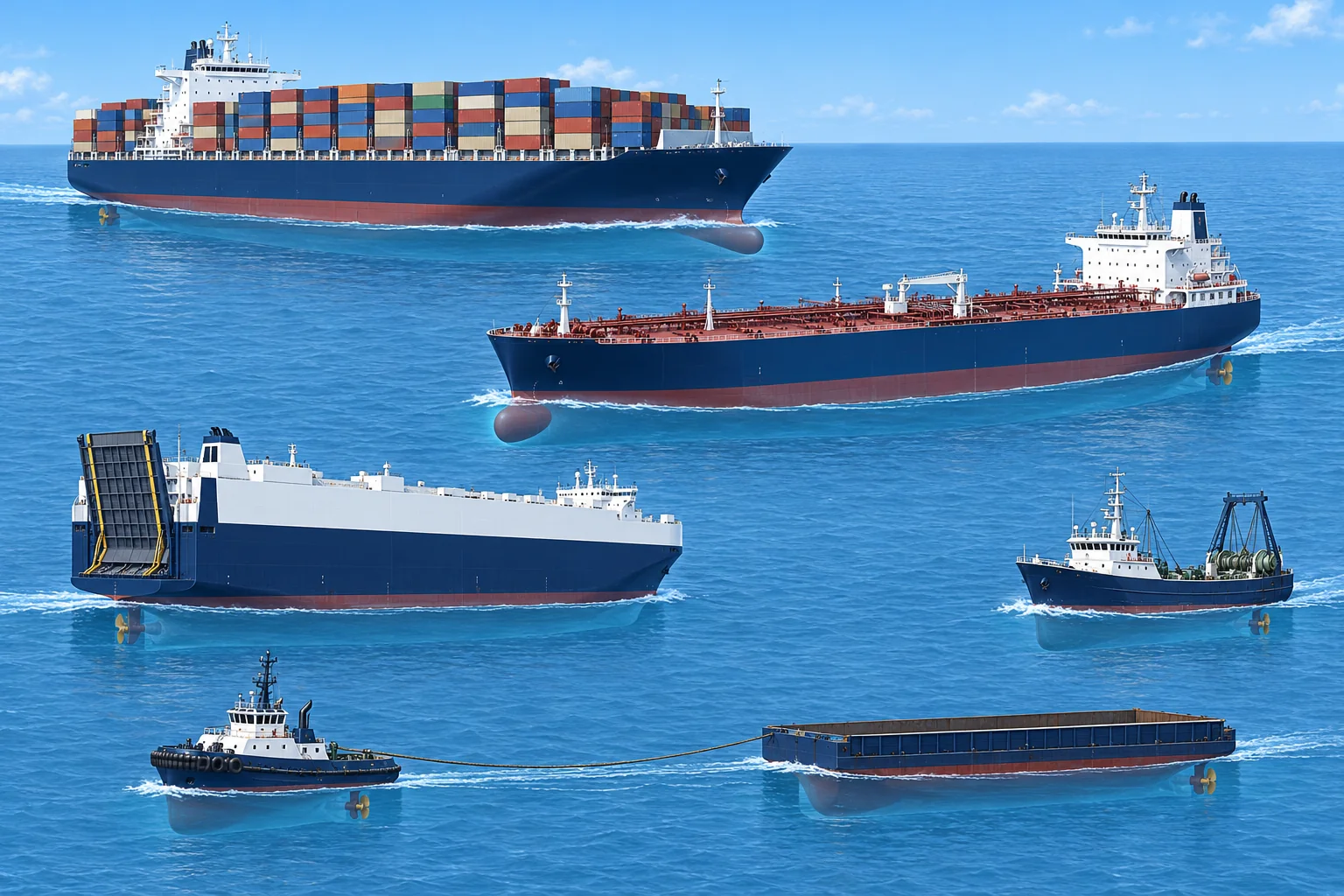
Tankers carry oil, chemicals or gas. They often have a long, low deck, crew living spaces aft, deck pipes and a manifold, where cargo hoses connect, near the middle. Gas carriers may show domes or spherical tanks. Bulk carriers carry ore, grain or coal under big hatch covers, sometimes with cranes. Both sit deep when loaded.
Container ships and ro-ros
Container ships carry stacked boxes; large ones can exceed 300 m and travel fast. Ro-ro means roll-on/roll-off: vehicles use ramps. Ro-ros and car carriers are often tall and slab-sided, with a stern ramp. A ro-pax ferry is a ro-ro carrying vehicles and passengers.
Fishing vessels
Trawlers tow nets, often from a stern gantry, a lifting frame. Purse seiners encircle fish with a net that closes underneath. Longliners set long lines carrying baited hooks; netters set fishing nets. Gear and marker buoys may extend well beyond the vessel. Working fishing boats may turn suddenly; give them and their gear room.
Tugs and tows
A tug has a high bow, heavy fenders and a low after deck. A tow may be hundreds of metres astern on a cable that sags under the water. Never pass between a tug and her tow; look for the second vessel before crossing behind.
The view from the bridge
A blind area is water the bridge team cannot see. Where SOLAS V/22 applies, the sea surface ahead must not be obscured beyond two ship lengths or 500 m forward of the bow, whichever is less. Other ships may have larger blind areas. A ship at 20 knots covers a nautical mile in 3 minutes. Do not assume the bridge team can see your boat.
2Key data
- Bridge blind area
- Where SOLAS V/22 applies: lesser of 2 lengths or 500 m from bow
- 20 knots
- 1 nautical mile every 3 minutes
- Tug and tow
- Tow can be far astern; never cross between
3Key points
- 1
Read the profile: tanker, bulk carrier, container ship, ro-ro, ferry, fisher, tug.
- 2
Large ships may travel faster than you expect, and their bridge can have a blind area ahead.
- 3
Never cross between a tug and her tow.
- 4
Fishing vessels turn suddenly and leave gear in the water.
- 5
Lights and shapes are in the COLREG module.
4Frequent mistakes
Wrong: A big ship will see a yacht ahead and alter.
Right: The bridge may have a blind area ahead. Do not assume a watchkeeper can see your boat.
Wrong: Crossing behind a tug is always safe.
Right: Check for a tow first. The cable may be long and hidden under the surface.
5Practice case & exam keys
You plan to cross behind a tug. Nothing is visible immediately astern, but your view farther back is blocked. Is the gap clear?
Show the answer
You cannot establish that it is clear. Search well astern for a tow and its connecting cable. The tow may be distant and the cable submerged. Keep clear of the possible towing gap until you can identify the tow and its extent. Never cross between tug and tow.
Exam keys
- Tanker: low deck, pipes, crew spaces aft. Bulk carrier: hatch covers. Container: stacks. Ro-ro: tall sides, often stern ramp.
- Tug: high bow, fenders. Never cross between tug and tow.
- Where SOLAS V/22 applies: lesser of 2 ship lengths or 500 m forward of the bow. Other ships may have larger blind areas.
- Fishing vessels: sudden turns, gear in the water.
Finish this unit
When you've read it, answer three questions. Get all three right to finish the unit; opening the page alone doesn't count.
My notes for this unit
No notes